Propidium Iodide
Propidium Iodide
Be the first to review this product! Submit a review
|
(65 Publications)
Propidium Iodide (PI) ab14083 is a fluorescent DNA stain that specifically binds to double-stranded DNA where the plasma membrane has been compromised/ permeabilized. It does not penetrate live cells.
- Use in fluorescence microscopy and flow cytometry
- Cited in over 50 publications.
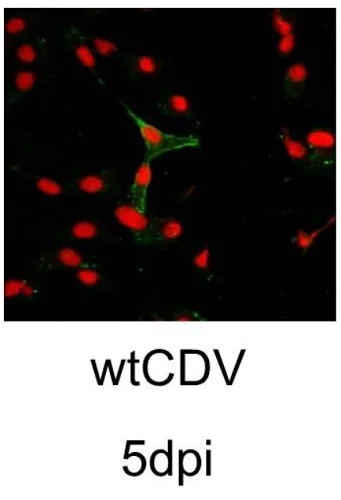
- IF
PubMed
Immunofluorescence - Propidium Iodide (AB14083)
Vero-DogSLAM (VDS) cells and Vero (African Green Monkey kidney) cells were infected with wtCDV. Cells were fixed, permeabilised and stained with SSPE serum and rabbit anti-human FITC; nuclei were stained using ab14083 propidium iodide. Images were taken using a Nikon Eclipse TE2000-U UV microscope (x400).
Image from Melia MM et al ., Plos One.,29 (8). Fig 1b DOI: 10.1371/journal.pone.0106281. Reproduced under the Creative Commons license http://creativecommons.org/licenses/by/4.0/
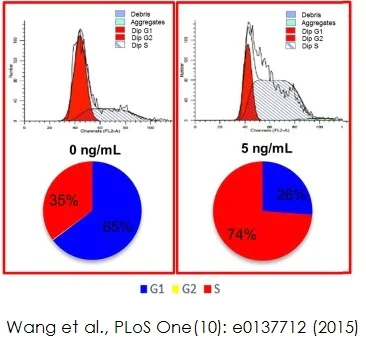
- Flow Cyt
PubMed
Flow Cytometry - Propidium Iodide (AB14083)
Wang et al. used ab14083 to investigate an optimized platform for maintaining proliferation of giant panda mesenchymal stem cells (MSCs). MSCs were fixed in 70% alcohol and 30% PBS at 4°C for 1 hour. Cells are then incubated in the dark with PBS, 20μg/ml propidium iodide (ab14083) and 1% RNaseA for 30 minutes at 37°C. Cell samples are resuspended in PBS and analyzed using FACS Calibur flow cytometry.
Flow cytometry analysis shows the cells are at different cell cycle stages in different concentrations (0ng/ml and 5ng/ml respectively) of basic fibroblast growth factor (bFGF).
Image from Wang et al., PLoS One., 10(9). Fig 3a & c. doi:10.1371/journal.pone.0137712 Reproduced under the Creative Commons license http://creativecommons.org/licenses/by/4.0/
搭配使用产品


反应性数据
产品详情
Propidium Iodide (PI) binds to double-stranded DNA. PI cannot cross intact plasma membrane and therefore will only be present in DNA of cells where the plasma membrane has been compromised/ permeabilized.
For Microscopy analysis: PI can be viewed using rhodamine(red) filter (λ= 536/617). Cells will only be stained if the membrane has been permeated, either naturally (non-viable cells) or with detergents (for fluorescent staining).
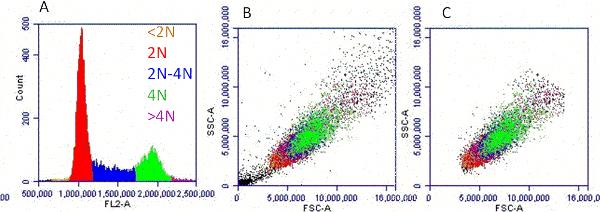
For Flow Cytometry analysis: PI staining can be monitored in FL2 channel.
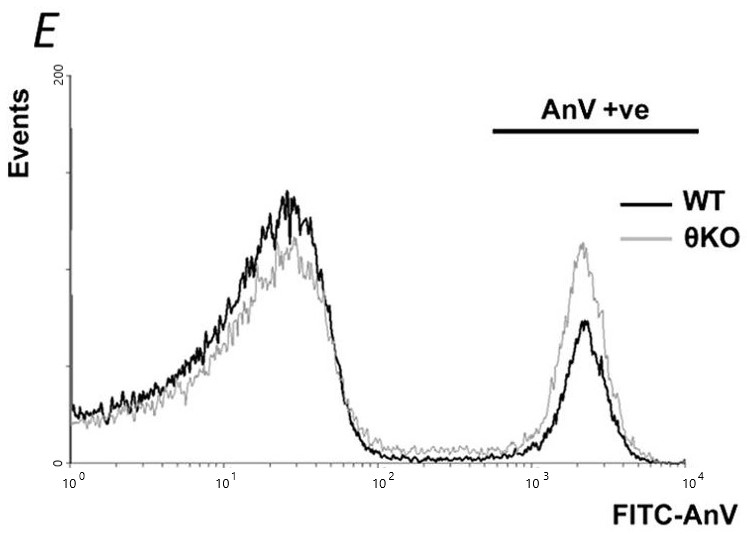
If used together as control for Annexin V assays ab14082, ab14083 or ab14152, PI should be diluted to 250 μg/ml solution (in PBS) prior use and added as 1 μl/ Annexin V Assay (0.25μg/assay).
Visit our FAQs page for tips and troubleshooting.
This product is manufactured by BioVision, an Abcam company and was previously called 1056 Propidium Iodide. 1056-1 is the same size as the 1 ml size of ab14083.
性能和储存信息
运输条件
推荐的短期储存条件
推荐的长期储存条件
靶点信息
文献 (65)
Recent publications for all applications. Explore the full list and refine your search
Clinical, cosmetic and investigational dermatology 18:459-473 PubMed40046939
2025
Applications
Unspecified application
Species
Unspecified reactive species
Viruses 17: PubMed40007014
2025
Applications
Unspecified application
Species
Unspecified reactive species
Scientific reports 15:1824 PubMed39805861
2025
Applications
Unspecified application
Species
Unspecified reactive species
Oncology letters 29:70 PubMed39628827
2024
Applications
Unspecified application
Species
Unspecified reactive species
Journal of virology 98:e0135624 PubMed39475279
2024
Applications
Unspecified application
Species
Unspecified reactive species
Open medicine (Warsaw, Poland) 19:20240973 PubMed38919547
2024
Applications
Unspecified application
Species
Unspecified reactive species
Journal of cellular and molecular medicine 28:e18413 PubMed38894694
2024
Applications
Unspecified application
Species
Unspecified reactive species
ACS nano 18:11025-11041 PubMed38626916
2024
Applications
Unspecified application
Species
Unspecified reactive species
Proceedings of the National Academy of Sciences of the United States of America 121:e2309579121 PubMed38175865
2024
Applications
Unspecified application
Species
Unspecified reactive species
Cell death discovery 9:451 PubMed38086808
2023
Applications
Unspecified application
Species
Unspecified reactive species
Abcam Product Promise
Please note: All products are 'FOR RESEARCH USE ONLY. NOT FOR USE IN DIAGNOSTIC OR THERAPEUTIC PROCEDURES'.
For licensing inquiries, please contact partnerships@abcam.com