Recombinant mouse SCF protein (Active)
Recombinant mouse SCF protein (Active)
- Premium Bioactive
- 了解详情
Be the first to review this product! Submit a review
|
(0 Publication)
Recombinant mouse SCF protein (Active) is a Mouse Fragment protein, in the 26 to 188 aa range, expressed in HEK 293 cells, with >95%, <0.005 EU/µg endotoxin level, suitable for SDS-PAGE, FuncS, Mass Spec, Cell Culture, HPLC.
查看别名
Kitl, Mgf, Sl, Slf, Kitlg, Kit ligand, Hematopoietic growth factor KL, Mast cell growth factor, Steel factor, Stem cell factor, c-Kit ligand, MGF, SCF
- FuncS
Supplier Data
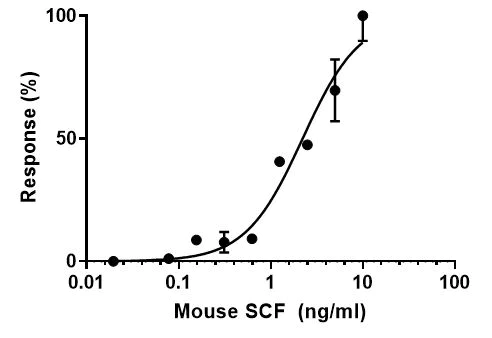
Functional Studies - Recombinant mouse SCF protein (Active) (AB259390)
Fully biologically active when compared to standard. Determined by dose-dependant stimulation of human TF-1 cells. ED50 is ≤ 2.223 ng /ml, corresponding to a specific activity of 4.50 x 10⁵ units/mg.
- SDS-PAGE
Lab
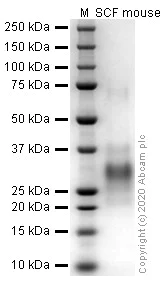
SDS-PAGE - Recombinant mouse SCF protein (Active) (AB259390)
SDS-PAGE analysis of ab259390.
- OI-RD Scanning
Supplier Data
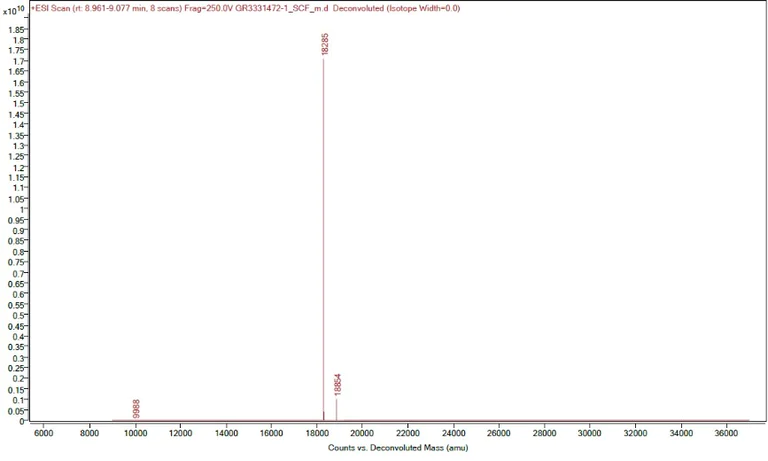
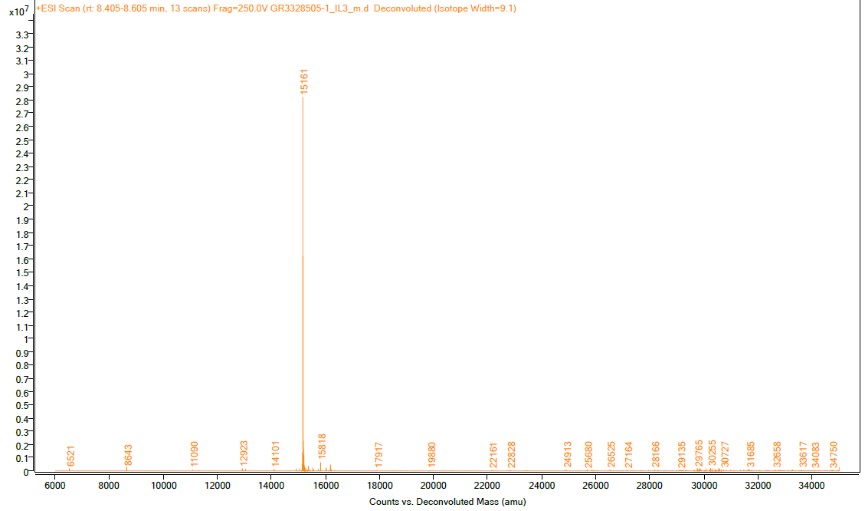
OI-RD Scanning - Recombinant mouse SCF protein (Active) (AB259390)
M + 0.49 Da (calc mass 18284.51) (+569 Da : Hex(1)HexNAc(2))
The spectrum was recorded with a 6545XT AdvanceBio LC/Q-TOF (Agilent Technologies) and a MabPac RP column (42.1x50 mm, 4 μm, Thermo Scientific). 5 μL of purified protein was injected and the gradient run from 85 % water : FA (99.9 : 0.1 v/v) and 15 % acetonitrile : FA (90 : 9.9 : 0.1 v/v/v) to 55 % water : FA (99.9 : 0.1 v/v) and 45 % acetonitrile : FA (90 : 9.9 : 0.1 v/v/v) within 3 minutes followed by an isocratic step for another 2.5 min. Flow rate was 0.4 mL/min and the column compartment temperature was 60 °C. Data was analysed and deconvoluted using the Bioconfirm software (Agilent Technologies).
- HPLC
Supplier Data
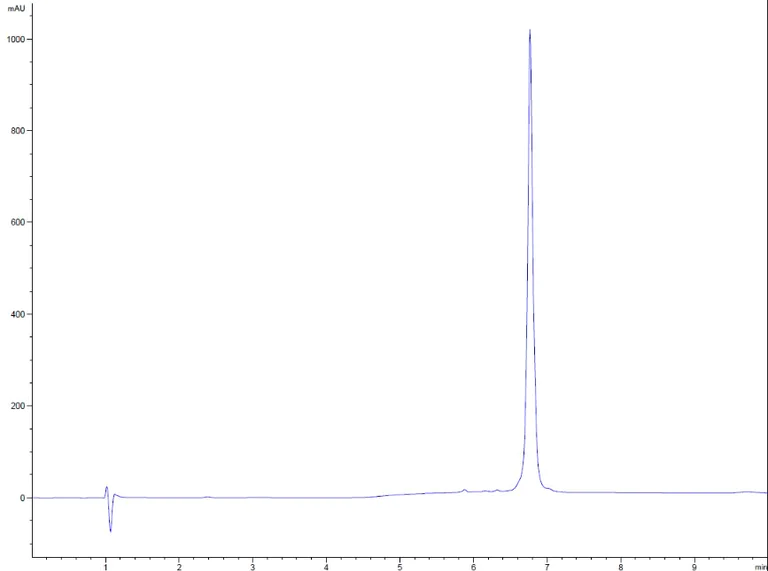
HPLC - Recombinant mouse SCF protein (Active) (AB259390)
Purity : 95%
The spectrum was recorded using a 1260 Infinity II HPLC system with DAD and a MabPac RP column (3.0x100 mm, 4 μm). 5 μL of purified protein was injected and the gradient run from 80 % water : TFA (99.9 : 0.1 v/v) and 20 % acetonitrile : water : TFA (90 : 9.9 : 0.1 v/v/v) to 20 % water : TFA (99.9 : 0.1 v/v) and 80 % acetonitrile : water : TFA (90 : 9.9 : 0.1 v/v/v) within 3 minutes followed by an isocratic step for another 3 min. Flow rate was 0.5 mL/min and the column compartment temperature was 50 °C.
搭配使用产品
Reagents, Controls & Accessories
AB313995
Prestained Protein Ladder - Mid-range molecular weight (15 - 170 kDa)

- 0
- 0
反应性数据
产品详情
序列信息
性能和储存信息
形式
运输条件
推荐的短期储存条件
推荐的长期储存条件
补充信息
This supplementary information is collated from multiple sources and compiled automatically.
Biological function summary
SCF acts as an indispensable growth factor promoting hematopoiesis and melanogenesis. It plays a significant role in the regulation of hematopoietic stem cells and mast cells. SCF and its receptor c-KIT form a complex that activates signaling pathways essential for these processes. This protein is also involved in gametogenesis by aiding the proliferation and survival of primordial germ cells. SCF's action is not limited to mammals as studies demonstrate its activity in other species like mouse SCF.
Pathways
SCF impacts multiple important biological systems by engaging with c-KIT. The SCF/c-KIT interaction contributes to the MAPK/ERK pathway influencing cell division and growth. It also plays a role in the PI3K/AKT pathway that governs cell survival. Beyond its direct association with c-KIT SCF's involvement in these pathways connects it to several other proteins like RAS and PI3K which are important for signal transduction.
常规信息
功能
Ligand for the receptor-type protein-tyrosine kinase KIT. Plays an essential role in the regulation of cell survival and proliferation, hematopoiesis, stem cell maintenance, gametogenesis, mast cell development, migration and function, and in melanogenesis. KITLG/SCF binding can activate several signaling pathways. Promotes phosphorylation of PIK3R1, the regulatory subunit of phosphatidylinositol 3-kinase, and subsequent activation of the kinase AKT1. KITLG/SCF and KIT also transmit signals via GRB2 and activation of RAS, RAF1 and the MAP kinases MAPK1/ERK2 and/or MAPK3/ERK1. KITLG/SCF and KIT promote activation of STAT family members STAT1, STAT3 and STAT5. KITLG/SCF and KIT promote activation of PLCG1, leading to the production of the cellular signaling molecules diacylglycerol and inositol 1,4,5-trisphosphate. KITLG/SCF acts synergistically with other cytokines, probably interleukins.
序列相似性
Belongs to the SCF family.
翻译后修饰
A soluble form is produced by proteolytic processing of isoform 1 in the extracellular domain.
亚细胞定位
Cytoskeleton
靶点信息
Abcam Product Promise
Please note: All products are 'FOR RESEARCH USE ONLY. NOT FOR USE IN DIAGNOSTIC OR THERAPEUTIC PROCEDURES'.
For licensing inquiries, please contact partnerships@abcam.com