重组小鼠Clusterin蛋白Standard (His tag)
Recombinant Mouse Clusterin Protein Standard (His tag)
Be the first to review this product! Submit a review
|
(0 Publication)
Recombinant Mouse Clusterin Protein Standard (His tag) is a Mouse Full Length protein, expressed in HEK 293 cells, with >80%, suitable for SDS-PAGE, sELISA.
查看别名
Apoj, Msgp-2, Clu, Clusterin, Apolipoprotein J, Clustrin, Sulfated glycoprotein 2, Apo-J, SGP-2
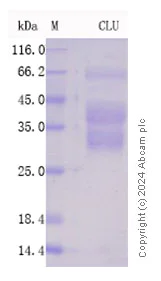
- SDS-PAGE
Supplier Data
SDS-PAGE - Recombinant Mouse Clusterin Protein Standard (His tag) (AB316399)
SDS-PAGE analysis of ab316399 under reducing conditions for 2ug protein.
搭配使用产品
Primary Antibodies
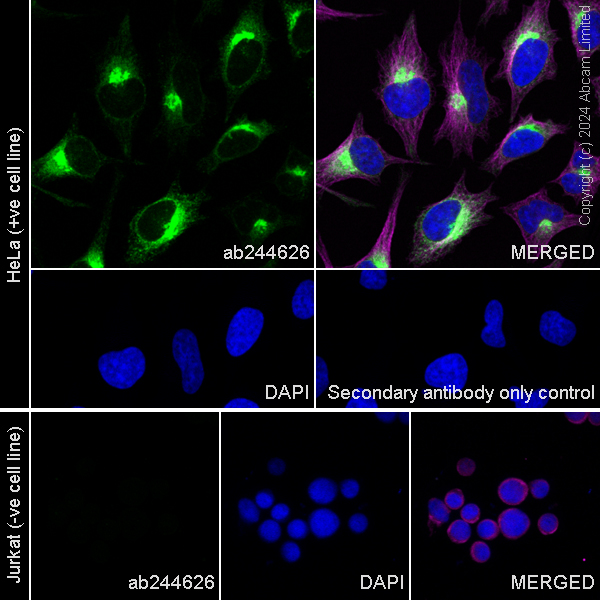
AB244626
Anti-Clusterin antibody [EPR20729-240] - BSA and Azide free (Capture)
BOND RX™ Validated|RabMAb|Recombinant|KO Validated
- 0
- 0
Proteins & Peptides
AB153213
Recombinant Human Phospholipase C beta 1/PLCB1 protein (GST tag N-Terminus)
- 0
- 0
反应性数据
产品详情
While the standard is the same as the one provided in the corresponding SimpleStep ELISA Kit, it cannot be treated as the consumable provided with our SimpleStep ELISA Kit due to differences in its concentration calibration.
Abcam guarantee that this protein standard is suitable for use in a sandwich ELISA. Individual results may vary due to differences in technique, laboratory equipment, buffers, and other experimental factors. The detection range provided for this protein standard is based on initial sandwich ELISA validation data.
The protein concentration is the concentration after validation on our sandwich ELISA platform. This Standard protein is guaranteed to work with our Capture and Detector antibodies in sELISA. Please contact our Scientific Support team to know which antibody pair is suitable for this protein.
序列信息
性能和储存信息
形式
纯化工艺
运输条件
推荐的短期储存条件
推荐的长期储存条件
分装信息
储存信息
补充信息
This supplementary information is collated from multiple sources and compiled automatically.
Biological function summary
Clusterin plays multiple roles particularly in lipid transport apoptosis and cell-cell interactions. It does not form part of a larger protein complex but it acts as a molecular chaperone that helps in folding and clearance of damaged proteins. This capability allows clusterin to protect cells against stress conditions such as oxidative stress by preventing abnormal protein aggregation.
Pathways
Clusterin is involved in pathways related to cell survival and lipid metabolism. It plays a role in the insulin signaling pathway and interacts with proteins like Heat Shock Protein 70 (HSP70) to assist in protein folding and in the activation of apoptotic pathways when needed. Clusterin's function in these processes helps in maintaining cellular homeostasis.
常规信息
功能
Functions as extracellular chaperone that prevents aggregation of non native proteins. Prevents stress-induced aggregation of blood plasma proteins (By similarity). Inhibits formation of amyloid fibrils by APP, APOC2, B2M, CALCA, CSN3, SNCA and aggregation-prone LYZ variants (in vitro) (PubMed : 14741101). Does not require ATP. Maintains partially unfolded proteins in a state appropriate for subsequent refolding by other chaperones, such as HSPA8/HSC70. Does not refold proteins by itself. Binding to cell surface receptors triggers internalization of the chaperone-client complex and subsequent lysosomal or proteasomal degradation. When secreted, protects cells against apoptosis and against cytolysis by complement : inhibits assembly of the complement membrane attack complex (MAC) by preventing polymerization of C9 pore component of the MAC complex. Intracellular forms interact with ubiquitin and SCF (SKP1-CUL1-F-box protein) E3 ubiquitin-protein ligase complexes and promote the ubiquitination and subsequent proteasomal degradation of target proteins. Promotes proteasomal degradation of COMMD1 and IKBKB. Modulates NF-kappa-B transcriptional activity (By similarity). Following stress, promotes apoptosis (PubMed : 12551933). Inhibits apoptosis when associated with the mitochondrial membrane by interference with BAX-dependent release of cytochrome c into the cytoplasm. Plays a role in the regulation of cell proliferation. Following ER stress, suppresses stress-induced apoptosis by stabilizing mitochondrial membrane integrity through interaction with HSPA5. When secreted, does not affect caspase or BAX-mediated intrinsic apoptosis and TNF-induced NF-kappa-B-activity (By similarity). When secreted, acts as an important modulator during neuronal differentiation through interaction with STMN3 (By similarity). Plays a role in the clearance of immune complexes that arise during cell injury (PubMed : 11865066).
序列相似性
Belongs to the clusterin family.
翻译后修饰
Proteolytically cleaved on its way through the secretory system, probably within the Golgi lumen. Proteolytic cleavage is not necessary for its chaperone activity. All non-secreted forms are not proteolytically cleaved. Chaperone activity of uncleaved forms is dependent on a non-reducing environment.. Polyubiquitinated, leading to proteasomal degradation. Under cellular stress, the intracellular level of cleaved form is reduced due to proteasomal degradation.. Extensively glycosylated with sulfated N-linked carbohydrates (By similarity). About 30% of the protein mass is comprised of complex N-linked carbohydrate. Endoplasmic reticulum (ER) stress induces changes in glycosylation status and increases level of hypoglycosylated forms. Core carbohydrates are essential for chaperone activity. Non-secreted forms are hypoglycosylated or unglycosylated (By similarity).
亚细胞定位
Nucleus
靶点信息
Abcam Product Promise
Please note: All products are 'FOR RESEARCH USE ONLY. NOT FOR USE IN DIAGNOSTIC OR THERAPEUTIC PROCEDURES'.
For licensing inquiries, please contact partnerships@abcam.com