JavaScript is disabled in your browser. Please enable JavaScript to view this website.
AB174416

重组人 UQCRH 蛋白 (His tag N-Terminus)

Recombinant Human UQCRH protein (His tag N-Terminus)

Be the first to review this product! Submit a review

|

(0 Publication)

Recombinant Human UQCRH protein (His tag N-Terminus) is a Human Full Length protein, in the 14 to 91 aa range, expressed in Escherichia coli, with >95%, suitable for SDS-PAGE, Mass Spec.

查看别名

Complex III subunit 6, Complex III subunit VIII, Cytochrome c1 non-heme 11 kDa protein, Mitochondrial hinge protein, Ubiquinol-cytochrome c reductase complex 11 kDa protein, UQCRH
1 Images
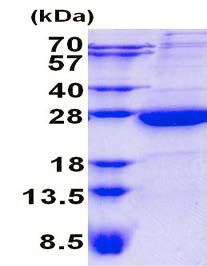
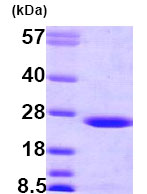
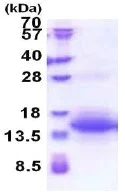
SDS-PAGE - Recombinant Human UQCRH protein (His tag N-Terminus) (AB174416)
  • SDS-PAGE

Supplier Data

SDS-PAGE - Recombinant Human UQCRH protein (His tag N-Terminus) (AB174416)

15% SDS-PAGE analysis of ab174416 (3 μg).

关键信息

纯度

>95% SDS-PAGE

ab174416 was purified using conventional chromatography techniques.

表达系统

Escherichia coli

标签

His tag N-Terminus

应用

Mass Spec, SDS-PAGE

applications

生物活性

No

访问

P07919

不含动物源

No

不含载体蛋白

No

种属

Human

存储溶液

pH: 8 Constituents: 20% Glycerol (glycerin, glycerine), 0.88% Sodium chloride, 0.32% Tris HCl, 0.02% (R*,R*)-1,4-Dimercaptobutan-2,3-diol

storage-buffer

反应性数据

{ "title": "Reactivity Data", "filters": { "stats": ["", "Reactivity", "Dilution Info", "Notes"] }, "values": { "SDS-PAGE": { "reactivity":"TESTED_AND_REACTS", "dilution-info":"", "notes":"<p></p>" }, "Mass Spec": { "reactivity":"TESTED_AND_REACTS", "dilution-info":"", "notes":"<p></p>" } } }

序列信息

[{"linker":null,"sequence":"MGSSHHHHHHSSGLVPRGSHMGSGDPEEEEEEEEELVDPLTTVREQCEQLEKCVKARERLELCDERVSSRSHTEEDCTEELFDFLHARDHCVAHKLFNNLK","proteinLength":"Full Length","predictedMolecularWeight":"11.6 kDa","actualMolecularWeight":null,"aminoAcidEnd":91,"aminoAcidStart":14,"nature":"Recombinant","expressionSystem":"Escherichia coli","accessionNumber":"P07919","tags":[{"tag":"His","terminus":"N-Terminus"}]}]

性能和储存信息

形式
Liquid
运输条件
Blue Ice
推荐的短期储存时间
1-2 weeks
推荐的短期储存条件
+4°C
推荐的长期储存条件
-20°C
分装信息
Upon delivery aliquot
储存信息
Avoid freeze / thaw cycle
False

补充信息

This supplementary information is collated from multiple sources and compiled automatically.

UQCRH also known as ubiquinol-cytochrome c reductase hinge protein plays an important role in the electron transport chain. It forms a part of the core structure of cytochrome bc1 complex (Complex III) in mitochondria. UQCRH has a molecular mass of about 9 kDa and is expressed ubiquitously in human tissues. Its primary role is to assist in transferring electrons by connecting cytochrome c1 and cytochrome c which is essential for cellular respiration and energy production.
Biological function summary

The hinge protein acts as a critical component of the mitochondrial respiratory chain complex III. UQCRH ensures the efficient transfer of electrons within the complex which contributes to generating a proton gradient across the inner mitochondrial membrane. This proton gradient drives ATP synthesis. It is a vital component of the larger respiratory chain complex which is important for aerobic cellular energy metabolism and plays an important role in overall mitochondrial function.

Pathways

UQCRH is a significant player in the oxidative phosphorylation pathway which is central to the production of ATP. The protein closely interacts with components of Complex III and adjacent complexes of the electron transport chain such as NADH dehydrogenase (Complex I) and cytochrome c oxidase (Complex IV). These interactions help UQCRH integrate smoothly within the pathway ensuring the consistent flow of electrons and maintenance of ATP production.

UQCRH mutations or dysfunctions link to mitochondrial disorders such as mitochondrial complex III deficiency. Dysfunction in this protein disrupts normal mitochondrial respiration leading to various symptoms including myopathy and encephalopathy. Additionally impaired UQCRH function can contribute to the development of neurodegenerative diseases. Studies have observed connections between abnormal UQCRH activity and proteins such as superoxide dismutase-1 (SOD1) in disease states indicating its possible role in oxidative stress-related pathologies.

常规信息

功能

Component of the ubiquinol-cytochrome c oxidoreductase, a multisubunit transmembrane complex that is part of the mitochondrial electron transport chain which drives oxidative phosphorylation. The respiratory chain contains 3 multisubunit complexes succinate dehydrogenase (complex II, CII), ubiquinol-cytochrome c oxidoreductase (cytochrome b-c1 complex, complex III, CIII) and cytochrome c oxidase (complex IV, CIV), that cooperate to transfer electrons derived from NADH and succinate to molecular oxygen, creating an electrochemical gradient over the inner membrane that drives transmembrane transport and the ATP synthase. The cytochrome b-c1 complex catalyzes electron transfer from ubiquinol to cytochrome c, linking this redox reaction to translocation of protons across the mitochondrial inner membrane, with protons being carried across the membrane as hydrogens on the quinol. In the process called Q cycle, 2 protons are consumed from the matrix, 4 protons are released into the intermembrane space and 2 electrons are passed to cytochrome c.

序列相似性

Belongs to the UQCRH/QCR6 family.

亚细胞定位

Mitochondrion inner membrane

产品实验方案

靶点信息

Component of the ubiquinol-cytochrome c oxidoreductase, a multisubunit transmembrane complex that is part of the mitochondrial electron transport chain which drives oxidative phosphorylation. The respiratory chain contains 3 multisubunit complexes succinate dehydrogenase (complex II, CII), ubiquinol-cytochrome c oxidoreductase (cytochrome b-c1 complex, complex III, CIII) and cytochrome c oxidase (complex IV, CIV), that cooperate to transfer electrons derived from NADH and succinate to molecular oxygen, creating an electrochemical gradient over the inner membrane that drives transmembrane transport and the ATP synthase. The cytochrome b-c1 complex catalyzes electron transfer from ubiquinol to cytochrome c, linking this redox reaction to translocation of protons across the mitochondrial inner membrane, with protons being carried across the membrane as hydrogens on the quinol. In the process called Q cycle, 2 protons are consumed from the matrix, 4 protons are released into the intermembrane space and 2 electrons are passed to cytochrome c.
See full target information UQCRH

Abcam Product Promise

我们致力于为您的研究提供高质量的试剂,为您科研的每一步提供支持。若我们的产品未能达到预期性能,我们向您提供 Abcam Product Promise 保障。
详情请参阅我们的条款与条件。

Please note: All products are 'FOR RESEARCH USE ONLY. NOT FOR USE IN DIAGNOSTIC OR THERAPEUTIC PROCEDURES'.

For licensing inquiries, please contact partnerships@abcam.com