重组 human TrkB protein (GST tag N-Terminus)
Recombinant human TrkB protein (GST tag N-Terminus)
Be the first to review this product! Submit a review
|
(1 Publication)
Recombinant human TrkB protein (GST tag N-Terminus) is a Human Fragment protein, in the 455 to 822 aa range, expressed in Baculovirus infected Sf9 cells, with >80%, suitable for SDS-PAGE, FuncS.
查看别名
TRKB, NTRK2, BDNF/NT-3 growth factors receptor, GP145-TrkB, Neurotrophic tyrosine kinase receptor type 2, TrkB tyrosine kinase, Tropomyosin-related kinase B, Trk-B
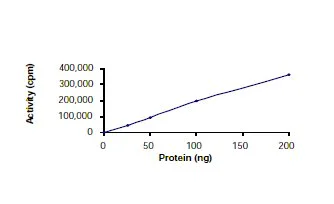
- FuncS
Unknown
Functional Studies - Recombinant human TrkB protein (GST tag N-Terminus) (AB56652)
Kinase Assay; Specific Activity 74nmol/min/mg
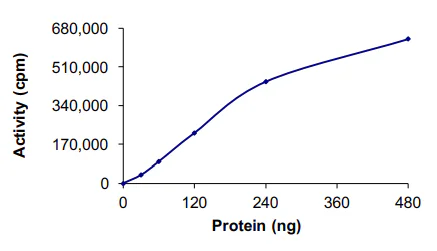
- FuncS
Unknown
Functional Studies - Recombinant human TrkB protein (GST tag N-Terminus) (AB56652)
The specific activity of TrkB (ab56652) was determined to be 85 nmol/min/mg as per activity assay protocol
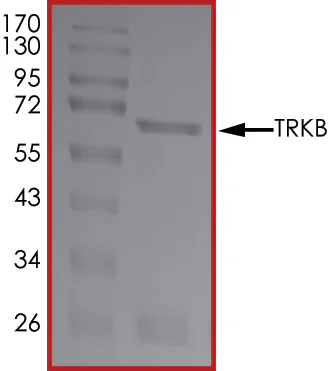
- SDS-PAGE
Unknown
SDS-PAGE - Recombinant human TrkB protein (GST tag N-Terminus) (AB56652)
SDS PAGE analysis of ab56652
- SDS-PAGE
Unknown
SDS-PAGE - Recombinant human TrkB protein (GST tag N-Terminus) (AB56652)
SDS Page analysis of ab56652.
搭配使用产品

Primary Antibodies
AB181560
Anti-Pan Trk antibody [EPR17341]
20ul selling size|BOND RX™ Validated|RabMAb|Recombinant

- 5
- 1
反应性数据
产品详情
序列信息
性能和储存信息
形式
纯化工艺
运输条件
推荐的短期储存条件
推荐的长期储存条件
分装信息
储存信息
补充信息
This supplementary information is collated from multiple sources and compiled automatically.
Biological function summary
TrkB plays essential roles in neuronal survival differentiation and synaptic plasticity. It acts as an important mediator for the effects of neurotrophins primarily BDNF on neurons. While TrkB itself is not part of a multi-protein complex it interacts closely with several adaptor proteins post-activation to propagate survival and proliferation signals within the neuron. These biochemical interactions greatly influence neurodevelopment and cognitive functions.
Pathways
TrkB is a pivotal player in both the MAPK/ERK and PI3K/AKT pathways. Upon BDNF binding TrkB undergoes autophosphorylation triggering these pathways which are critically involved in cell survival and growth. Other proteins such as SHC1 and PLCγ interact with TrkB in these pathways extending the range of cellular responses to neurotrophin signaling facilitating processes like neuronal plasticity and memory formation.
常规信息
功能
Receptor tyrosine kinase involved in the development and the maturation of the central and the peripheral nervous systems through regulation of neuron survival, proliferation, migration, differentiation, and synapse formation and plasticity (By similarity). Receptor for BDNF/brain-derived neurotrophic factor and NTF4/neurotrophin-4. Alternatively can also bind NTF3/neurotrophin-3 which is less efficient in activating the receptor but regulates neuron survival through NTRK2 (PubMed : 15494731, PubMed : 7574684). Upon ligand-binding, undergoes homodimerization, autophosphorylation and activation (PubMed : 15494731). Recruits, phosphorylates and/or activates several downstream effectors including SHC1, FRS2, SH2B1, SH2B2 and PLCG1 that regulate distinct overlapping signaling cascades. Through SHC1, FRS2, SH2B1, SH2B2 activates the GRB2-Ras-MAPK cascade that regulates for instance neuronal differentiation including neurite outgrowth. Through the same effectors controls the Ras-PI3 kinase-AKT1 signaling cascade that mainly regulates growth and survival. Through PLCG1 and the downstream protein kinase C-regulated pathways controls synaptic plasticity. Thereby, plays a role in learning and memory by regulating both short term synaptic function and long-term potentiation. PLCG1 also leads to NF-Kappa-B activation and the transcription of genes involved in cell survival. Hence, it is able to suppress anoikis, the apoptosis resulting from loss of cell-matrix interactions. May also play a role in neutrophin-dependent calcium signaling in glial cells and mediate communication between neurons and glia.
序列相似性
Belongs to the protein kinase superfamily. Tyr protein kinase family. Insulin receptor subfamily.
翻译后修饰
Phosphorylated. Undergoes ligand-mediated autophosphorylation that is required for interaction with SHC1 and PLCG1 and other downstream effectors. Isoform TrkB-T-Shc is not phosphorylated.. Ubiquitinated. Undergoes polyubiquitination upon activation; regulated by NGFR. Ubiquitination regulates the internalization of the receptor (By similarity).
靶点信息
文献 (1)
Recent publications for all applications. Explore the full list and refine your search
PloS one 9:e94036 PubMed24714156
2014
Applications
Unspecified application
Species
Unspecified reactive species
Abcam Product Promise
Please note: All products are 'FOR RESEARCH USE ONLY. NOT FOR USE IN DIAGNOSTIC OR THERAPEUTIC PROCEDURES'.
For licensing inquiries, please contact partnerships@abcam.com