JavaScript is disabled in your browser. Please enable JavaScript to view this website.
AB233665

重组人TLR4蛋白(Active)

Recombinant human TLR4 protein (Active)

Be the first to review this product! Submit a review

|

(5 Publications)

Recombinant human TLR4 protein (Active) is a Human Fragment protein, in the 24 to 632 aa range, expressed in HEK 293 cells, with >95%, suitable for SDS-PAGE, FuncS, HPLC.

查看别名

CD284, Toll-like receptor 4, hToll, TLR4

关键信息

纯度

>95% SDS-PAGE

>= 95% by HPLC analysis.

表达系统

HEK 293 cells

标签

Tag free

应用

FuncS, SDS-PAGE, HPLC

applications

生物活性

Yes

生物学活性

Determined by its ability to bind rhMD-2 in a functional ELISA.

访问

O00206

不含动物源

No

不含载体蛋白

No

种属

Human

反应性数据

{ "title": "Reactivity Data", "filters": { "stats": ["", "Reactivity", "Dilution Info", "Notes"] }, "values": { "SDS-PAGE": { "reactivity":"TESTED_AND_REACTS", "dilution-info":"", "notes":"<p></p>" }, "FuncS": { "reactivity":"TESTED_AND_REACTS", "dilution-info":"", "notes":"<p></p>" }, "HPLC": { "reactivity":"TESTED_AND_REACTS", "dilution-info":"", "notes":"<p></p>" } } }

产品详情

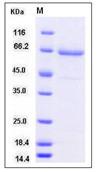
Migrates with an apparent molecular mass of approximately 90-100 kDa by SDS-PAGE gel, under reducing and non-reducing conditions.

序列信息

[{"linker":null,"sequence":"ESWEPCVEVVPNITYQCMELNFYKIPDNLPFSTKNLDLSFNPLRHLGSYSFFSFPELQVLDLSRCEIQTIEDGAYQSLSHLSTLILTGNPIQSLALGAFSGLSSLQKLVAVETNLASLENFPIGHLKTLKELNVAHNLIQSFKLPEYFSNLTNLEHLDLSSNKIQSIYCTDLRVLHQMPLLNLSLDLSLNPMNFIQPGAFKEIRLHKLTLRNNFDSLNVMKTCIQGLAGLEVHRLVLGEFRNEGNLEKFDKSALEGLCNLTIEEFRLAYLDYYLDDIIDLFNCLTNVSSFSLVSVTIERVKDFSYNFGWQHLELVNCKFGQFPTLKLKSLKRLTFTSNKGGNAFSEVDLPSLEFLDLSRNGLSFKGCCSQSDFGTTSLKYLDLSFNGVITMSSNFLGLEQLEHLDFQHSNLKQMSEFSVFLSLRNLIYLDISHTHTRVAFNGIFNGLSSLEVLKMAGNSFQENFLPDIFTELRNLTFLDLSQCQLEQLSPTAFNSLSSLQVLNMSHNNFFSLDTFPYKCLNSLQVLDYSLNHIMTSKKQELQHFPSSLAFLNLTQNDFACTCEHQSFLQWIKDQRQLLVEVERMECATPSDKQGMPVLSLNITCQMNKT","proteinLength":"Fragment","predictedMolecularWeight":"69.3 kDa","actualMolecularWeight":null,"aminoAcidEnd":632,"aminoAcidStart":24,"nature":"Recombinant","expressionSystem":"HEK 293 cells","accessionNumber":"O00206","tags":[]}]

性能和储存信息

形式
Lyophilized
运输条件
Blue Ice
推荐的短期储存时间
1-2 weeks
推荐的短期储存条件
+4°C
推荐的长期储存条件
-20°C
分装信息
Upon delivery aliquot
储存信息
Avoid freeze / thaw cycle
True

补充信息

This supplementary information is collated from multiple sources and compiled automatically.

Toll-like receptor 4 (TLR4) is a membrane protein involved in the innate immune response. It serves as a receptor that recognizes pathogen-associated molecular patterns such as lipopolysaccharides from bacterial cell walls. Often referred to by its alternate names TLR-2 and CD284 this protein has a molecular weight of approximately 95 kDa. TLR4 is mainly expressed on the surface of immune cells like macrophages and dendritic cells enabling these cells to detect and respond to microbial invaders effectively.
Biological function summary

TLR4 plays an important role in activating the immune system. It forms a complex with myeloid differentiation factor 2 (MD-2) to facilitate binding to its ligands. Upon activation TLR4 triggers a signaling cascade that leads to the release of pro-inflammatory cytokines and interferons which are important for initiating the immune response. This early detection mechanism alerts the immune system to the presence of pathogens allowing the body to mount a defense.

Pathways

TLR4 participates in the nuclear factor kappa-light-chain-enhancer of activated B cells (NF-κB) and mitogen-activated protein kinase (MAPK) signaling pathways. These pathways are central to the inflammatory response with TLR4 acting as a sensor that activates downstream components like the MyD88 and TRIF proteins. These interactions result in the expression of genes that produce cytokines and enzymes involved in inflammation and immunity.

TLR4 has been implicated in the development of sepsis and atherosclerosis. In sepsis TLR4 recognizes lipopolysaccharides from bacterial infections which can cause excessive inflammation if uncontrolled. In atherosclerosis TLR4 receptors on vascular cells respond to endogenous ligands such as oxidized low-density lipoproteins contributing to plaque formation. The TLR4 interaction with proteins like CD14 and MD-2 is significant as it influences the inflammatory pathways that exacerbate these conditions.

常规信息

功能

Transmembrane receptor that functions as a pattern recognition receptor recognizing pathogen- and damage-associated molecular patterns (PAMPs and DAMPs) to induce innate immune responses via downstream signaling pathways (PubMed : 10835634, PubMed : 15809303, PubMed : 16622205, PubMed : 17292937, PubMed : 17478729, PubMed : 20037584, PubMed : 20711192, PubMed : 23880187, PubMed : 27022195, PubMed : 29038465, PubMed : 17803912, PubMed : 15852007). At the plasma membrane, cooperates with LY96 to mediate the innate immune response to bacterial lipopolysaccharide (LPS) (PubMed : 27022195). Also involved in LPS-independent inflammatory responses triggered by free fatty acids, such as palmitate, and Ni(2+) (PubMed : 20711192). Mechanistically, acts via MYD88, TIRAP and TRAF6, leading to NF-kappa-B activation, cytokine secretion and the inflammatory response (PubMed : 10835634, PubMed : 21393102, PubMed : 27022195, PubMed : 36945827, PubMed : 9237759). Alternatively, CD14-mediated TLR4 internalization via endocytosis is associated with the initiation of a MYD88-independent signaling via the TICAM1-TBK1-IRF3 axis leading to type I interferon production (PubMed : 14517278). In addition to the secretion of proinflammatory cytokines, initiates the activation of NLRP3 inflammasome and formation of a positive feedback loop between autophagy and NF-kappa-B signaling cascade (PubMed : 32894580). In complex with TLR6, promotes inflammation in monocytes/macrophages by associating with TLR6 and the receptor CD86 (PubMed : 23880187). Upon ligand binding, such as oxLDL or amyloid-beta 42, the TLR4 : TLR6 complex is internalized and triggers inflammatory response, leading to NF-kappa-B-dependent production of CXCL1, CXCL2 and CCL9 cytokines, via MYD88 signaling pathway, and CCL5 cytokine, via TICAM1 signaling pathway (PubMed : 23880187). In myeloid dendritic cells, vesicular stomatitis virus glycoprotein G but not LPS promotes the activation of IRF7, leading to type I IFN production in a CD14-dependent manner (PubMed : 15265881, PubMed : 23880187). Required for the migration-promoting effects of ZG16B/PAUF on pancreatic cancer cells.

序列相似性

Belongs to the Toll-like receptor family.

翻译后修饰

N-Glycosylation of Asn-526 and Asn-575 by STT3A-containing OST-A complex is necessary for the expression of TLR4 on the cell surface and the LPS-response (PubMed:11706042, PubMed:38670073). Likewise, mutants lacking two or more of the other N-glycosylation sites were deficient in interaction with LPS (PubMed:11706042, PubMed:38670073).. Phosphorylated on tyrosine residues by LYN after binding lipopolysaccharide.. Ubiquitinated by RNF128 via 'Lys-28'-linked polyubiquitin chains, leading to proteasomal degradation.

产品实验方案

靶点信息

Transmembrane receptor that functions as a pattern recognition receptor recognizing pathogen- and damage-associated molecular patterns (PAMPs and DAMPs) to induce innate immune responses via downstream signaling pathways (PubMed : 10835634, PubMed : 15809303, PubMed : 16622205, PubMed : 17292937, PubMed : 17478729, PubMed : 20037584, PubMed : 20711192, PubMed : 23880187, PubMed : 27022195, PubMed : 29038465, PubMed : 17803912, PubMed : 15852007). At the plasma membrane, cooperates with LY96 to mediate the innate immune response to bacterial lipopolysaccharide (LPS) (PubMed : 27022195). Also involved in LPS-independent inflammatory responses triggered by free fatty acids, such as palmitate, and Ni(2+) (PubMed : 20711192). Mechanistically, acts via MYD88, TIRAP and TRAF6, leading to NF-kappa-B activation, cytokine secretion and the inflammatory response (PubMed : 10835634, PubMed : 21393102, PubMed : 27022195, PubMed : 36945827, PubMed : 9237759). Alternatively, CD14-mediated TLR4 internalization via endocytosis is associated with the initiation of a MYD88-independent signaling via the TICAM1-TBK1-IRF3 axis leading to type I interferon production (PubMed : 14517278). In addition to the secretion of proinflammatory cytokines, initiates the activation of NLRP3 inflammasome and formation of a positive feedback loop between autophagy and NF-kappa-B signaling cascade (PubMed : 32894580). In complex with TLR6, promotes inflammation in monocytes/macrophages by associating with TLR6 and the receptor CD86 (PubMed : 23880187). Upon ligand binding, such as oxLDL or amyloid-beta 42, the TLR4 : TLR6 complex is internalized and triggers inflammatory response, leading to NF-kappa-B-dependent production of CXCL1, CXCL2 and CCL9 cytokines, via MYD88 signaling pathway, and CCL5 cytokine, via TICAM1 signaling pathway (PubMed : 23880187). In myeloid dendritic cells, vesicular stomatitis virus glycoprotein G but not LPS promotes the activation of IRF7, leading to type I IFN production in a CD14-dependent manner (PubMed : 15265881, PubMed : 23880187). Required for the migration-promoting effects of ZG16B/PAUF on pancreatic cancer cells.
See full target information TLR4

文献 (5)

Recent publications for all applications. Explore the full list and refine your search

Journal of biomedical science 32:19 PubMed39930418

2025

Multifunctional hyaluronic acid-based biomimetic/pH-responsive hybrid nanostructured lipid carriers for treating bacterial sepsis.

Applications

Unspecified application

Species

Unspecified reactive species

Eman Elhassan,Calvin A Omolo,Mohammed A Gafar,Eman A Ismail,Usri H Ibrahim,Rene Khan,Mathieu Lesouhaitier,Paul Kubes,Thirumala Govender

Cell communication and signaling : CCS 23:64 PubMed39910535

2025

Extracellular vimentin is a damage-associated molecular pattern protein serving as an agonist of TLR4 in human neutrophils.

Applications

Unspecified application

Species

Unspecified reactive species

Łukasz Suprewicz,Krzysztof Fiedoruk,Karol Skłodowski,Evan Hutt,Magdalena Zakrzewska,Alicja Walewska,Piotr Deptuła,Agata Lesiak,Sławomir Okła,Peter A Galie,Alison E Patteson,Paul A Janmey,Robert Bucki

The EMBO journal 43:4954-4983 PubMed39294473

2024

Acetylation of TIR domains in the TLR4-Mal-MyD88 complex regulates immune responses in sepsis.

Applications

Unspecified application

Species

Unspecified reactive species

Xue Li,Xiangrong Li,Pengpeng Huang,Facai Zhang,Juanjuan K Du,Ying Kong,Ziqiang Shao,Xinxing Wu,Weijiao Fan,Houquan Tao,Chuanzan Zhou,Yan Shao,Yanling Jin,Meihua Ye,Yan Chen,Jong Deng,Jimin Shao,Jicheng Yue,Xiaju Cheng,Y Eugene Chinn

Cell reports 41:111562 PubMed36288690

2022

Activation of Toll-like receptor 4 by Ebola virus-shed glycoprotein is direct and requires the internal fusion loop but not glycosylation.

Applications

Unspecified application

Species

Unspecified reactive species

Michael J Scherm,Monique Gangloff,Nicholas J Gay

Frontiers in oncology 11:736882 PubMed34900687

2021

PcrV Enhances the Nitric Oxide-Mediated Tumoricidal Activity of Tumor-Associated Macrophages a TLR4/PI3K/AKT/mTOR-Glycolysis-Nitric Oxide Circuit.

Applications

Unspecified application

Species

Unspecified reactive species

Hua Yu,Ying Bai,Jing Qiu,Xiaomei He,Junzhi Xiong,Qian Dai,Xingmin Wang,Yuanyuan Li,Halei Sheng,Rong Xin,Lu Jiang,Qiaoqiao Li,Defeng Li,Hong Zhang,Le Zhang,Qian Chen,Jin Peng,Xiaomei Hu,Kebin Zhang
View all publications

Abcam Product Promise

我们致力于为您的研究提供高质量的试剂,为您科研的每一步提供支持。若我们的产品未能达到预期性能,我们向您提供 Abcam Product Promise 保障。
详情请参阅我们的条款与条件。

Please note: All products are 'FOR RESEARCH USE ONLY. NOT FOR USE IN DIAGNOSTIC OR THERAPEUTIC PROCEDURES'.

For licensing inquiries, please contact partnerships@abcam.com