重组人 RNF168 蛋白 (GST tag N-Terminus)
Recombinant Human RNF168 protein (GST tag N-Terminus)
Be the first to review this product! Submit a review
|
(0 Publication)
Recombinant Human RNF168 protein (GST tag N-Terminus) is a Human Full Length protein, in the 1 to 571 aa range, expressed in Wheat germ, suitable for ELISA, WB.
查看别名
E3 ubiquitin-protein ligase RNF168, hRNF168, RING finger protein 168, RING-type E3 ubiquitin transferase RNF168, RNF168

- SDS-PAGE
Unknown
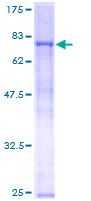
SDS-PAGE - Recombinant Human RNF168 protein (GST tag N-Terminus) (AB153613)
ab153613 on a 12.5% SDS-PAGE stained with Coomassie Blue.
搭配使用产品
Reagents, Controls & Accessories
AB325995
Prestained Protein Ladder - Broad molecular weight (11-250 kDa, 5-color, 11 bands)

- 0
- 0
Primary Antibodies
AB283507
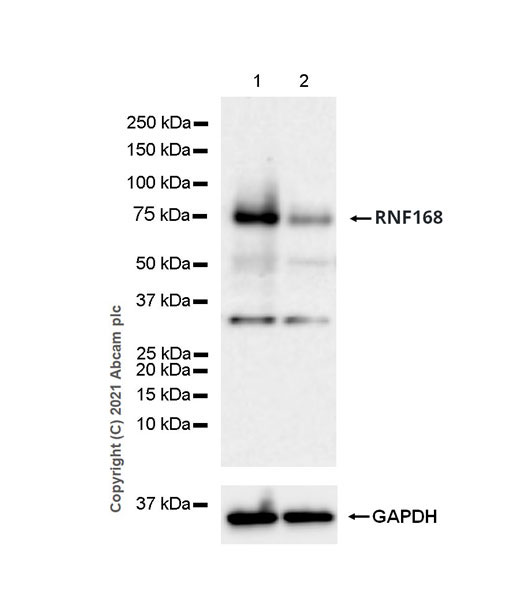
Anti-RNF168 antibody [EPR24239-2] - BSA and Azide free
KD Validated|RabMAb|Recombinant
- 0
- 0


反应性数据
序列信息
性能和储存信息
形式
纯化工艺
运输条件
推荐的短期储存条件
推荐的长期储存条件
分装信息
储存信息
补充信息
This supplementary information is collated from multiple sources and compiled automatically.
Biological function summary
The actions of RNF168 are critical in maintaining genome stability and it serves as a part of the DNA damage signaling complex. It collaborates with other proteins in recognizing DNA damage and signaling repair processes. RNF168 amplifies the ubiquitin signal which then attracts repair proteins to the site of damage. This function places it as an important component in the cellular response to DNA breaks.
Pathways
RNF168 is an important player in the DNA damage response pathway and is particularly associated with the homologous recombination repair mechanism. It works alongside proteins such as 53BP1 and BRCA1 to initiate repair processes. RNF168’s ubiquitination activity facilitates the recruitment of these repair proteins coordinating the cellular response to DNA lesions and ensuring effective repair.
常规信息
功能
E3 ubiquitin-protein ligase required for accumulation of repair proteins to sites of DNA damage. Acts with UBE2N/UBC13 to amplify the RNF8-dependent histone ubiquitination. Recruited to sites of DNA damage at double-strand breaks (DSBs) by binding to ubiquitinated histone H2A and H2AX and amplifies the RNF8-dependent H2A ubiquitination, promoting the formation of 'Lys-63'-linked ubiquitin conjugates. This leads to concentrate ubiquitinated histones H2A and H2AX at DNA lesions to the threshold required for recruitment of TP53BP1 and BRCA1. Also recruited at DNA interstrand cross-links (ICLs) sites and promotes accumulation of 'Lys-63'-linked ubiquitination of histones H2A and H2AX, leading to recruitment of FAAP20/C1orf86 and Fanconi anemia (FA) complex, followed by interstrand cross-link repair. H2A ubiquitination also mediates the ATM-dependent transcriptional silencing at regions flanking DSBs in cis, a mechanism to avoid collision between transcription and repair intermediates. Also involved in class switch recombination in immune system, via its role in regulation of DSBs repair. Following DNA damage, promotes the ubiquitination and degradation of JMJD2A/KDM4A in collaboration with RNF8, leading to unmask H4K20me2 mark and promote the recruitment of TP53BP1 at DNA damage sites. Not able to initiate 'Lys-63'-linked ubiquitination in vitro; possibly due to partial occlusion of the UBE2N/UBC13-binding region. Catalyzes monoubiquitination of 'Lys-13' and 'Lys-15' of nucleosomal histone H2A (H2AK13Ub and H2AK15Ub, respectively).
序列相似性
Belongs to the RNF168 family.
翻译后修饰
Sumoylated with SUMO1 by PIAS4 in response to double-strand breaks (DSBs).. Ubiquitinated.
亚细胞定位
Nucleus
靶点信息
Abcam Product Promise
Please note: All products are 'FOR RESEARCH USE ONLY. NOT FOR USE IN DIAGNOSTIC OR THERAPEUTIC PROCEDURES'.
For licensing inquiries, please contact partnerships@abcam.com