JavaScript is disabled in your browser. Please enable JavaScript to view this website.
AB116152

重组人 Phosphoserine Aminotransferase 蛋白 (His tag N-Terminus)

Recombinant Human Phosphoserine Aminotransferase protein (His tag N-Terminus)

Be the first to review this product! Submit a review

|

(0 Publication)

Recombinant Human Phosphoserine Aminotransferase protein (His tag N-Terminus) is a Human Full Length protein, in the 1 to 370 aa range, expressed in Escherichia coli, with >90%, suitable for SDS-PAGE, Mass Spec.

查看别名

PSA, PSAT1, Phosphoserine aminotransferase, Phosphohydroxythreonine aminotransferase, PSAT
1 Images
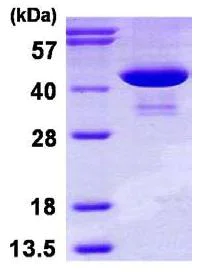
SDS-PAGE - Recombinant Human Phosphoserine Aminotransferase protein (His tag N-Terminus) (AB116152)
  • SDS-PAGE

Unknown

SDS-PAGE - Recombinant Human Phosphoserine Aminotransferase protein (His tag N-Terminus) (AB116152)

15% SDS-PAGE image showing 3ug ab116152

关键信息

纯度

>90% SDS-PAGE

ab116152 was purified using conventional chromatography.

表达系统

Escherichia coli

标签

His tag N-Terminus

应用

Mass Spec, SDS-PAGE

applications

生物活性

No

访问

Q9Y617

不含动物源

No

不含载体蛋白

No

种属

Human

存储溶液

pH: 8 Constituents: 20% Glycerol (glycerin, glycerine), 0.32% Tris HCl, 0.02% (R*,R*)-1,4-Dimercaptobutan-2,3-diol

storage-buffer

反应性数据

{ "title": "Reactivity Data", "filters": { "stats": ["", "Reactivity", "Dilution Info", "Notes"] }, "values": { "SDS-PAGE": { "reactivity":"TESTED_AND_REACTS", "dilution-info":"", "notes":"<p></p>" }, "Mass Spec": { "reactivity":"TESTED_AND_REACTS", "dilution-info":"", "notes":"<p></p>" } } }

序列信息

[{"linker":null,"sequence":"MGSSHHHHHHSSGLVPRGSHMGSHMDAPRQVVNFGPGPAKLPHSVLLEIQKELLDYKGVGISVLEMSHRSSDFAKIINNTENLVRELLAVPDNYKVIFLQGGGCGQFSAVPLNLIGLKAGRCADYVVTGAWSAKAAEEAKKFGTINIVHPKLGSYTKIPDPSTWNLNPDASYVYYCANETVHGVEFDFIPDVKGAVLVCDMSSNFLSKPVDVSKFGVIFAGAQKNVGSAGVTVVIVRDDLLGFALRECPSVLEYKVQAGNSSLYNTPPCFSIYVMGLVLEWIKNNGGAAAMEKLSSIKSQTIYEIIDNSQGFYVCPVEPQNRSKMNIPFRIGNAKGDDALEKRFLDKALELNMLSLKGHRSVGGIRASLYNAVTIEDVQKLAAFMKKFLEMHQL","proteinLength":"Full Length","predictedMolecularWeight":"42.9 kDa","actualMolecularWeight":null,"aminoAcidEnd":370,"aminoAcidStart":1,"nature":"Recombinant","expressionSystem":"Escherichia coli","accessionNumber":"Q9Y617","tags":[{"tag":"His","terminus":"N-Terminus"}]}]

性能和储存信息

形式
Liquid
运输条件
Blue Ice
推荐的短期储存时间
1-2 weeks
推荐的短期储存条件
+4°C
推荐的长期储存条件
-20°C
分装信息
Upon delivery aliquot
储存信息
Avoid freeze / thaw cycle
False

补充信息

This supplementary information is collated from multiple sources and compiled automatically.

Phosphoserine Aminotransferase (PSAT1) is an enzyme that actively participates in amino acid metabolism. It is also known by alternate names like O-phospho-L-serine:2-oxoglutarate aminotransferase. With a molecular mass of approximately 39 kDa PSAT1 facilitates the conversion of 3-phosphohydroxypyruvate to phosphoserine. You can find its expression across various tissues including liver brain and kidney. This widespread presence suggests its essential role in cellular functions and metabolism.
Biological function summary

PSAT1 plays an important role in the biosynthesis of the amino acid serine. It is part of a multi-step serine biosynthesis complex involving other enzymes like 3-phosphoglycerate dehydrogenase and phosphoserine phosphatase. PSAT1 works in conjunction with these enzymes to ensure the proper synthesis of serine which is vital for nucleotide synthesis and cell proliferation. This function establishes PSAT1 as an important regulator of cellular growth and division.

Pathways

PSAT1 is a significant component of the serine biosynthesis pathway which is linked to the folate cycle. This metabolic pathway is important for one-carbon metabolism affecting thymidine and purine synthesis. PSAT1 interacts with proteins such as 3-phosphoglycerate dehydrogenase highlighting its involvement in these interconnected metabolic processes. This connection indicates the critical position that PSAT1 holds in facilitating the production of biomolecules essential for cell survival and function.

PSAT1 has been associated with conditions such as Neu-Laxova syndrome and certain cancer types. Neu-Laxova syndrome linked to defects in serine biosynthesis involves abnormal neurological and physical development. Additionally PSAT1's role in cell proliferation pathways associates it with oncogenic processes where its altered expression can lead to tumor growth. Dysregulation of related proteins like phosphoserine phosphatase further ties PSAT1 to the pathogenesis of these conditions making it a target of interest in therapeutic research.

常规信息

功能

Involved in L-serine biosynthesis via the phosphorylated pathway, a three-step pathway converting the glycolytic intermediate 3-phospho-D-glycerate into L-serine. Catalyzes the second step, that is the pyridoxal 5'-phosphate-dependent transamination of 3-phosphohydroxypyruvate and L-glutamate to O-phosphoserine (OPS) and alpha-ketoglutarate.

序列相似性

Belongs to the class-V pyridoxal-phosphate-dependent aminotransferase family. SerC subfamily.

产品实验方案

靶点信息

Involved in L-serine biosynthesis via the phosphorylated pathway, a three-step pathway converting the glycolytic intermediate 3-phospho-D-glycerate into L-serine. Catalyzes the second step, that is the pyridoxal 5'-phosphate-dependent transamination of 3-phosphohydroxypyruvate and L-glutamate to O-phosphoserine (OPS) and alpha-ketoglutarate.
See full target information PSAT1

Abcam Product Promise

我们致力于为您的研究提供高质量的试剂,为您科研的每一步提供支持。若我们的产品未能达到预期性能,我们向您提供 Abcam Product Promise 保障。
详情请参阅我们的条款与条件。

Please note: All products are 'FOR RESEARCH USE ONLY. NOT FOR USE IN DIAGNOSTIC OR THERAPEUTIC PROCEDURES'.

For licensing inquiries, please contact partnerships@abcam.com