重组人PCNA蛋白(His tag)
Recombinant Human PCNA protein (His tag)
Be the first to review this product! Submit a review
|
(0 Publication)
Recombinant Human PCNA protein (His tag) is a Human Full Length protein, in the 1 to 261 aa range, expressed in Escherichia coli, with >95%, <0.1 EU/mg endotoxin level, suitable for SDS-PAGE, HPLC, Mass Spec.
查看别名
DNA sliding clamp PCNA, Cyclin, Proliferating cell nuclear antigen, PCNA
- Mass Spec
Supplier Data
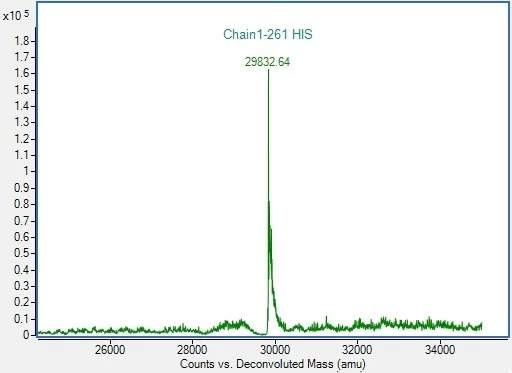
Mass Spectrometry - Recombinant Human PCNA protein (His tag) (AB307191)
Mass determination by ESI-TOF. Predicted MW is 29832.96 Da (+/- 10 Da by ESI-TOF). Observed MW is 29832.64 Da.
- SDS-PAGE
Supplier Data
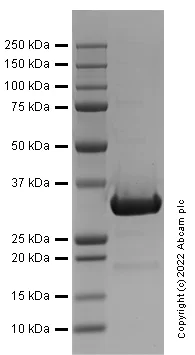
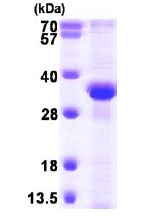
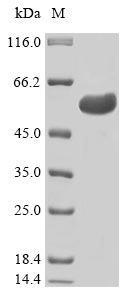
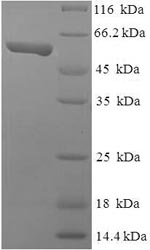
SDS-PAGE - Recombinant Human PCNA protein (His tag) (AB307191)
SDS-page analysis of ab307191
- HPLC
Supplier Data
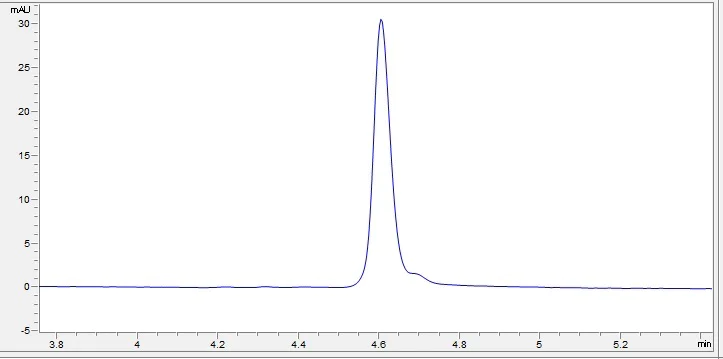
HPLC - Recombinant Human PCNA protein (His tag) (AB307191)
HPLC analysis of ab307191
搭配使用产品
Reagents, Controls & Accessories
AB325995
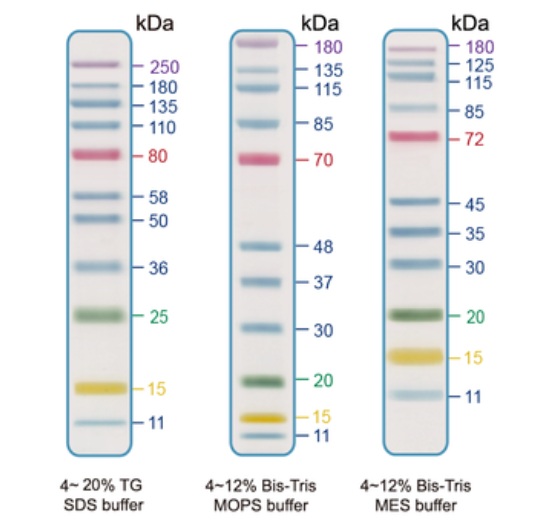
Prestained Protein Ladder - Broad molecular weight (11-250 kDa, 5-color, 11 bands)
- 0
- 0

反应性数据
序列信息
性能和储存信息
形式
运输条件
推荐的短期储存条件
推荐的长期储存条件
补充信息
This supplementary information is collated from multiple sources and compiled automatically.
Biological function summary
This protein serves a core function in cell cycle regulation and DNA repair. PCNA acts as a scaffold for the assembly of numerous proteins involved in DNA processing forming part of the replication fork complex. It interacts with cyclins and cyclin-dependent kinases (CDKs) linking DNA synthesis to cell cycle progression. Furthermore PCNA partners with proteins involved in DNA mismatch repair base excision repair and nucleotide excision repair.
Pathways
PCNA is integral in the DNA replication and repair pathways. It closely associates with the p21 protein which regulates the cell cycle by inhibiting cyclin-CDK complexes upon DNA damage. PCNA also plays a part in the ubiquitin-proteasome pathway where its modification by ubiquitin impacts how cells respond to DNA damage. This modification recruits specific proteins for DNA repair highlighting its central role in maintaining genomic stability.
常规信息
功能
Confers DNA tethering and processivity to DNA polymerases and other proteins (PubMed : 24695737, PubMed : 24939902, PubMed : 35585232). Auxiliary protein of DNA polymerase delta and epsilon, is involved in the control of DNA replication by increasing the polymerases' processivity during elongation of the leading strand (PubMed : 35585232). Induces a robust stimulatory effect on the 3'-5' exonuclease and 3'-phosphodiesterase, but not apurinic-apyrimidinic (AP) endonuclease, APEX2 activities. Has to be loaded onto DNA in order to be able to stimulate APEX2. Plays a key role in DNA damage response (DDR) by being conveniently positioned at the replication fork to coordinate DNA replication with DNA repair and DNA damage tolerance pathways (PubMed : 24939902). Acts as a loading platform to recruit DDR proteins that allow completion of DNA replication after DNA damage and promote postreplication repair : monoubiquitinated PCNA leads to recruitment of translesion (TLS) polymerases, while 'Lys-63'-linked polyubiquitination of PCNA is involved in error-free pathway and employs recombination mechanisms to synthesize across the lesion (PubMed : 24695737).
序列相似性
Belongs to the PCNA family.
翻译后修饰
Phosphorylated. Phosphorylation at Tyr-211 by EGFR stabilizes chromatin-associated PCNA.. Acetylated by CREBBP and p300/EP300; preferentially acetylated by CREBBP on Lys-80, Lys-13 and Lys-14 and on Lys-77 by p300/EP300 upon loading on chromatin in response to UV irradiation (PubMed:19419956, PubMed:24939902). Lysine acetylation disrupts association with chromatin, hence promoting PCNA ubiquitination and proteasomal degradation in response to UV damage in a CREBBP- and EP300-dependent manner (PubMed:24939902). Acetylation disrupts interaction with NUDT15 and promotes degradation (PubMed:19419956).. Ubiquitinated (PubMed:20227374, PubMed:24939902). Following DNA damage, can be either monoubiquitinated to stimulate direct bypass of DNA lesions by specialized DNA polymerases or polyubiquitinated to promote recombination-dependent DNA synthesis across DNA lesions by template switching mechanisms. Following induction of replication stress, monoubiquitinated by the UBE2B-RAD18 complex on Lys-164, leading to recruit translesion (TLS) polymerases, which are able to synthesize across DNA lesions in a potentially error-prone manner. An error-free pathway also exists and requires non-canonical polyubiquitination on Lys-164 through 'Lys-63' linkage of ubiquitin moieties by the E2 complex UBE2N-UBE2V2 and the E3 ligases, HLTF, RNF8 and SHPRH. This error-free pathway, also known as template switching, employs recombination mechanisms to synthesize across the lesion, using as a template the undamaged, newly synthesized strand of the sister chromatid. Monoubiquitination at Lys-164 also takes place in undamaged proliferating cells, and is mediated by the DCX(DTL) complex, leading to enhance PCNA-dependent translesion DNA synthesis. Sumoylated during S phase.. Methylated on glutamate residues by DCPH1/C6orf211.
亚细胞定位
Nucleus
靶点信息
Abcam Product Promise
Please note: All products are 'FOR RESEARCH USE ONLY. NOT FOR USE IN DIAGNOSTIC OR THERAPEUTIC PROCEDURES'.
For licensing inquiries, please contact partnerships@abcam.com