JavaScript is disabled in your browser. Please enable JavaScript to view this website.
AB172827

重组人NST蛋白

Recombinant Human NST protein

Be the first to review this product! Submit a review

|

(0 Publication)

Recombinant Human NST protein is a Human Full Length protein, in the 1 to 284 aa range, expressed in Escherichia coli, with >95%, < 1 EU/µg endotoxin level, suitable for SDS-PAGE, HPLC.

查看别名

SULTX3, SULT4A1, Sulfotransferase 4A1, ST4A1, Brain sulfotransferase-like protein, Nervous system sulfotransferase, hBR-STL, hBR-STL-1, NST

关键信息

纯度

>95% SDS-PAGE

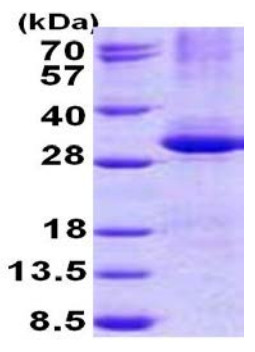
ab172827 is greater than 95%, as determined by SEC-HPLC and reducing SDS-PAGE. It is supplied as an 0.2 µM filtered solution.

内毒素水平

< 1 EU/µg

表达系统

Escherichia coli

标签

Tag free

应用

HPLC, SDS-PAGE

applications

生物活性

No

访问

Q9BR01

不含动物源

No

不含载体蛋白

No

种属

Human

存储溶液

pH: 7.4 Constituents: PBS

storage-buffer

反应性数据

{ "title": "Reactivity Data", "filters": { "stats": ["", "Reactivity", "Dilution Info", "Notes"] }, "values": { "SDS-PAGE": { "reactivity":"TESTED_AND_REACTS", "dilution-info":"", "notes":"<p></p>" }, "HPLC": { "reactivity":"TESTED_AND_REACTS", "dilution-info":"", "notes":"<p></p>" } } }

产品详情

Previously labelled as SULT4A1.

序列信息

[{"linker":null,"sequence":"MAESEAETPSTPGEFESKYFEFHGVRLPPFCRGKMEEIANFPVRPSDVWIVTYPKSGTSLLQEVVYLVSQGADPDEIGLMNIDEQLPVLEYPQPGLDIIKELTSPRLIKSHLPYRFLPSDLHNGDSKVIYMARNPKDLVVSYYQFHRSLRTMSYRGTFQEFCRRFMNDKLGYGSWFEHVQEFWEHRMDSNVLFLKYEDMHRDLVTMVEQLARFLGVSCDKAQLEALTEHCHQLVDQCCSAEALPVGRGRVGLWKDIFTVSMNEKFDLVYKQKMGKCDLTFDFYL","proteinLength":"Full Length","predictedMolecularWeight":"33 kDa","actualMolecularWeight":null,"aminoAcidEnd":284,"aminoAcidStart":1,"nature":"Recombinant","expressionSystem":"Escherichia coli","accessionNumber":"Q9BR01","tags":[]}]

性能和储存信息

形式
Liquid
运输条件
Dry Ice
推荐的短期储存条件
-20°C
推荐的长期储存条件
-20°C
储存信息
Avoid freeze / thaw cycle
False

补充信息

This supplementary information is collated from multiple sources and compiled automatically.

The NST protein also known popularly as Non-Structural Protein plays an important role in molecular mechanics. It often displays a specific mass which varies depending on its subtype and source within different organisms. NST typically expresses itself in various cell types mainly in those undergoing specific physiological processes or viral replication. Its expression allows it to interact and modulate several cellular activities adapting according to cellular needs and environmental conditions.
Biological function summary

NST proteins perform functions that are integral to cellular operations and survival. As components of several complexes they contribute to the modulation of viral replication processes and cellular stress response mechanisms. Within the host cell NST assists in altering cellular machinery to favor viral propagation ensuring efficiency and survival of viral particles. This modulation often includes interference with normal cell signaling pathways giving malignant cells or viruses a survival advantage.

Pathways

NST proteins interact dynamically with numerous cellular pathways to ensure their effectiveness. They are notably involved in pathways like the viral infection pathway and the stress response pathway. Within these pathways NST proteins often connect with other proteins like polymerases and helicases facilitating the smooth progression of tasks essential for pathogenesis. These interactions highlight the central role NST plays in altering host cellular functions to align with pathogenic needs.

NST relates particularly to viral infections and resultant complications. Diseases such as virus-induced fever and some respiratory disorders have shown an association with NST proteins. In these contexts proteins such as polymerases directly complement the function of NST enhancing pathogenic processes. This association highlights the potential of targeting NST proteins in therapeutic approaches aimed at mitigating the impacts of such infections and aiding in disease management.

常规信息

功能

Atypical sulfotransferase family member with very low affinity for 3'-phospho-5'-adenylyl sulfate (PAPS) and very low catalytic activity towards L-triiodothyronine, thyroxine, estrone, p-nitrophenol, 2-naphthylamine, and 2-beta-naphthol. May have a role in the metabolism of drugs and neurotransmitters in the CNS.

序列相似性

Belongs to the sulfotransferase 1 family.

产品实验方案

靶点信息

Atypical sulfotransferase family member with very low affinity for 3'-phospho-5'-adenylyl sulfate (PAPS) and very low catalytic activity towards L-triiodothyronine, thyroxine, estrone, p-nitrophenol, 2-naphthylamine, and 2-beta-naphthol. May have a role in the metabolism of drugs and neurotransmitters in the CNS.
See full target information SULT4A1

Abcam Product Promise

我们致力于为您的研究提供高质量的试剂,为您科研的每一步提供支持。若我们的产品未能达到预期性能,我们向您提供 Abcam Product Promise 保障。
详情请参阅我们的条款与条件。

Please note: All products are 'FOR RESEARCH USE ONLY. NOT FOR USE IN DIAGNOSTIC OR THERAPEUTIC PROCEDURES'.

For licensing inquiries, please contact partnerships@abcam.com