重组人 NLRP3 蛋白 (His-DDDDK tag N-Terminus)
Recombinant Human NLRP3 protein (His-DDDDK tag N-Terminus)
Be the first to review this product! Submit a review
|
(1 Publication)
Recombinant Human NLRP3 protein (His-DDDDK tag N-Terminus) is a Human Full Length protein, in the 2 to 1036 aa range, expressed in Baculovirus infected Sf9 cells, with >50%, suitable for SDS-PAGE.
查看别名
C1orf7, CIAS1, NALP3, PYPAF1, NLRP3, Angiotensin/vasopressin receptor AII/AVP-like, Caterpiller protein 1.1, Cold-induced autoinflammatory syndrome 1 protein, Cryopyrin, PYRIN-containing APAF1-like protein 1, CLR1.1
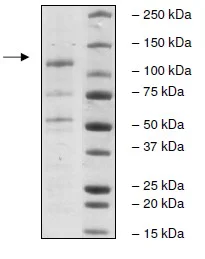
- SDS-PAGE
Supplier Data
SDS-PAGE - Recombinant Human NLRP3 protein (His-DDDDK tag N-Terminus) (AB198069)
4-20% SDS-PAGE analysis of 1 μg ab198069 with Coomassie staining.
搭配使用产品
Reagents, Controls & Accessories
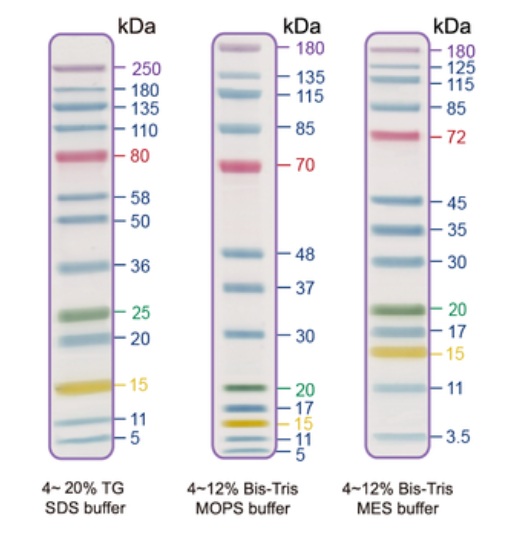
AB325997
Prestained Protein Ladder - Extra broad molecular weight (3-250 kDa, 5-color)
- 0
- 0
Primary Antibodies
AB263899
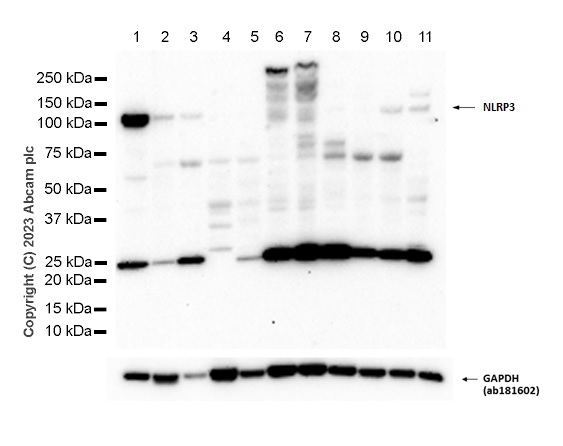
Anti-NLRP3 antibody [EPR23094-1]
KO Validated|RabMAb|Recombinant|20ul selling size
- 4
- 2
反应性数据
序列信息
性能和储存信息
形式
纯化工艺
运输条件
推荐的短期储存条件
推荐的长期储存条件
储存信息
补充信息
This supplementary information is collated from multiple sources and compiled automatically.
Biological function summary
NLRP3 is central to the body’s defense mechanism by participating in forming the inflammasome complex which activates caspase-1. This activation leads to the cleavage of pro-inflammatory cytokines like IL-1β and IL-18 into their active forms. NLRP3's function is essential for mounting an effective immune response to infections and damage signals. It senses a range of stimuli including crystalline substances and cellular stress triggering an immune response. Its expression is tightly regulated to prevent excessive inflammation.
Pathways
The NLRP3 inflammasome is key in the innate immune response and inflammation pathways. It links cellular stress signals to inflammation through the activation of caspase-1 which is important for the IL-1 signaling pathway. NLRP3 interacts with other proteins like ASC (apoptosis-associated speck-like protein containing a CARD) to form the inflammasome complex which is a core part of the inflammatory signaling pathways and links innate and adaptive immunity.
常规信息
功能
Sensor component of the NLRP3 inflammasome, which mediates inflammasome activation in response to defects in membrane integrity, leading to secretion of inflammatory cytokines IL1B and IL18 and pyroptosis (PubMed : 16407889, PubMed : 18403674, PubMed : 18604214, PubMed : 23582325, PubMed : 25686105, PubMed : 27929086, PubMed : 28656979, PubMed : 28847925, PubMed : 30487600, PubMed : 30612879, PubMed : 31086327, PubMed : 31086329, PubMed : 31189953, PubMed : 33231615, PubMed : 34133077, PubMed : 34341353, PubMed : 34512673, PubMed : 36442502, PubMed : 40450990). In response to pathogens and other damage-associated signals that affect the integrity of membranes, initiates the formation of the inflammasome polymeric complex composed of NLRP3, CASP1 and PYCARD/ASC (PubMed : 16407889, PubMed : 18403674, PubMed : 27432880, PubMed : 28847925, PubMed : 31189953, PubMed : 33231615, PubMed : 34133077, PubMed : 34341353, PubMed : 36142182, PubMed : 36442502). Recruitment of pro-caspase-1 (proCASP1) to the NLRP3 inflammasome promotes caspase-1 (CASP1) activation, which subsequently cleaves and activates inflammatory cytokines IL1B and IL18 and gasdermin-D (GSDMD), promoting cytokine secretion and pyroptosis (PubMed : 23582325, PubMed : 28847925, PubMed : 31189953, PubMed : 33231615, PubMed : 34133077, PubMed : 34341353). Activation of NLRP3 inflammasome is also required for HMGB1 secretion; stimulating inflammatory responses (PubMed : 22801494). Involved in the homeostatic wound healing response to tissue injury, a multistep cascade that guides neutrophil migration to necrotic sites while avoiding collateral damage of healthy tissues. ATP released from necrotic cells triggers activation of NLRP3 inflammasome through P2RX7 signaling leading to neutrophil adhesion to the vascular endothelium close to the injury site (By similarity). Under resting conditions, ADP-bound NLRP3 is autoinhibited (PubMed : 35114687). NLRP3 activation stimuli include extracellular ATP, nigericin, reactive oxygen species, crystals of monosodium urate or cholesterol, amyloid-beta fibers, environmental or industrial particles and nanoparticles, such as asbestos, silica, aluminum salts, cytosolic dsRNA, etc (PubMed : 16407889, PubMed : 18403674, PubMed : 18604214, PubMed : 19414800, PubMed : 23871209). Almost all stimuli trigger intracellular K(+) efflux (By similarity). These stimuli lead to membrane perturbation and activation of NLRP3 (By similarity). Upon activation, NLRP3 is transported to microtubule organizing center (MTOC), where it is unlocked by NEK7, leading to its relocalization to dispersed trans-Golgi network (dTGN) vesicle membranes and formation of an active inflammasome complex (PubMed : 36442502, PubMed : 39173637). Associates with dTGN vesicle membranes by binding to phosphatidylinositol 4-phosphate (PtdIns4P) (PubMed : 30487600, PubMed : 34554188). Shows ATPase activity (PubMed : 17483456).. Independently of inflammasome activation, regulates the differentiation of T helper 2 (Th2) cells and has a role in Th2 cell-dependent asthma and tumor growth (By similarity). During Th2 differentiation, required for optimal IRF4 binding to IL4 promoter and for IRF4-dependent IL4 transcription (By similarity). Binds to the consensus DNA sequence 5'-GRRGGNRGAG-3' (By similarity). May also participate in the transcription of IL5, IL13, GATA3, CCR3, CCR4 and MAF (By similarity).
序列相似性
Belongs to the NLRP family.
翻译后修饰
Phosphorylation at Ser-198 by MAPK8/JNK1 increases inflammasome activation by promoting deubiquitination by BRCC3 and NLRP3 homooligomerization (PubMed:28943315). Phosphorylation at Ser-806 by CSNK1A1 prevents inflammasome activation by preventing NEK7 recruitment (PubMed:34615873). Phosphorylation at Ser-5 in the pyrin domain inhibits homomultimerization of NLRP3 and activation of the NLRP3 inflammasome: dephosphorylation by protein phosphatase 2A (PP2A) promotes assembly of the NLRP3 inflammasome (PubMed:28465465). Phosphorylation at Ser-295 by PKD/PRKD1 promotes NLRP3 inflammasome assembly (By similarity). Phosphorylation by ERK1/MAPK3 promotes NLRP3 inflammasome assembly (PubMed:24623131). Phosphorylation by BTK (at Tyr-136, Tyr-140, Tyr-143 and Tyr-168) in the region that mediates binding to phosphatidylinositol phosphate, promotes relocalization of NLRP3 and assembly of the NLRP3 inflammasome (PubMed:34554188). Phosphorylation at Tyr-861 inhibits NLRP3 inflammasome assembly: dephosphorylation by PTPN22 promotes inflammasome activation (PubMed:27043286). Phosphorylated by LATS1 and LATS2 at Ser-265 following palmitoylation by ZDHHC1, promoting its relocalization to the microtubule organizing center (MTOC), where NLRP3 is activated by NEK7, leading to inflammasome assembly and activation (PubMed:39173637).. Ubiquitinated; undergoes both 'Lys-48'- and 'Lys-63'-linked polyubiquitination (PubMed:22948162, PubMed:27929086). Ubiquitination does not lead to degradation, but inhibits inflammasome activation (By similarity). Deubiquitination is catalyzed by BRCC3 and associated with NLRP3 activation and inflammasome assembly (By similarity). This process can be induced by the activation of Toll-like receptors (by LPS), through a non-transcriptional pathway dependent on the mitochondrial production of reactive oxygen species, and by ATP (By similarity). Ubiquitinated by TRIM31 via 'Lys-48'-linked ubiquitination, leading to its degradation by the proteasome (PubMed:27929086). Ubiquitinated at Lys-689 by the SCF(FBXL2) complex, leading to its degradation by the proteasome (PubMed:26037928). Ubiquitinated by TRIM35 via 'lys-48' and 'Lys-63'-linked ubiquitination leading to inhibition of NLRP3 inflammasome activation (PubMed:34512673). Undergoes 'Lys-27'-linked polyubiquitination by MARCHF5, leading to NLRP3-NEK7 complex formation and NLRP3 oligomerization (PubMed:37575012).. Palmitoylation by ZDHHC12 promotes NLRP3 degradation by the chaperone-mediated autophagy pathway (CMA) and therefore limits NLRP3 inflammasome activation (PubMed:36586411, PubMed:39225180). Following palmitoylation, HSPA8/HSC70 recognizes and binds the KFERQ-like motifs on NLRP3 and promotes NLRP3 recruitment to lysosomes, where it is degraded via the chaperone-mediated autophagy pathway in a LAMP2-dependent process (PubMed:36586411). Palmitoylation at Cys-837 and Cys-838 by ZDHHC5 enhances its binding to NEK7 leading to inflammasome assembly and activation (PubMed:38092000). Palmitoylation at Cys-130 and Cys-958 by ZDHHC1 facilitates phosphorylation at Ser-265 by LATS1 and LATS2, promoting its relocalization to the microtubule organizing center (MTOC), where NLRP3 is activated by NEK7, leading to inflammasome assembly and activation (PubMed:39173637). Depalmitoylated by ABHD17A (PubMed:38092000).. Degraded via selective autophagy following interaction with IRGM (PubMed:30612879). IRGM promotes NLRP3 recruitment to autophagosome membranes, promoting its SQSTM1/p62-dependent autophagy-dependent degradation (PubMed:30612879).. The disulfide bond in the pyrin domain might play a role in reactive oxygen species-mediated activation.. (Microbial infection) ADP-ribosylated by M.pneumoniae CARDS toxin in vitro.
靶点信息
文献 (1)
Recent publications for all applications. Explore the full list and refine your search
Neuron 110:2422-2437.e9 PubMed35654037
2022
Applications
Unspecified application
Species
Unspecified reactive species
Abcam Product Promise
Please note: All products are 'FOR RESEARCH USE ONLY. NOT FOR USE IN DIAGNOSTIC OR THERAPEUTIC PROCEDURES'.
For licensing inquiries, please contact partnerships@abcam.com