JavaScript is disabled in your browser. Please enable JavaScript to view this website.
AB103504

重组人 N myc interactor/NMI 蛋白 (His tag N-Terminus)

Recombinant Human N myc interactor/NMI protein (His tag N-Terminus)

Be the first to review this product! Submit a review

|

(0 Publication)

Recombinant Human N myc interactor/NMI protein (His tag N-Terminus) is a Human Full Length protein, in the 1 to 307 aa range, expressed in Escherichia coli, with >90%, suitable for SDS-PAGE, Mass Spec.

查看别名

N-myc-interactor, Nmi, N-myc and STAT interactor, NMI
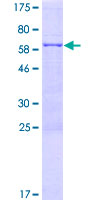
1 Images
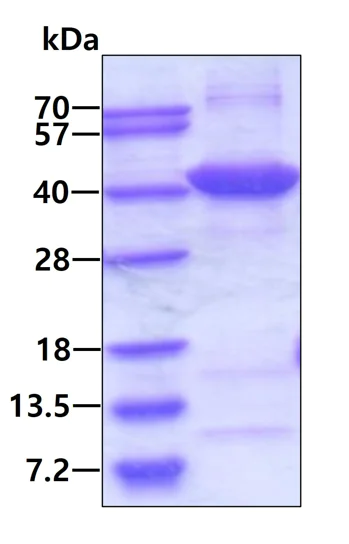
SDS-PAGE - Recombinant Human N myc interactor/NMI protein (His tag N-Terminus) (AB103504)
  • SDS-PAGE

Supplier Data

SDS-PAGE - Recombinant Human N myc interactor/NMI protein (His tag N-Terminus) (AB103504)

关键信息

纯度

>90% SDS-PAGE

purified by using anion-exchange chromatography (DEAE sepharose resin) and gel-filtration chromatography (Sephacryl S-200) with 20mM Tris pH 7.5, 2mM EDTA.

表达系统

Escherichia coli

标签

His tag N-Terminus

应用

SDS-PAGE, Mass Spec

applications

生物活性

No

访问

Q13287

不含动物源

No

不含载体蛋白

No

种属

Human

存储溶液

pH: 8 Constituents: 20% Glycerol (glycerin, glycerine), 0.316% Tris HCl, 0.0154% (R*,R*)-1,4-Dimercaptobutan-2,3-diol

storage-buffer

反应性数据

{ "title": "Reactivity Data", "filters": { "stats": ["", "Reactivity", "Dilution Info", "Notes"] }, "values": { "SDS-PAGE": { "reactivity":"TESTED_AND_REACTS", "dilution-info":"", "notes":"<p></p>" }, "Mass Spec": { "reactivity":"TESTED_AND_REACTS", "dilution-info":"", "notes":"<p></p>" } } }

产品详情

This product was previously labelled as N myc interactor

序列信息

[{"linker":null,"sequence":"MGSSHHHHHHSSGLVPRGSHFLSVETPENDSQLSNISCSFQVSSKVPYEIQKGQALITFEKEEVAQNVVSMSKHHVQIKDVNLEVTAKPVPLNSGVRFQVYVEVSKMKINMEADKDDTQQILKEHSPDEFIKDEQNKGLIDEITKKNIQLKKEIQKLETELQEATKEFQIKEDIPETKMKVTEIPDTLREDQMRDKLELSFSKSRNGGGEVDRVDYDRQSGSAVITFVEIGVADKILKKKEYPLYINQTCHRVTVSPYTEIHLKKYQIFSGTSKRTVLLTGMEGIQMDEEIVEDLINIHFQRAKNGGGEVDVVKCSLGQPHIAYFEE","proteinLength":"Full Length","predictedMolecularWeight":"37.2 kDa","actualMolecularWeight":null,"aminoAcidEnd":307,"aminoAcidStart":1,"nature":"Recombinant","expressionSystem":"Escherichia coli","accessionNumber":"Q13287","tags":[{"tag":"His","terminus":"N-Terminus"}]}]

性能和储存信息

形式
Liquid
运输条件
Blue Ice
推荐的短期储存条件
-20°C
推荐的长期储存条件
-20°C
分装信息
Upon delivery aliquot
储存信息
Avoid freeze / thaw cycle
False

补充信息

This supplementary information is collated from multiple sources and compiled automatically.

N myc interactor often referred to as NMI interacts with members of the MYC family including N-MYC and C-MYC. Known as N-MYC and C-MYC interacting protein NMI has a molecular weight of approximately 54 kDa. NMI expresses in a variety of tissues with higher levels in brain and liver tissues. Its presence is also notable in immune cells pointing towards a complex role in cellular processes related to both developmental and immune responses.
Biological function summary

NMI collaborates with transcription factors to influence the regulation of gene expression. It plays a significant role in the formation of protein complexes that regulate transcriptional activities of oncogenes particularly through interaction with MYC and STAT proteins. NMI's ability to form complexes makes it a notable player in modulating signal transduction pathways. Its balancing act with transcription factors affects cell proliferation and differentiation critical components of its biological functionality.

Pathways

NMI has a significant impact on the JAK-STAT signaling pathway and the MYC-mediated transcription network. Within these pathways NMI modulates the activities of the MYC family of oncogenes and interacts with signal transducers and activators like STATs. These interactions contribute to the regulation of cellular processes such as growth and apoptosis. Such pathways illustrate NMI's role in maintaining cellular homeostasis and its interactive role with proteins like STAT and MYC.

NMI has been associated with cancer and autoimmune diseases. NMI's interaction with MYC oncogenes links it to various cancers particularly neuroblastoma. It also associates with autoimmune disorder mechanisms implicating its expression and regulation in immune-related pathologies. In cancer NMI's relationship with MYC affects tumor growth and progression illustrating its potential as a target for therapeutic intervention. Its involvement highlights the importance of understanding its function in disease pathways.

常规信息

功能

Acts as a signaling pathway regulator involved in innate immune system response (PubMed : 26342464, PubMed : 29038465, PubMed : 29350881, PubMed : 9989503). In response to interleukin 2/IL2 and interferon IFN-gamma/IFNG, interacts with signal transducer and activator of transcription/STAT which activate the transcription of downstream genes involved in a multitude of signals for development and homeostasis (PubMed : 29377960, PubMed : 9989503). Enhances the recruitment of CBP/p300 coactivators to STAT1 and STAT5, resulting in increased STAT1- and STAT5-dependent transcription (PubMed : 9989503). In response to interferon IFN-alpha, associates in a complex with signaling pathway regulator IFI35 to regulate immune response; the complex formation prevents proteasome-mediated degradation of IFI35 (PubMed : 10779520, PubMed : 10950963). In complex with IFI35, inhibits virus-triggered type I IFN-beta production when ubiquitinated by ubiquitin-protein ligase TRIM21 (PubMed : 26342464). In complex with IFI35, negatively regulates nuclear factor NF-kappa-B signaling by inhibiting the nuclear translocation, activation and transcription of NF-kappa-B subunit p65/RELA, resulting in the inhibition of endothelial cell proliferation, migration and re-endothelialization of injured arteries (PubMed : 29350881). Negatively regulates virus-triggered type I interferon/IFN production by inducing proteosome-dependent degradation of IRF7, a transcriptional regulator of type I IFN, thereby interfering with cellular antiviral responses (By similarity). Beside its role as an intracellular signaling pathway regulator, also functions extracellularly as damage-associated molecular patterns (DAMPs) to promote inflammation, when actively released by macrophage to the extracellular space during cell injury or pathogen invasion (PubMed : 29038465). Macrophage-secreted NMI activates NF-kappa-B signaling in adjacent macrophages through Toll-like receptor 4/TLR4 binding and activation, thereby inducing NF-kappa-B translocation from the cytoplasm into the nucleus which promotes the release of pro-inflammatory cytokines (PubMed : 29038465).

序列相似性

Belongs to the NMI family.

翻译后修饰

Ubiquitinated. 'Lys-63'-linked ubiquitination by TRIM21 promotes interaction with IFI35 and inhibits virus-triggered type I IFN-beta production.

亚细胞定位

Nucleus

产品实验方案

靶点信息

Acts as a signaling pathway regulator involved in innate immune system response (PubMed : 26342464, PubMed : 29038465, PubMed : 29350881, PubMed : 9989503). In response to interleukin 2/IL2 and interferon IFN-gamma/IFNG, interacts with signal transducer and activator of transcription/STAT which activate the transcription of downstream genes involved in a multitude of signals for development and homeostasis (PubMed : 29377960, PubMed : 9989503). Enhances the recruitment of CBP/p300 coactivators to STAT1 and STAT5, resulting in increased STAT1- and STAT5-dependent transcription (PubMed : 9989503). In response to interferon IFN-alpha, associates in a complex with signaling pathway regulator IFI35 to regulate immune response; the complex formation prevents proteasome-mediated degradation of IFI35 (PubMed : 10779520, PubMed : 10950963). In complex with IFI35, inhibits virus-triggered type I IFN-beta production when ubiquitinated by ubiquitin-protein ligase TRIM21 (PubMed : 26342464). In complex with IFI35, negatively regulates nuclear factor NF-kappa-B signaling by inhibiting the nuclear translocation, activation and transcription of NF-kappa-B subunit p65/RELA, resulting in the inhibition of endothelial cell proliferation, migration and re-endothelialization of injured arteries (PubMed : 29350881). Negatively regulates virus-triggered type I interferon/IFN production by inducing proteosome-dependent degradation of IRF7, a transcriptional regulator of type I IFN, thereby interfering with cellular antiviral responses (By similarity). Beside its role as an intracellular signaling pathway regulator, also functions extracellularly as damage-associated molecular patterns (DAMPs) to promote inflammation, when actively released by macrophage to the extracellular space during cell injury or pathogen invasion (PubMed : 29038465). Macrophage-secreted NMI activates NF-kappa-B signaling in adjacent macrophages through Toll-like receptor 4/TLR4 binding and activation, thereby inducing NF-kappa-B translocation from the cytoplasm into the nucleus which promotes the release of pro-inflammatory cytokines (PubMed : 29038465).
See full target information NMI

Abcam Product Promise

我们致力于为您的研究提供高质量的试剂,为您科研的每一步提供支持。若我们的产品未能达到预期性能,我们向您提供 Abcam Product Promise 保障。
详情请参阅我们的条款与条件。

Please note: All products are 'FOR RESEARCH USE ONLY. NOT FOR USE IN DIAGNOSTIC OR THERAPEUTIC PROCEDURES'.

For licensing inquiries, please contact partnerships@abcam.com