JavaScript is disabled in your browser. Please enable JavaScript to view this website.
AB89982

重组人 JAK3 蛋白 (Active) (His tag N-Terminus)

Recombinant human JAK3 protein (Active) (His tag N-Terminus)

Be the first to review this product! Submit a review

|

(0 Publication)

Recombinant human JAK3 protein (Active) (His tag N-Terminus) is a Human Fragment protein, in the 811 to 1124 aa range, expressed in Baculovirus infected insect cells, with >90%, suitable for SDS-PAGE, FuncS.

查看别名

Tyrosine-protein kinase JAK3, Janus kinase 3, Leukocyte janus kinase, JAK-3, L-JAK, JAK3

2 Images
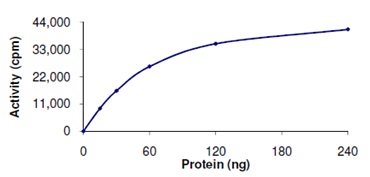
Functional Studies - Recombinant human JAK3 protein (Active) (His tag N-Terminus) (AB89982)
  • FuncS

Unknown

Functional Studies - Recombinant human JAK3 protein (Active) (His tag N-Terminus) (AB89982)

Image showing specific activity of ab89982.

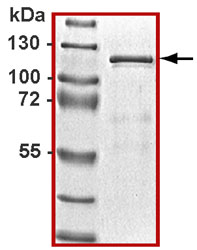
SDS-PAGE - Recombinant human JAK3 protein (Active) (His tag N-Terminus) (AB89982)
  • SDS-PAGE

Supplier Data

SDS-PAGE - Recombinant human JAK3 protein (Active) (His tag N-Terminus) (AB89982)

4-20% SDS-page coomassie staining.

关键信息

纯度

>90% SDS-PAGE

Affinity purified.

表达系统

Baculovirus infected insect cells

标签

His tag N-Terminus

应用

FuncS, SDS-PAGE

applications

生物活性

Yes

生物学活性

Specific Activity: 500 pmol/min/μg. Assay conditions: 40 mM Tris-HCL pH 7.4, 20 mM MgCl2, 0.1 mg/mL BSA and 0.2 mM DTT using 0.2 mg/ml Poly-(Glu4:Tyr) substrate and 20 mM ATP. Reaction was done at 30°C for 45 min.

访问

P52333

不含动物源

No

不含载体蛋白

No

种属

Human

存储溶液

pH: 8 Preservative: 1.36% Imidazole Constituents: 20% Glycerol (glycerin, glycerine), 0.63% Tris HCl, 0.58% Sodium chloride, 0.05% (R*,R*)-1,4-Dimercaptobutan-2,3-diol, 0.02% Potassium chloride

storage-buffer

反应性数据

{ "title": "Reactivity Data", "filters": { "stats": ["", "Reactivity", "Dilution Info", "Notes"] }, "values": { "SDS-PAGE": { "reactivity":"TESTED_AND_REACTS", "dilution-info":"", "notes":"<p></p>" }, "FuncS": { "reactivity":"TESTED_AND_REACTS", "dilution-info":"", "notes":"<p></p>" } } }

序列信息

[{"linker":null,"sequence":"","proteinLength":"Fragment","predictedMolecularWeight":null,"actualMolecularWeight":"37 kDa","aminoAcidEnd":1124,"aminoAcidStart":811,"nature":"Recombinant","expressionSystem":null,"accessionNumber":"P52333","tags":[{"tag":"His","terminus":"N-Terminus"}]}]

性能和储存信息

形式
Liquid
纯化工艺
Affinity purification
运输条件
Dry Ice
推荐的短期储存条件
-80°C
推荐的长期储存条件
-80°C
True

补充信息

This supplementary information is collated from multiple sources and compiled automatically.

JAK3 also known as Janus kinase 3 is a protein with a molecular mass of approximately 125 kDa. It belongs to the Janus kinase family and plays an important role in the signal transduction pathways. JAK3 is expressed mainly in hematopoietic cells which include white blood cells and related precursor cells. Its primary function involves mediating signaling by associating with the common gamma chain used by cytokine receptors.
Biological function summary

JAK3 is instrumental in the signaling mechanism of the immune system. It participates in the activation of various interleukins specifically those that signal through the common gamma chain receptor complex. JAK3's role is essential in the proper functioning and development of immune cells such as T cells and natural killer cells. Within this framework JAK3 pairs with cytokine receptors transmitting signals that regulate both proliferation and differentiation of these immune cells.

Pathways

JAK3 integrates into JAK-STAT signaling pathways. This protein works alongside STAT proteins including STAT5 to facilitate the transcription of genes involved in cell survival and proliferation. It also interacts with JAK1 another member of the Janus kinase family to form functional complexes. These interactions are pivotal in maintaining normal immune responses and ensuring that signaling pathways are activated appropriately in response to extracellular cues.

Abnormal JAK3 function can lead to immune-related conditions. Severe combined immunodeficiency (SCID) is one such disorder arising from JAK3 mutations that impair immune cell function. Additionally JAK3 dysregulation links to malignancies such as T-cell acute lymphoblastic leukemia. Relating to these disorders JAK3 affects proteins like IL-7R and gamma chains which are important for cytokine signaling contributing to pathologies when malfunctioning.

常规信息

功能

Non-receptor tyrosine kinase involved in various processes such as cell growth, development, or differentiation. Mediates essential signaling events in both innate and adaptive immunity and plays a crucial role in hematopoiesis during T-cells development. In the cytoplasm, plays a pivotal role in signal transduction via its association with type I receptors sharing the common subunit gamma such as IL2R, IL4R, IL7R, IL9R, IL15R and IL21R. Following ligand binding to cell surface receptors, phosphorylates specific tyrosine residues on the cytoplasmic tails of the receptor, creating docking sites for STATs proteins. Subsequently, phosphorylates the STATs proteins once they are recruited to the receptor. Phosphorylated STATs then form homodimer or heterodimers and translocate to the nucleus to activate gene transcription. For example, upon IL2R activation by IL2, JAK1 and JAK3 molecules bind to IL2R beta (IL2RB) and gamma chain (IL2RG) subunits inducing the tyrosine phosphorylation of both receptor subunits on their cytoplasmic domain. Then, STAT5A and STAT5B are recruited, phosphorylated and activated by JAK1 and JAK3. Once activated, dimerized STAT5 translocates to the nucleus and promotes the transcription of specific target genes in a cytokine-specific fashion.

序列相似性

Belongs to the protein kinase superfamily. Tyr protein kinase family. JAK subfamily.

翻译后修饰

Tyrosine phosphorylated in response to IL-2 and IL-4. Dephosphorylation of Tyr-980 and Tyr-981 by PTPN2 negatively regulates cytokine-mediated signaling (Probable).

产品实验方案

靶点信息

Non-receptor tyrosine kinase involved in various processes such as cell growth, development, or differentiation. Mediates essential signaling events in both innate and adaptive immunity and plays a crucial role in hematopoiesis during T-cells development. In the cytoplasm, plays a pivotal role in signal transduction via its association with type I receptors sharing the common subunit gamma such as IL2R, IL4R, IL7R, IL9R, IL15R and IL21R. Following ligand binding to cell surface receptors, phosphorylates specific tyrosine residues on the cytoplasmic tails of the receptor, creating docking sites for STATs proteins. Subsequently, phosphorylates the STATs proteins once they are recruited to the receptor. Phosphorylated STATs then form homodimer or heterodimers and translocate to the nucleus to activate gene transcription. For example, upon IL2R activation by IL2, JAK1 and JAK3 molecules bind to IL2R beta (IL2RB) and gamma chain (IL2RG) subunits inducing the tyrosine phosphorylation of both receptor subunits on their cytoplasmic domain. Then, STAT5A and STAT5B are recruited, phosphorylated and activated by JAK1 and JAK3. Once activated, dimerized STAT5 translocates to the nucleus and promotes the transcription of specific target genes in a cytokine-specific fashion.
See full target information JAK3

Abcam Product Promise

我们致力于为您的研究提供高质量的试剂,为您科研的每一步提供支持。若我们的产品未能达到预期性能,我们向您提供 Abcam Product Promise 保障。
详情请参阅我们的条款与条件。

Please note: All products are 'FOR RESEARCH USE ONLY. NOT FOR USE IN DIAGNOSTIC OR THERAPEUTIC PROCEDURES'.

For licensing inquiries, please contact partnerships@abcam.com