JavaScript is disabled in your browser. Please enable JavaScript to view this website.
AB217833

重组 Human HtrA2 / Omi protein (His tag N-Terminus)

Recombinant Human HtrA2 / Omi protein (His tag N-Terminus)

Be the first to review this product! Submit a review

|

(0 Publication)

Recombinant Human HtrA2 / Omi protein (His tag N-Terminus) is a Human Fragment protein, in the 133 to 358 aa range, expressed in Escherichia coli, with >95%, suitable for SDS-PAGE.

查看别名

OMI, PRSS25, HTRA2, High temperature requirement protein A2, Omi stress-regulated endoprotease, Serine protease 25, Serine proteinase OMI, HtrA2
1 Images
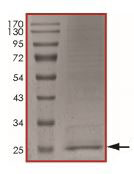
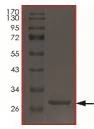
SDS-PAGE - Recombinant Human HtrA2 / Omi protein (His tag N-Terminus) (AB217833)
  • SDS-PAGE

Supplier Data

SDS-PAGE - Recombinant Human HtrA2 / Omi protein (His tag N-Terminus) (AB217833)

SDS-PAGE analysis of ab217833.

关键信息

纯度

>95% SDS-PAGE

表达系统

Escherichia coli

标签

His tag N-Terminus

应用

SDS-PAGE

applications

生物活性

No

访问

O43464

不含动物源

No

不含载体蛋白

No

种属

Human

存储溶液

pH: 7 Preservative: 1.02% Imidazole Constituents: 10% Glycerol (glycerin, glycerine), 1.74% Sodium chloride, 0.79% Tris HCl

storage-buffer

反应性数据

{ "title": "Reactivity Data", "filters": { "stats": ["", "Reactivity", "Dilution Info", "Notes"] }, "values": { "SDS-PAGE": { "reactivity":"TESTED_AND_REACTS", "dilution-info":"", "notes":"<p></p>" } } }

序列信息

[{"linker":null,"sequence":"AAVPSPPPASPRSQYNFIADVVEKTAPAVVYIEILDRHPFLGREVPISNGSGFVVAADGLIVTNAHVVADRRRVRVRLLSGDTYEAVVTAVDPVADIATLRIQTKEPLPTLPLGRSADVRQGEFVVAMGSPFALQNTITSGIVSSAQRPARDLGLPQTNVEYIQTDAAIDFGNSGGPLVNLDGEVIGVNTMKVTAGISFAIPSDRLREFLHRGEKKNSSSGISGSQ","proteinLength":"Fragment","predictedMolecularWeight":"29 kDa","actualMolecularWeight":null,"aminoAcidEnd":358,"aminoAcidStart":133,"nature":"Recombinant","expressionSystem":"Escherichia coli","accessionNumber":"O43464","tags":[{"tag":"His","terminus":"N-Terminus"}]}]

性能和储存信息

形式
Liquid
运输条件
Dry Ice
推荐的短期储存条件
-80°C
推荐的长期储存条件
-80°C
分装信息
Upon delivery aliquot
储存信息
Avoid freeze / thaw cycle
False

补充信息

This supplementary information is collated from multiple sources and compiled automatically.

HtrA2 also known as Omi or the Omi protein is a serine protease with a molecular mass of approximately 50 kDa. It is a mitochondrial protein and commonly found in the cytosol following cellular stress. HtrA2/Omi mediates its function through its protease and pro-apoptotic activities. It is involved in the degradation of damaged proteins and exerts an important role in maintaining protein quality control within mitochondria. Researchers often study HtrA2/Omi for its function in apoptosis and Parkinson's disease-related pathways.
Biological function summary

The degradation and signaling processes of HtrA2/Omi protect against proteotoxic stress. It operates within the mitochondria and under stress conditions relocates to the cytosol where it can influence apoptosis. HtrA2/Omi can interact with inhibitors of apoptosis proteins (IAPs) and by doing this promotes apoptosis when necessary. This regulation of cell death links HtrA2/Omi to the cellular quality control mechanisms directly impacting cell survival and health.

Pathways

HtrA2/Omi integrates into the mitochondrial apoptosis pathway and is important in Parkinson's disease pathways. Through its interactions with apoptosis regulators like XIAP HtrA2/Omi facilitates the removal of unwanted cells. Additionally it participates in signaling pathways involving caspases and other pro-apoptotic factors. Its activity ensures proper communication and response within these pathways to maintain cellular balance and respond to stressors or damage.

HtrA2/Omi links to neurodegenerative conditions such as Parkinson's disease and Huntington's disease. Mutations or alterations in expression levels can contribute to these conditions by disrupting normal apoptotic signaling. Other proteins like PINK1 and Parkin are closely related to HtrA2/Omi in the context of Parkinson's disease where they collectively regulate mitochondrial function and health. In such disorders the malfunction of HtrA2/Omi or its interactions leads to impaired cell survival and increased susceptibility to neuronal damage.

常规信息

功能

Isoform 1. Serine protease that shows proteolytic activity against a non-specific substrate beta-casein (PubMed : 10873535). Promotes apoptosis by either relieving the inhibition of BIRC proteins on caspases, leading to an increase in caspase activity; or by a BIRC inhibition-independent, caspase-independent and serine protease activity-dependent mechanism (PubMed : 15200957). Cleaves BIRC6 and relieves its inhibition on CASP3, CASP7 and CASP9, but it is also prone to inhibition by BIRC6 (PubMed : 36758104, PubMed : 36758105). Cleaves THAP5 and promotes its degradation during apoptosis (PubMed : 19502560).. Isoform 2. Seems to be proteolytically inactive.

序列相似性

Belongs to the peptidase S1C family.

翻译后修饰

Ubiquitinated by BIRC6; this activity is inhibited by DIABLO/SMAC.. Autoproteolytically activated.

产品实验方案

靶点信息

Isoform 1. Serine protease that shows proteolytic activity against a non-specific substrate beta-casein (PubMed : 10873535). Promotes apoptosis by either relieving the inhibition of BIRC proteins on caspases, leading to an increase in caspase activity; or by a BIRC inhibition-independent, caspase-independent and serine protease activity-dependent mechanism (PubMed : 15200957). Cleaves BIRC6 and relieves its inhibition on CASP3, CASP7 and CASP9, but it is also prone to inhibition by BIRC6 (PubMed : 36758104, PubMed : 36758105). Cleaves THAP5 and promotes its degradation during apoptosis (PubMed : 19502560).. Isoform 2. Seems to be proteolytically inactive.
See full target information HTRA2

Abcam Product Promise

我们致力于为您的研究提供高质量的试剂,为您科研的每一步提供支持。若我们的产品未能达到预期性能,我们向您提供 Abcam Product Promise 保障。
详情请参阅我们的条款与条件。

Please note: All products are 'FOR RESEARCH USE ONLY. NOT FOR USE IN DIAGNOSTIC OR THERAPEUTIC PROCEDURES'.

For licensing inquiries, please contact partnerships@abcam.com