重组人GSK3 alpha fusion蛋白
Recombinant Human GSK3 alpha fusion protein
Be the first to review this product! Submit a review
|
(0 Publication)
Recombinant Human GSK3 alpha fusion protein is a Human protein, expressed in Escherichia coli, with >95%, suitable for SDS-PAGE.
查看别名
Glycogen synthase kinase-3 alpha, GSK-3 alpha, Serine/threonine-protein kinase GSK3A, GSK3A
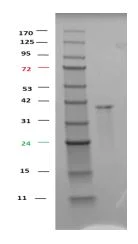
- SDS-PAGE
Supplier Data
SDS-PAGE - Recombinant Human GSK3 alpha fusion protein (AB285758)
SDS-page analysis of ab285758
搭配使用产品
反应性数据
序列信息
性能和储存信息
形式
运输条件
推荐的短期储存条件
推荐的长期储存条件
储存信息
补充信息
This supplementary information is collated from multiple sources and compiled automatically.
Biological function summary
GSK3 alpha influences several cellular functions including cell division differentiation and apoptosis. It functions independently or as part of a protein complex often forming dimeric complexes with GSK3 beta. GSK3 alpha alters the activity of numerous transcription factors and regulates insulin and Wnt signaling pathways affecting glucose metabolism and cellular growth.
Pathways
GSK3 alpha is involved in the Wnt and insulin signaling pathways. In the Wnt pathway GSK3 alpha phosphorylates beta-catenin marking it for degradation and controlling gene expression. In the insulin pathway it modulates glycogen synthesis and affects glucose homeostasis. GSK3 alpha interacts closely with proteins like APC and glycogen synthase making it integral to these pathways.
常规信息
功能
Constitutively active protein kinase that acts as a negative regulator in the hormonal control of glucose homeostasis, Wnt signaling and regulation of transcription factors and microtubules, by phosphorylating and inactivating glycogen synthase (GYS1 or GYS2), CTNNB1/beta-catenin, APC and AXIN1 (PubMed : 11749387, PubMed : 17478001, PubMed : 19366350). Requires primed phosphorylation of the majority of its substrates (PubMed : 11749387, PubMed : 17478001, PubMed : 19366350). Contributes to insulin regulation of glycogen synthesis by phosphorylating and inhibiting GYS1 activity and hence glycogen synthesis (PubMed : 11749387, PubMed : 17478001, PubMed : 19366350). Regulates glycogen metabolism in liver, but not in muscle (By similarity). May also mediate the development of insulin resistance by regulating activation of transcription factors (PubMed : 10868943, PubMed : 17478001). In Wnt signaling, regulates the level and transcriptional activity of nuclear CTNNB1/beta-catenin (PubMed : 17229088). Facilitates amyloid precursor protein (APP) processing and the generation of APP-derived amyloid plaques found in Alzheimer disease (PubMed : 12761548). May be involved in the regulation of replication in pancreatic beta-cells (By similarity). Is necessary for the establishment of neuronal polarity and axon outgrowth (By similarity). Through phosphorylation of the anti-apoptotic protein MCL1, may control cell apoptosis in response to growth factors deprivation (By similarity). Acts as a regulator of autophagy by mediating phosphorylation of KAT5/TIP60 under starvation conditions which activates KAT5/TIP60 acetyltransferase activity and promotes acetylation of key autophagy regulators, such as ULK1 and RUBCNL/Pacer (PubMed : 30704899). Negatively regulates extrinsic apoptotic signaling pathway via death domain receptors. Promotes the formation of an anti-apoptotic complex, made of DDX3X, BRIC2 and GSK3B, at death receptors, including TNFRSF10B. The anti-apoptotic function is most effective with weak apoptotic signals and can be overcome by stronger stimulation (By similarity). Phosphorylates mTORC2 complex component RICTOR at 'Thr-1695' which facilitates FBXW7-mediated ubiquitination and subsequent degradation of RICTOR (PubMed : 25897075).
序列相似性
Belongs to the protein kinase superfamily. CMGC Ser/Thr protein kinase family. GSK-3 subfamily.
翻译后修饰
Phosphorylated by AKT1 at Ser-21: upon insulin-mediated signaling, the activated PKB/AKT1 protein kinase phosphorylates and deactivates GSK3A, resulting in the dephosphorylation and activation of GYS1. Activated by phosphorylation at Tyr-279.. (Microbial infection) Dephosphorylated at Tyr-279 by M.tuberculosis PtpA, which leads to prevention of apoptosis during early stages of microbial infection.
靶点信息
Abcam Product Promise
Please note: All products are 'FOR RESEARCH USE ONLY. NOT FOR USE IN DIAGNOSTIC OR THERAPEUTIC PROCEDURES'.
For licensing inquiries, please contact partnerships@abcam.com