重组人 Factor H 蛋白 (GST tag N-Terminus)
Recombinant Human Factor H protein (GST tag N-Terminus)
Be the first to review this product! Submit a review
|
(0 Publication)
Recombinant Human Factor H protein (GST tag N-Terminus) is a Human Full Length protein, in the 20 to 449 aa range, expressed in Wheat germ, suitable for SDS-PAGE, ELISA, WB.
查看别名
HF, HF1, HF2, CFH, Complement factor H, H factor 1

- SDS-PAGE
Unknown
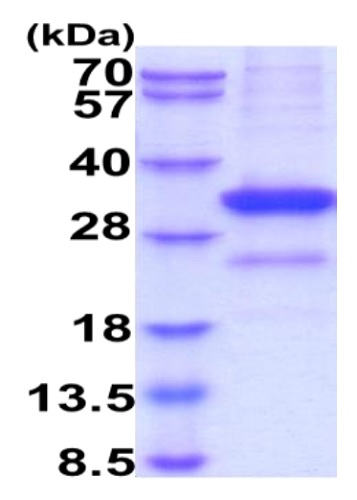
SDS-PAGE - Recombinant Human Factor H protein (GST tag N-Terminus) (AB131757)
12.5% SDS-PAGE stained with Coomassie Blue showing ab131757.
搭配使用产品
Reagents, Controls & Accessories
AB313995
Prestained Protein Ladder - Mid-range molecular weight (15 - 170 kDa)

- 0
- 0
Primary Antibodies
AB315879
Anti-Factor H antibody [EPR26491-30]
20ul selling size|BOND RX™ Validated|RabMAb|Recombinant

- 0
- 0


Proteins & Peptides
AB229367
Recombinant Human Mannan Binding Lectin/MBL protein (His tag C-Terminus)
- 0
- 0
反应性数据
序列信息
性能和储存信息
形式
纯化工艺
运输条件
推荐的短期储存条件
推荐的长期储存条件
分装信息
储存信息
补充信息
This supplementary information is collated from multiple sources and compiled automatically.
Biological function summary
Factor H limits the activity of the complement system to prevent damage to host tissues. The protein exists in the plasma in a soluble form. It functions by recognizing host cell surfaces via specific markers avoiding inappropriate activation. Factor H belongs to a group of proteins which include other regulators of complement activation. These proteins maintain the balance between effective immune defense and protection of host tissue from excessive immune responses.
Pathways
Factor H is a part of the alternative complement pathway. This pathway is important for innate immune response involving proteins like factor P (properdin) which stabilizes C3 convertase. Factor H modulates these interactions to prevent unwarranted complement activity on host cells. Another related pathway is the classic complement pathway although factor H's involvement here is less direct since it primarily regulates the alternative pathway.
常规信息
功能
Glycoprotein that plays an essential role in maintaining a well-balanced immune response by modulating complement activation. Acts as a soluble inhibitor of complement, where its binding to self markers such as glycan structures prevents complement activation and amplification on cell surfaces (PubMed : 21285368, PubMed : 21317894, PubMed : 25402769). Accelerates the decay of the complement alternative pathway (AP) C3 convertase C3bBb, thus preventing local formation of more C3b, the central player of the complement amplification loop (PubMed : 19503104, PubMed : 21317894, PubMed : 26700768). As a cofactor of the serine protease factor I, CFH also regulates proteolytic degradation of already-deposited C3b (PubMed : 18252712, PubMed : 23332154, PubMed : 28671664). In addition, mediates several cellular responses through interaction with specific receptors. For example, interacts with CR3/ITGAM receptor and thereby mediates the adhesion of human neutrophils to different pathogens. In turn, these pathogens are phagocytosed and destroyed (PubMed : 20008295, PubMed : 9558116).. (Microbial infection) In the mosquito midgut, binds to the surface of parasite P.falciparum gametocytes and protects the parasite from alternative complement pathway-mediated elimination.
翻译后修饰
Sulfated on tyrosine residues.. According to a report, Asn-217 is not glycosylated (PubMed:17591618). Another study observed glycosylation at this position (PubMed:19139490).
靶点信息
Abcam Product Promise
Please note: All products are 'FOR RESEARCH USE ONLY. NOT FOR USE IN DIAGNOSTIC OR THERAPEUTIC PROCEDURES'.
For licensing inquiries, please contact partnerships@abcam.com