重组人 ECM 蛋白 (GST tag N-Terminus)
Recombinant Human ECM protein (GST tag N-Terminus)
Be the first to review this product! Submit a review
|
(0 Publication)
Recombinant Human ECM protein (GST tag N-Terminus) is a Human Fragment protein, in the 291 to 390 aa range, expressed in Wheat germ, suitable for ELISA, WB.
查看别名
ECM, EMILIN4, GPIA*, MMRN, MMRN1, Multimerin-1, EMILIN-4, Elastin microfibril interface located protein 4, Endothelial cell multimerin, Elastin microfibril interfacer 4

- SDS-PAGE
Unknown
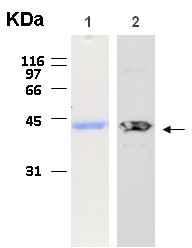
SDS-PAGE - Recombinant Human ECM protein (GST tag N-Terminus) (AB161476)
ab161476 on a 12.5% SDS-PAGE stained with Coomassie Blue.
搭配使用产品

Primary Antibodies
AB138492
Anti-Collagen I antibody [EPR7785]
20ul selling size|BOND RX™ Validated|KO Validated|RabMAb|Recombinant|Lab Essentials

- 4
- 37
反应性数据
序列信息
性能和储存信息
形式
纯化工艺
运输条件
推荐的短期储存条件
推荐的长期储存条件
分装信息
储存信息
补充信息
This supplementary information is collated from multiple sources and compiled automatically.
Biological function summary
The extracellular matrix coordinates cellular functions by mediating mechanical and biochemical signals influencing cellular processes such as adhesion differentiation and migration. The ECM is an essential component of the matrix receptor complex interacting dynamically with cell-surface receptors like integrins. These interactions are important to tissue remodeling and repair allowing tissues to maintain homeostasis and respond to external stresses.
Pathways
The extracellular matrix participates in significant biological pathways like the integrin signaling pathway and the Wnt signaling pathway. These pathways link ECM to various cellular responses affecting processes such as cell migration proliferation and survival. Integrin proteins for example bind to ECM proteins transmitting signals that can regulate gene expression and determine cell fate. Disruption in these pathways has implications for developmental processes and disease states.
常规信息
功能
Carrier protein for platelet (but not plasma) factor V/Va. Plays a role in the storage and stabilization of factor V in platelets. Upon release following platelet activation, may limit platelet and plasma factor Va-dependent thrombin generation. Ligand for integrin alpha-IIb/beta-3 and integrin alpha-V/beta-3 on activated platelets, and may function as an extracellular matrix or adhesive protein.
翻译后修饰
The N-terminus is blocked.. Extensively N-glycosylated.. O-fucosylated within the EMI domain (at Thr-216 and Thr-265) by POFUT3 and POFUT4 (PubMed:39775168). O-fucosylation at Thr-216 and Thr-1055 are required for facilitating protein folding and secretion (PubMed:38237698, PubMed:39775168).
靶点信息
Abcam Product Promise
Please note: All products are 'FOR RESEARCH USE ONLY. NOT FOR USE IN DIAGNOSTIC OR THERAPEUTIC PROCEDURES'.
For licensing inquiries, please contact partnerships@abcam.com