JavaScript is disabled in your browser. Please enable JavaScript to view this website.
AB158331

重组人 EBV Induced Gene 2/EBI2 蛋白 (GST tag N-Terminus)

Recombinant Human EBV Induced Gene 2/EBI2 protein (GST tag N-Terminus)

Be the first to review this product! Submit a review

|

(0 Publication)

Recombinant Human EBV Induced Gene 2/EBI2 protein (GST tag N-Terminus) is a Human Full Length protein, in the 1 to 361 aa range, expressed in Wheat germ, suitable for ELISA, WB.

查看别名

EBI2, GPR183, G-protein coupled receptor 183, Epstein-Barr virus-induced G-protein coupled receptor 2, EBV-induced G-protein coupled receptor 2, hEBI2
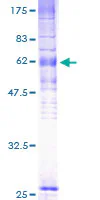
1 Images
SDS-PAGE - Recombinant Human EBV Induced Gene 2/EBI2 protein (GST tag N-Terminus) (AB158331)
  • SDS-PAGE

Unknown

SDS-PAGE - Recombinant Human EBV Induced Gene 2/EBI2 protein (GST tag N-Terminus) (AB158331)

ab158331 on a 12.5% SDS-PAGE stained with Coomassie Blue.

关键信息

表达系统

Wheat germ

标签

GST tag N-Terminus

应用

ELISA, WB

applications

生物活性

No

访问

P32249

不含动物源

No

不含载体蛋白

No

种属

Human

存储溶液

pH: 8 Constituents: 0.79% Tris HCl, 0.31% Glutathione

storage-buffer

反应性数据

{ "title": "Reactivity Data", "filters": { "stats": ["", "Reactivity", "Dilution Info", "Notes"] }, "values": { "ELISA": { "reactivity":"TESTED_AND_REACTS", "dilution-info":"", "notes":"<p></p>" }, "WB": { "reactivity":"TESTED_AND_REACTS", "dilution-info":"", "notes":"<p></p>" } } }

序列信息

[{"linker":null,"sequence":"MDIQMANNFTPPSATPQGNDCDLYAHHSTARIVMPLHYSLVFIIGLVGNLLALVVIVQNRKKINSTTLYSTNLVISDILFTTALPTRIAYYAMGFDWRIGDALCRITALVFYINTYAGVNFMTCLSIDRFIAVVHPLRYNKIKRIEHAKGVCIFVWILVFAQTLPLLINPMSKQEAERITCMEYPNFEETKSLPWILLGACFIGYVLPLIIILICYSQICCKLFRTAKQNPLTEKSGVNKKALNTIILIIVVFVLCFTPYHVAIIQHMIKKLRFSNFLECSQRHSFQISLHFTVCLMNFNCCMDPFIYFFACKGYKRKVMRMLKRQVSVSISSAVKSAPEENSREMTETQMMIHSKSSNGK","proteinLength":"Full Length","predictedMolecularWeight":null,"actualMolecularWeight":null,"aminoAcidEnd":361,"aminoAcidStart":1,"nature":"Recombinant","expressionSystem":"Wheat germ","accessionNumber":"P32249","tags":[{"tag":"GST","terminus":"N-Terminus"}]}]

性能和储存信息

形式
Liquid
纯化工艺
Proprietary technique
运输条件
Dry Ice
推荐的短期储存条件
-80°C
推荐的长期储存条件
-80°C
分装信息
Upon delivery aliquot
储存信息
Avoid freeze / thaw cycle
False

补充信息

This supplementary information is collated from multiple sources and compiled automatically.

EBV Induced Gene 2 (EBI2) also known as GPR183 is a G protein-coupled receptor with a mass of approximately 41 kDa. It is prominently expressed in immune cells such as B cells and T cells. EBI2 is activated by oxysterols which are oxidized derivatives of cholesterol and triggers a signaling cascade that influences cell positioning and migration. The receptor plays an important role in guiding B cell migration during immune responses especially within lymphoid tissues.
Biological function summary

EBI2 supports the positioning of immune cells within secondary lymphoid organs by detecting specific chemokine gradients. It does not form part of larger complexes but instead functions independently to interpret chemotactic signals. EBI2 is important during B cell maturation orchestrating the cellular movement that is essential for executing adaptive immune responses effectively.

Pathways

EBI2 integrates into the oxysterol signaling pathway which directly impacts immune cell dynamics. Through its effects on B cell migration its function connects to the chemokine signaling pathway. EBI2 interacts with proteins like CXCR5 enabling the directed movement of B cells towards follicular dendritic cells playing a role in ensuring effective humoral immunity.

Irregular EBI2 expression correlates with autoimmune conditions such as rheumatoid arthritis and lupus. Aberrant signaling through EBI2 can contribute to improper immune cell localization which is a characteristic of these disorders. The receptor's interplay with CXCR5 is particularly significant in the context of rheumatoid arthritis as both are implicated in the dysregulation of immune cell homing leading to inflammation.

常规信息

功能

G-protein coupled receptor expressed in lymphocytes that acts as a chemotactic receptor for B-cells, T-cells, splenic dendritic cells, monocytes/macrophages and astrocytes (By similarity). Receptor for oxysterol 7-alpha,25-dihydroxycholesterol (7-alpha,25-OHC) and other related oxysterols (PubMed : 21796212, PubMed : 22875855, PubMed : 22930711). Mediates cell positioning and movement of a number of cells by binding the 7-alpha,25-OHC ligand that forms a chemotactic gradient (By similarity). Binding of 7-alpha,25-OHC mediates the correct localization of B-cells during humoral immune responses (By similarity). Guides B-cell movement along the B-cell zone-T-cell zone boundary and later to interfollicular and outer follicular regions (By similarity). Its specific expression during B-cell maturation helps position B-cells appropriately for mounting T-dependent antibody responses (By similarity). Collaborates with CXCR5 to mediate B-cell migration; probably by forming a heterodimer with CXCR5 that affects the interaction between of CXCL13 and CXCR5 (PubMed : 22913878). Also acts as a chemotactic receptor for some T-cells upon binding to 7-alpha,25-OHC ligand (By similarity). Promotes follicular helper T (Tfh) cells differentiation by positioning activated T-cells at the follicle-T-zone interface, promoting contact of newly activated CD4 T-cells with activated dendritic cells and exposing them to Tfh-cell-promoting inducible costimulator (ICOS) ligand (By similarity). Expression in splenic dendritic cells is required for their homeostasis, localization and ability to induce B- and T-cell responses : GPR183 acts as a chemotactic receptor in dendritic cells that mediates the accumulation of CD4(+) dendritic cells in bridging channels (By similarity). Regulates migration of astrocytes and is involved in communication between astrocytes and macrophages (PubMed : 25297897). Promotes osteoclast precursor migration to bone surfaces (By similarity). Signals constitutively through G(i)-alpha, but not G(s)-alpha or G(q)-alpha (PubMed : 21673108, PubMed : 25297897). Signals constitutively also via MAPK1/3 (ERK1/2) (By similarity).

序列相似性

Belongs to the G-protein coupled receptor 1 family.

产品实验方案

靶点信息

G-protein coupled receptor expressed in lymphocytes that acts as a chemotactic receptor for B-cells, T-cells, splenic dendritic cells, monocytes/macrophages and astrocytes (By similarity). Receptor for oxysterol 7-alpha,25-dihydroxycholesterol (7-alpha,25-OHC) and other related oxysterols (PubMed : 21796212, PubMed : 22875855, PubMed : 22930711). Mediates cell positioning and movement of a number of cells by binding the 7-alpha,25-OHC ligand that forms a chemotactic gradient (By similarity). Binding of 7-alpha,25-OHC mediates the correct localization of B-cells during humoral immune responses (By similarity). Guides B-cell movement along the B-cell zone-T-cell zone boundary and later to interfollicular and outer follicular regions (By similarity). Its specific expression during B-cell maturation helps position B-cells appropriately for mounting T-dependent antibody responses (By similarity). Collaborates with CXCR5 to mediate B-cell migration; probably by forming a heterodimer with CXCR5 that affects the interaction between of CXCL13 and CXCR5 (PubMed : 22913878). Also acts as a chemotactic receptor for some T-cells upon binding to 7-alpha,25-OHC ligand (By similarity). Promotes follicular helper T (Tfh) cells differentiation by positioning activated T-cells at the follicle-T-zone interface, promoting contact of newly activated CD4 T-cells with activated dendritic cells and exposing them to Tfh-cell-promoting inducible costimulator (ICOS) ligand (By similarity). Expression in splenic dendritic cells is required for their homeostasis, localization and ability to induce B- and T-cell responses : GPR183 acts as a chemotactic receptor in dendritic cells that mediates the accumulation of CD4(+) dendritic cells in bridging channels (By similarity). Regulates migration of astrocytes and is involved in communication between astrocytes and macrophages (PubMed : 25297897). Promotes osteoclast precursor migration to bone surfaces (By similarity). Signals constitutively through G(i)-alpha, but not G(s)-alpha or G(q)-alpha (PubMed : 21673108, PubMed : 25297897). Signals constitutively also via MAPK1/3 (ERK1/2) (By similarity).
See full target information GPR183

Abcam Product Promise

我们致力于为您的研究提供高质量的试剂,为您科研的每一步提供支持。若我们的产品未能达到预期性能,我们向您提供 Abcam Product Promise 保障。
详情请参阅我们的条款与条件。

Please note: All products are 'FOR RESEARCH USE ONLY. NOT FOR USE IN DIAGNOSTIC OR THERAPEUTIC PROCEDURES'.

For licensing inquiries, please contact partnerships@abcam.com