重组人 DDB1 蛋白 (GST tag N-Terminus)
Recombinant Human DDB1 protein (GST tag N-Terminus)
Be the first to review this product! Submit a review
|
(2 Publications)
Recombinant Human DDB1 protein (GST tag N-Terminus) is a Human Full Length protein, in the 1 to 1140 aa range, expressed in Wheat germ, suitable for SDS-PAGE, ELISA, WB.
查看别名
XAP1, DDB1, DNA damage-binding protein 1, DDB p127 subunit, DNA damage-binding protein a, Damage-specific DNA-binding protein 1, HBV X-associated protein 1, UV-damaged DNA-binding factor, UV-damaged DNA-binding protein 1, XPE-binding factor, Xeroderma pigmentosum group E-complementing protein, DDBa, XAP-1, UV-DDB 1, XPE-BF, XPCe
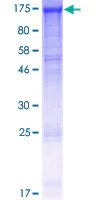
- SDS-PAGE
Unknown
SDS-PAGE - Recombinant Human DDB1 protein (GST tag N-Terminus) (AB114333)
ab114333 analysed on a 12.5% SDS-PAGE gel stained with Coomassie Blue.
搭配使用产品
Proteins & Peptides
AB271497
Recombinant human Elongin-B + Elongin C + VHL protein (DDDDK tag N-Terminus, His tag N-Terminus)
- 0
- 0
反应性数据
序列信息
性能和储存信息
形式
纯化工艺
运输条件
推荐的短期储存条件
推荐的长期储存条件
分装信息
储存信息
补充信息
This supplementary information is collated from multiple sources and compiled automatically.
Biological function summary
In terms of cellular processes beyond DDB1's immediate interactions it plays a critical role in DNA repair mechanisms and the cell cycle. DDB1 is part of the larger CUL4-DDB1 ubiquitin ligase complex which targets specific proteins for ubiquitination and subsequent degradation therefore facilitating DNA repair and regulating cell cycle progression. This ability to target damaged proteins or signaling errors for removal helps maintain cellular health and preserve genetic information integrity.
Pathways
DDB1 is pivotal in the nucleotide excision repair pathway and the DNA damage response pathway. It interacts dynamically with proteins such as XPC (xeroderma pigmentosum group C) to initiate repair mechanisms ensuring the proper removal of damaged DNA sections. Moreover DDB1's role in ubiquitination connects it to pathways regulating protein turnover and cellular homeostasis interacting with the ubiquitin-proteasome system which is important for controlling protein degradation.
常规信息
功能
Protein, which is both involved in DNA repair and protein ubiquitination, as part of the UV-DDB complex and DCX (DDB1-CUL4-X-box) complexes, respectively (PubMed : 14739464, PubMed : 15448697, PubMed : 16260596, PubMed : 16407242, PubMed : 16407252, PubMed : 16482215, PubMed : 16940174, PubMed : 17079684). Core component of the UV-DDB complex (UV-damaged DNA-binding protein complex), a complex that recognizes UV-induced DNA damage and recruit proteins of the nucleotide excision repair pathway (the NER pathway) to initiate DNA repair (PubMed : 15448697, PubMed : 16260596, PubMed : 16407242, PubMed : 16940174). The UV-DDB complex preferentially binds to cyclobutane pyrimidine dimers (CPD), 6-4 photoproducts (6-4 PP), apurinic sites and short mismatches (PubMed : 15448697, PubMed : 16260596, PubMed : 16407242, PubMed : 16940174). Also functions as a component of numerous distinct DCX (DDB1-CUL4-X-box) E3 ubiquitin-protein ligase complexes which mediate the ubiquitination and subsequent proteasomal degradation of target proteins (PubMed : 14739464, PubMed : 16407252, PubMed : 16482215, PubMed : 17079684, PubMed : 18332868, PubMed : 18381890, PubMed : 19966799, PubMed : 22118460, PubMed : 25043012, PubMed : 25108355, PubMed : 28886238). The functional specificity of the DCX E3 ubiquitin-protein ligase complex is determined by the variable substrate recognition component recruited by DDB1 (PubMed : 14739464, PubMed : 16407252, PubMed : 16482215, PubMed : 17079684, PubMed : 18332868, PubMed : 18381890, PubMed : 19966799, PubMed : 22118460, PubMed : 25043012, PubMed : 25108355). DCX(DDB2) (also known as DDB1-CUL4-ROC1, CUL4-DDB-ROC1 and CUL4-DDB-RBX1) may ubiquitinate histone H2A, histone H3 and histone H4 at sites of UV-induced DNA damage (PubMed : 16473935, PubMed : 16678110, PubMed : 17041588, PubMed : 18593899). The ubiquitination of histones may facilitate their removal from the nucleosome and promote subsequent DNA repair (PubMed : 16473935, PubMed : 16678110, PubMed : 17041588, PubMed : 18593899). DCX(DDB2) also ubiquitinates XPC, which may enhance DNA-binding by XPC and promote NER (PubMed : 15882621). DCX(DTL) plays a role in PCNA-dependent polyubiquitination of CDT1 and MDM2-dependent ubiquitination of TP53 in response to radiation-induced DNA damage and during DNA replication (PubMed : 17041588). DCX(ERCC8) (the CSA complex) plays a role in transcription-coupled repair (TCR) (PubMed : 12732143). The DDB1-CUL4A-DTL E3 ligase complex regulates the circadian clock function by mediating the ubiquitination and degradation of CRY1 (PubMed : 26431207). DDB1-mediated CRY1 degradation promotes FOXO1 protein stability and FOXO1-mediated gluconeogenesis in the liver (By similarity). By acting on TET dioxygenses, essential for oocyte maintenance at the primordial follicle stage, hence essential for female fertility (By similarity). Maternal factor required for proper zygotic genome activation and genome reprogramming (By similarity).
序列相似性
Belongs to the DDB1 family.
翻译后修饰
Phosphorylated by ABL1.. Ubiquitinated by CUL4A. Subsequently degraded by ubiquitin-dependent proteolysis.. Acetylated, promoting interaction with CUL4 (CUL4A or CUL4B) and subsequent formation of DCX (DDB1-CUL4-X-box) E3 ubiquitin-protein ligase complexes (PubMed:28886238). Deacetylation by SIRT7 impairs the interaction with CUL4 (CUL4A or CUL4B) and formation of DCX (DDB1-CUL4-X-box) E3 ubiquitin-protein ligase complexes (PubMed:28886238).
靶点信息
文献 (2)
Recent publications for all applications. Explore the full list and refine your search
Acta pharmaceutica Sinica. B 14:4001-4013 PubMed39309493
2024
Applications
Unspecified application
Species
Unspecified reactive species
Cell reports 29:3620-3635.e7 PubMed31825840
2019
Applications
Unspecified application
Species
Unspecified reactive species
Abcam Product Promise
Please note: All products are 'FOR RESEARCH USE ONLY. NOT FOR USE IN DIAGNOSTIC OR THERAPEUTIC PROCEDURES'.
For licensing inquiries, please contact partnerships@abcam.com