JavaScript is disabled in your browser. Please enable JavaScript to view this website.
AB283902

重组人CXCL9蛋白(Active)

Recombinant Human CXCL9 Protein (Active)

Be the first to review this product! Submit a review

|

(0 Publication)

Recombinant Human CXCL9 Protein (Active) is a Human Full Length protein, in the 23 to 125 aa range, expressed in HEK 293 cells, <0.005 EU/µg endotoxin level, suitable for HPLC, SDS-PAGE, Mass Spec, FuncS.

查看别名

CMK, MIG, SCYB9, CXCL9, C-X-C motif chemokine 9, Gamma-interferon-induced monokine, Monokine induced by interferon-gamma, Small-inducible cytokine B9, HuMIG
3 Images
Mass Spectrometry - Recombinant Human CXCL9 Protein (Active) (AB283902)
  • Mass Spec

Supplier Data

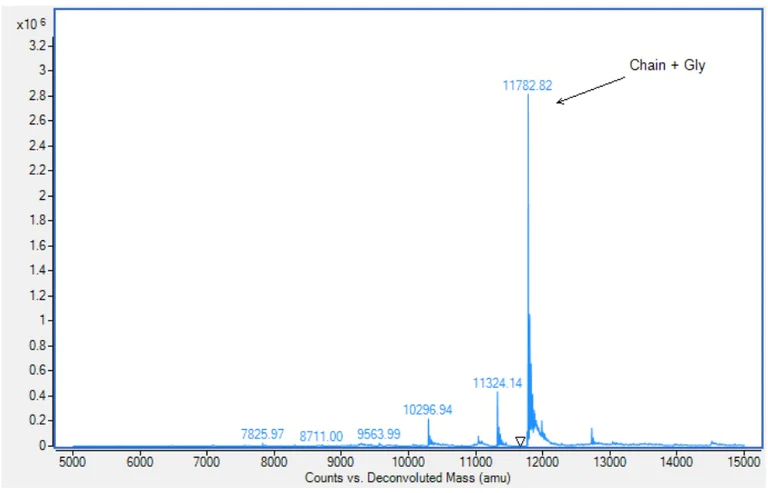
Mass Spectrometry - Recombinant Human CXCL9 Protein (Active) (AB283902)

Mass determination by ESI-TOF. Predicted MW is 11781.9 (+/- 10Da by ESI-TOF). Observed MW is 11782.82 Da.
Biochemical assay - Recombinant Human CXCL9 Protein (Active) (AB283902)
  • Biochemical assay

Supplier Data

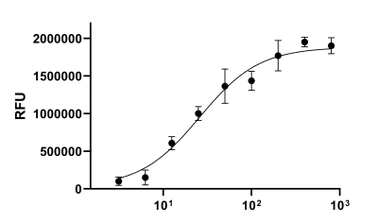
Biochemical assay - Recombinant Human CXCL9 Protein (Active) (AB283902)

Fully biologically active determined by dose dependent cell migration of human KHYG-1 cells. ED50 for this effect is ≤ 25.9 ng/ml corresponding to specific activity of 3.86 X 10⁴ units/mg.
HPLC - Recombinant Human CXCL9 Protein (Active) (AB283902)
  • HPLC

Supplier Data

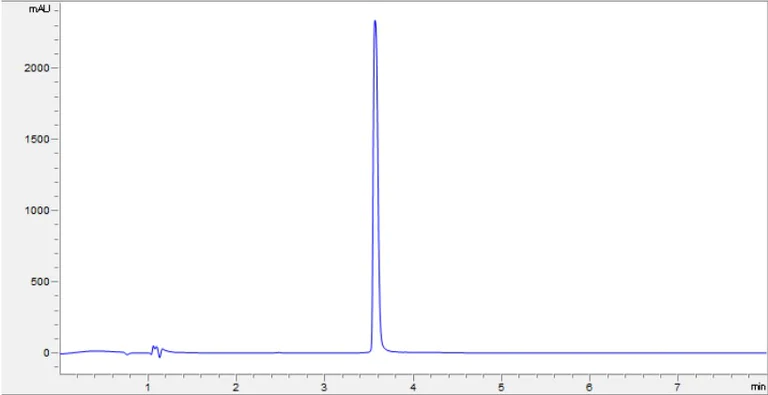
HPLC - Recombinant Human CXCL9 Protein (Active) (AB283902)

HPLC analysis of ab283902.

关键信息

纯度

undefined HPLC

内毒素水平

<0.005 EU/µg

表达系统

HEK 293 cells

标签

Tag free

应用

HPLC, FuncS, SDS-PAGE, Mass Spec

applications

生物活性

Yes

生物学活性

Fully biologically active determined by dose dependent cell migration of human KHYG-1 cells. ED50 is ≤ 25.9 ng/ml, corresponding to a specific activity of 3.86 X 10⁴units/mg.

访问

Q07325

不含动物源

Yes

不含载体蛋白

No

种属

Human

复溶

Reconstitute in PBS

存储溶液

pH: 7.4 Constituents: 10.26% Trehalose, 0.727% Dibasic monohydrogen potassium phosphate, 0.248% Potassium phosphate monobasic

storage-buffer

反应性数据

{ "title": "Reactivity Data", "filters": { "stats": ["", "Reactivity", "Dilution Info", "Notes"] }, "values": { "HPLC": { "reactivity":"TESTED_AND_REACTS", "dilution-info":"", "notes":"<p></p>" }, "SDS-PAGE": { "reactivity":"TESTED_AND_REACTS", "dilution-info":"", "notes":"<p></p>" }, "Mass Spec": { "reactivity":"TESTED_AND_REACTS", "dilution-info":"", "notes":"<p></p>" }, "FuncS": { "reactivity":"TESTED_AND_REACTS", "dilution-info":"", "notes":"<p></p>" "reactivity":"TESTED_AND_REACTS", "dilution-info":"", "notes":"<p></p>" } } }

序列信息

[{"linker":null,"sequence":"TPVVRKGRCSCISTNQGTIHLQSLKDLKQFAPSPSCEKIEIIATLKNGVQTCLNPDSADVKELIKKWEKQVSQKKKQKNGKKHQKKKVLKVRKSQRSRQKKTT","proteinLength":"Full Length","predictedMolecularWeight":"11.78 kDa","actualMolecularWeight":"11.78 kDa","aminoAcidEnd":125,"aminoAcidStart":23,"nature":"Recombinant","expressionSystem":null,"accessionNumber":"Q07325","tags":[]}]

性能和储存信息

形式
Lyophilized
运输条件
Ambient - Can Ship with Ice
推荐的短期储存条件
Ambient
推荐的长期储存条件
Ambient
True

补充信息

This supplementary information is collated from multiple sources and compiled automatically.

CXCL9 also known as MIG (monokine induced by gamma interferon) is a small cytokine protein with a molecular weight of approximately 13 kDa. CXCL9 exhibits strong chemotactic properties and is secreted by various cells including endothelial cells macrophages and fibroblasts upon stimulation by interferon-gamma. Its expression primarily occurs in inflamed tissues and is associated with immune responses. Researchers often use tools like a CXCL9 ELISA kit or CXCL9 test to measure its expression levels in biological samples aiding in understanding its role in various conditions.
Biological function summary

This cytokine plays a pivotal role in the immune system by regulating leukocyte trafficking. CXCL9 exerts its function through binding to the CXCR3 receptor attracting T cells towards sites of inflammation or infection. This interaction is significant in mediating immune surveillance and host defense. CXCL9 does not form part of a larger protein complex but its chemokine activity is critical for immune system coordination. Scientific studies often highlight its involvement through CXCL9 function and expression analysis.

Pathways

CXCL9 significantly influences the chemokine signaling pathway and the Th1-type adaptive immune response. Within these pathways it interacts closely with other chemokines like CXCL10 and CXCL11 which also bind to the CXCR3 receptor. These pathways highlight the coordinated mobilization of T cells during immune challenges and inflammation emphasizing how CXCL9 is often examined alongside these related chemokines in research settings.

CXCL9 is notably associated with autoimmune diseases such as rheumatoid arthritis and inflammatory conditions like psoriasis. Its elevated expression is often observed in affected tissues contributing to disease pathogenesis through T cell migration and activation. In these contexts CXCL9 is frequently examined alongside other pro-inflammatory cytokines such as interferon-gamma and TNF-alpha which are known to modulate its expression and activity impacting disease progression and therapeutic strategies.

常规信息

功能

Cytokine that affects the growth, movement, or activation state of cells that participate in immune and inflammatory response. Chemotactic for activated T-cells. Binds to CXCR3.

序列相似性

Belongs to the intercrine alpha (chemokine CxC) family.

产品实验方案

靶点信息

Cytokine that affects the growth, movement, or activation state of cells that participate in immune and inflammatory response. Chemotactic for activated T-cells. Binds to CXCR3.
See full target information CXCL9

Abcam Product Promise

我们致力于为您的研究提供高质量的试剂,为您科研的每一步提供支持。若我们的产品未能达到预期性能,我们向您提供 Abcam Product Promise 保障。
详情请参阅我们的条款与条件。

Please note: All products are 'FOR RESEARCH USE ONLY. NOT FOR USE IN DIAGNOSTIC OR THERAPEUTIC PROCEDURES'.

For licensing inquiries, please contact partnerships@abcam.com