重组人 CD16a (mutated F176V) 蛋白 (Avi tag C-Terminus + His tag C-Terminus)
Recombinant Human CD16a (mutated F176V) protein (Avi tag C-Terminus + His tag C-Terminus)
Be the first to review this product! Submit a review
|
(0 Publication)
Recombinant Human CD16a (mutated F176V) protein (Avi tag C-Terminus + His tag C-Terminus) is a Human Fragment protein, in the 17 to 208 aa range, expressed in HEK 293 cells, with >90%, suitable for SDS-PAGE.
查看别名
CD16a, CD16A, FCG3, FCGR3, IGFR3, FCGR3A, Low affinity immunoglobulin gamma Fc region receptor III-A, IgG Fc receptor III-A, CD16-II, CD16a antigen, Fc-gamma RIII-alpha, FcR-10, IgG Fc receptor III-2, Fc-gamma RIII, Fc-gamma RIIIa, FcRIII, FcRIIIa, FcgammaRIIIA
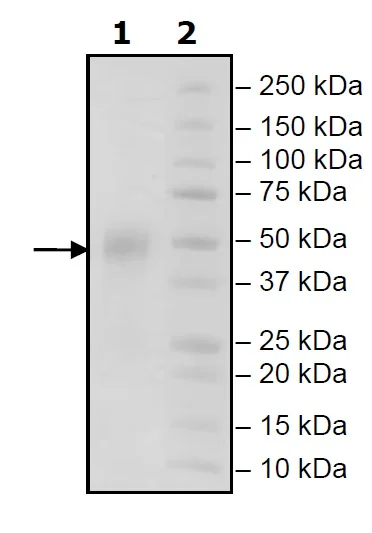
- SDS-PAGE
Supplier Data
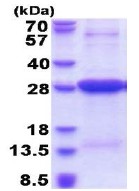
SDS-PAGE - Recombinant Human CD16a (mutated F176V) protein (Avi tag C-Terminus + His tag C-Terminus) (AB271801)
SDS-PAGE analysis of 4 μg ab271801.
搭配使用产品
Reagents, Controls & Accessories
AB116029
Prestained Protein Ladder - Extra broad molecular weight (5 - 245 kDa)

- 5
- 1
反应性数据
序列信息
性能和储存信息
形式
运输条件
推荐的短期储存条件
推荐的长期储存条件
储存信息
补充信息
This supplementary information is collated from multiple sources and compiled automatically.
Biological function summary
CD16a is important for immune responses and occurs as part of a receptor complex. It signals downstream effects through its association with the CD3 zeta chain and the Fc epsilon receptor gamma chain which possess immunoreceptor tyrosine-based activation motifs (ITAMs). Upon binding to IgG CD16a triggers a cascade of events leading to the release of cytokines and cytotoxic granules. This action helps in eliminating infected or cancerous cells demonstrating its role in both innate and adaptive immunity.
Pathways
CD16a contributes significantly to the immunological synapse formation and NK cell activation pathway. This receptor cooperates with other proteins such as CD3 and CD19 to modulate the immune response. It also participates in signaling pathways like the PI3K-Akt pathway which regulates cell survival and proliferation. CD16a's interaction with these pathways highlights its importance in immune cell communication and function.
常规信息
功能
Receptor for the invariable Fc fragment of immunoglobulin gamma (IgG). Optimally activated upon binding of clustered antigen-IgG complexes displayed on cell surfaces, triggers lysis of antibody-coated cells, a process known as antibody-dependent cellular cytotoxicity (ADCC). Does not bind free monomeric IgG, thus avoiding inappropriate effector cell activation in the absence of antigenic trigger (PubMed : 11711607, PubMed : 21768335, PubMed : 22023369, PubMed : 24412922, PubMed : 25786175, PubMed : 25816339, PubMed : 28652325, PubMed : 8609432, PubMed : 9242542). Mediates IgG effector functions on natural killer (NK) cells. Binds antigen-IgG complexes generated upon infection and triggers NK cell-dependent cytokine production and degranulation to limit viral load and propagation. Involved in the generation of memory-like adaptive NK cells capable to produce high amounts of IFNG and to efficiently eliminate virus-infected cells via ADCC (PubMed : 24412922, PubMed : 25786175). Regulates NK cell survival and proliferation, in particular by preventing NK cell progenitor apoptosis (PubMed : 29967280, PubMed : 9916693). Following the engagement of antigen-IgG complexes, triggers phosphorylation of immunoreceptor tyrosine-based activation motif (ITAM)-containing adapters with subsequent activation of phosphatidylinositol 3-kinase signaling and sustained elevation of intracellular calcium that ultimately drive NK cell activation. The ITAM-dependent signaling coupled to receptor phosphorylation by PKC mediates robust intracellular calcium flux that leads to production of pro-inflammatory cytokines, whereas in the absence of receptor phosphorylation it mainly activates phosphatidylinositol 3-kinase signaling leading to cell degranulation (PubMed : 1825220, PubMed : 23024279, PubMed : 2532305). Costimulates NK cells and trigger lysis of target cells independently of IgG binding (PubMed : 10318937, PubMed : 23006327). Mediates the antitumor activities of therapeutic antibodies. Upon ligation on monocytes triggers TNFA-dependent ADCC of IgG-coated tumor cells (PubMed : 27670158). Mediates enhanced opsonisation and ADCC in response to afucosylated IgGs (PubMed : 34485821, PubMed : 28566370).. (Microbial infection) Involved in Dengue virus pathogenesis via antibody-dependent enhancement (ADE) mechanism. Secondary infection with Dengue virus triggers elevated levels of afucosylated non-neutralizing IgG1s with reactivity to viral envelope/E protein. Viral antigen-IgG1 complexes bind with high affinity to FCGR3A, facilitating virus entry in myeloid cells and subsequent viral replication.
翻译后修饰
Glycosylated. Contains high mannose- and complex-type oligosaccharides. Glycosylation at Asn-180 is mandatory for high affinity binding to the Fc and for discrimination between fucosylated and afucosylated IgG glycoforms.. Undergoes rapid ectodomain shedding upon NK cell stimulation. The soluble form is produced by a proteolytic cleavage mediated by ADAM17. Repeated stimulation causes receptor shedding, a mechanism that allows for increased NK cell motility and detachment from opsonized target cells while avoiding activation-induced NK cell apoptosis.. Phosphorylated at RSSTR motif by PKC. The relevant physiological PKCs might be PRKCI, PRKCG, PRKCE, PRKCH and PRKCQ.
靶点信息
Abcam Product Promise
Please note: All products are 'FOR RESEARCH USE ONLY. NOT FOR USE IN DIAGNOSTIC OR THERAPEUTIC PROCEDURES'.
For licensing inquiries, please contact partnerships@abcam.com