重组人 Bim 蛋白 (GST tag N-Terminus)
Recombinant Human Bim protein (GST tag N-Terminus)
Be the first to review this product! Submit a review
|
(1 Publication)
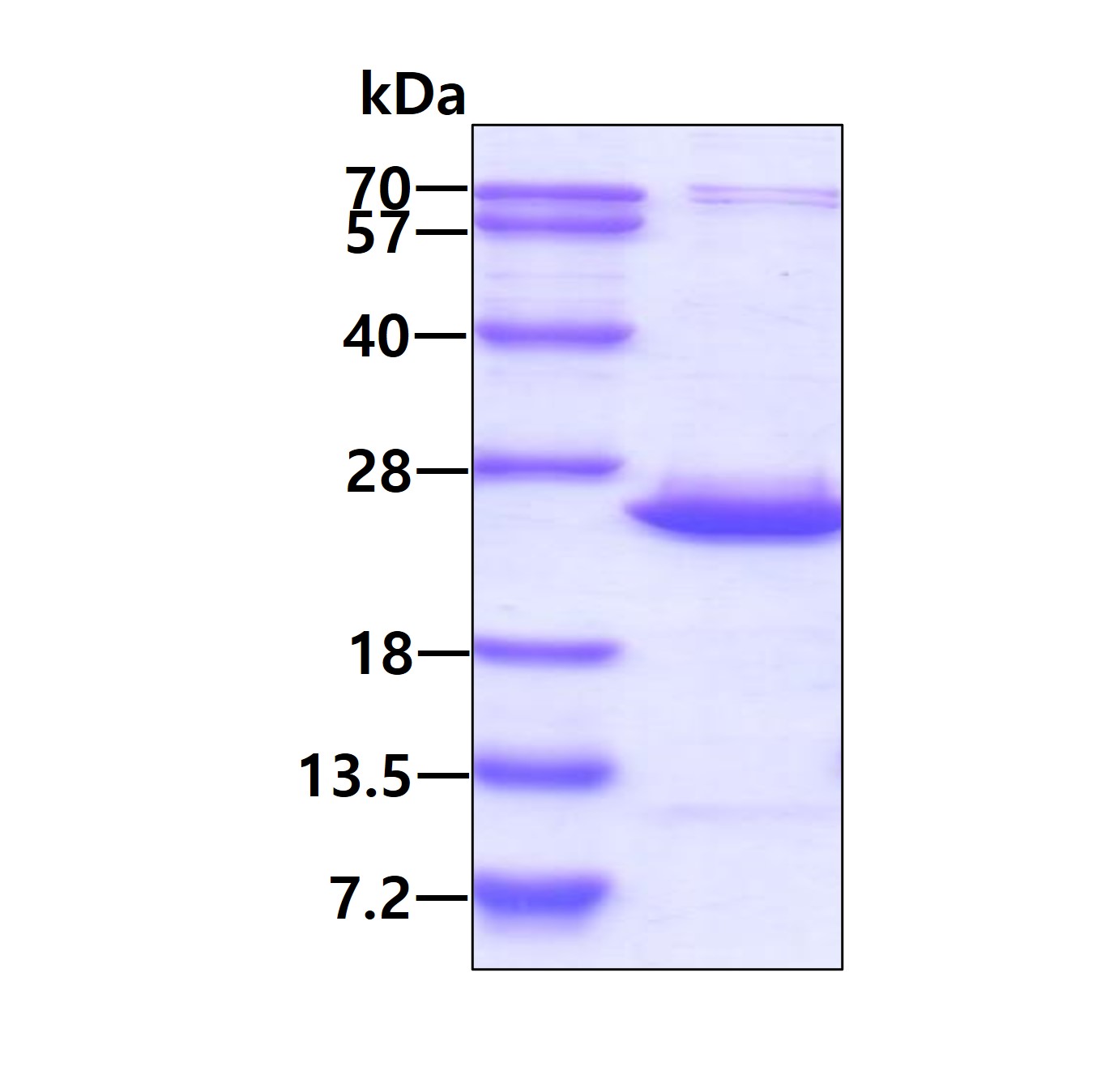
Recombinant Human Bim protein is a Human Full Length Bim protein, in the 1 to 112 aa range, expressed in Wheat germ and suitable for western blot, SDS-PAGE and ELISA. The predicted molecular weight of ab91136 protein is 38.8 kDa.
- Save time and ensure accurate results - use our BIM protein as a control
查看别名
BIM, BCL2L11, Bcl-2-like protein 11, Bcl2-L-11, Bcl2-interacting mediator of cell death

- SDS-PAGE
Unknown
SDS-PAGE - Recombinant Human Bim protein (GST tag N-Terminus) (AB112387)
12.5% SDS-PAGE analysis of ab112387. Stained with Coomassie Blue
搭配使用产品
Reagents, Controls & Accessories
AB234592
Prestained Protein Ladder - Extra broad molecular weight (6.5 - 270 kDa)

- 0
- 0



反应性数据
产品详情
Analyze your Bim/ Bcl-2-like protein 11 (BCL2L11) ELISA data using the ab112387 protein to generate and plot a standard curve.
Check out of western blot protocol for more information here
Check out our protein gel staining guide for SDS-PAGE here
Check out our ELISA protocol for more information here.
序列信息
性能和储存信息
形式
纯化工艺
运输条件
推荐的短期储存条件
推荐的长期储存条件
分装信息
储存信息
补充信息
This supplementary information is collated from multiple sources and compiled automatically.
Biological function summary
Bim regulates apoptosis by binding to pro-survival proteins like Bcl-2 and Bcl-xL releasing pro-apoptotic factors from mitochondria and activating caspases. Bim acts as part of the apoptosome complex and influences cell death regulation significantly. By promoting cytochrome c release from mitochondria Bim initiates a cascade of events leading to cell apoptosis. This regulation is vital in maintaining the balance between cell survival and death necessary for normal development and tissue homeostasis.
Pathways
Bim plays a critical role in the intrinsic apoptotic pathway. This pathway involves mitochondrial outer membrane permeabilization where Bim interacts with several Bcl-2 family proteins such as Bax and Bak to induce apoptosis. The modulation of Bim expression and activity is influenced by growth factor signaling pathways such as the PI3K-Akt pathway which affects Bim phosphorylation leading to its inactivation and subsequent degradation. Therefore Bim acts as an important node linking survival signals and apoptotic machinery.
常规信息
功能
Induces apoptosis and anoikis. Isoform BimL is more potent than isoform BimEL. Isoform Bim-alpha1, isoform Bim-alpha2 and isoform Bim-alpha3 induce apoptosis, although less potent than isoform BimEL, isoform BimL and isoform BimS. Isoform Bim-gamma induces apoptosis. Isoform Bim-alpha3 induces apoptosis possibly through a caspase-mediated pathway. Isoform BimAC and isoform BimABC lack the ability to induce apoptosis.
序列相似性
Belongs to the Bcl-2 family.
翻译后修饰
Phosphorylation at Ser-69 by MAPK1/MAPK3 leads to interaction with TRIM2 and polyubiquitination, followed by proteasomal degradation (PubMed:15486195, PubMed:21478148). Deubiquitination catalyzed by USP27X stabilizes the protein (By similarity).. Ubiquitination by TRIM2 following phosphorylation by MAPK1/MAPK3 leads to proteasomal degradation. Conversely, deubiquitination catalyzed by USP27X stabilizes the protein.
靶点信息
文献 (1)
Recent publications for all applications. Explore the full list and refine your search
The Canadian journal of cardiology 35:875-883 PubMed31292086
2019
Applications
Unspecified application
Species
Unspecified reactive species
Abcam Product Promise
Please note: All products are 'FOR RESEARCH USE ONLY. NOT FOR USE IN DIAGNOSTIC OR THERAPEUTIC PROCEDURES'.
For licensing inquiries, please contact partnerships@abcam.com