重组人BCL2蛋白
Recombinant Human BCL2 Protein
Be the first to review this product! Submit a review
|
(0 Publication)
Recombinant Human BCL2 Protein is a Human Fragment protein, in the 1 to 211 aa range, expressed in HEK 293 cells, with >95%, <0.005 EU/µg endotoxin level.
查看别名
Apoptosis regulator Bcl-2, BCL2

- Mass Spec
Supplier Data
Mass Spectrometry - Recombinant Human BCL2 Protein (AB290060)
Mass determination by ESI-TOF.
Predicted MW is 23364.35 Da. (+/- 10 Da by ESI-TOF). Observed MW is 23364.81 Da.

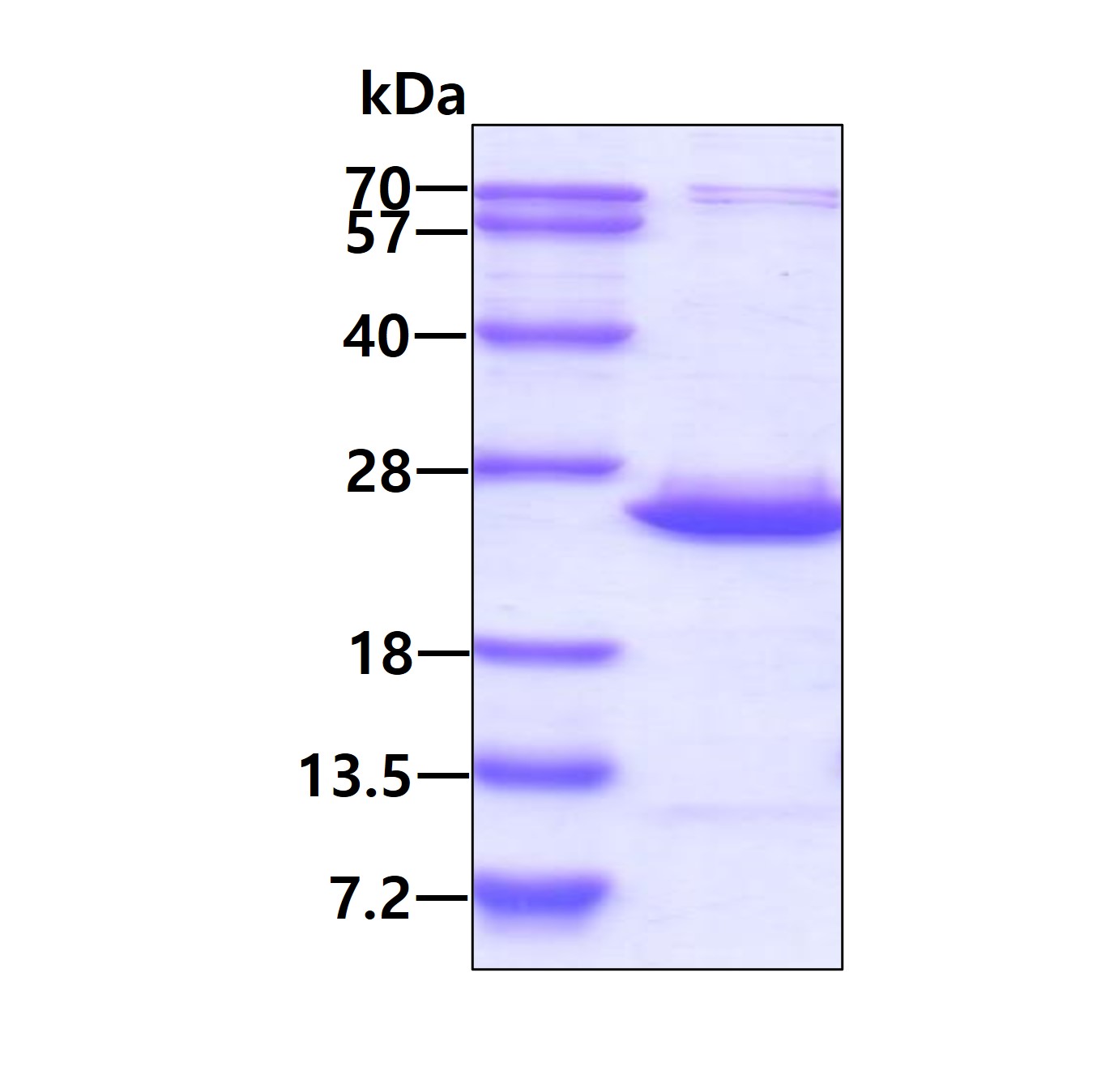
- SDS-PAGE
Supplier Data
SDS-PAGE - Recombinant Human BCL2 Protein (AB290060)
SDS-PAGE analysis of ab290060

- HPLC
Supplier Data
HPLC - Recombinant Human BCL2 Protein (AB290060)
HPLC analysis of ab290060
搭配使用产品
Reagents, Controls & Accessories
AB234617
Prestained Protein Ladder - Mid-range molecular weight (10 - 180 kDa)

- 0
- 0
序列信息
性能和储存信息
形式
运输条件
推荐的短期储存条件
推荐的长期储存条件
补充信息
This supplementary information is collated from multiple sources and compiled automatically.
Biological function summary
The role of Bcl-2 extends to maintaining cell survival and balancing apoptotic signals. It functions as an anti-apoptotic molecule within the cell primarily involved in forming complexes with pro-apoptotic members of the Bcl-2 family like Bax and Bak. These interactions prevent mitochondrial membrane permeabilization which is an important step in apoptotic signal transduction. As an important regulator of apoptosis Bcl-2 helps in cellular homeostasis and appropriate immune responses under physiological conditions.
Pathways
Bcl-2 plays a critical role in the intrinsic or mitochondrial pathway of apoptosis. Within this pathway Bcl-2 interacts with other proteins such as cytochrome c and APAF-1 to inhibit apoptosis. This pathway involves a network of Bcl-2 family proteins where Bcl-2's anti-apoptotic role counteracts the pro-apoptotic activity of proteins like Bax. These interactions help fine-tune the apoptotic response to various internal stimuli maintaining cellular integrity and function.
常规信息
功能
Suppresses apoptosis in a variety of cell systems including factor-dependent lymphohematopoietic and neural cells (PubMed : 1508712, PubMed : 8183370). Regulates cell death by controlling the mitochondrial membrane permeability (PubMed : 11368354). Appears to function in a feedback loop system with caspases (PubMed : 11368354). Inhibits caspase activity either by preventing the release of cytochrome c from the mitochondria and/or by binding to the apoptosis-activating factor (APAF-1) (PubMed : 11368354). Also acts as an inhibitor of autophagy : interacts with BECN1 and AMBRA1 during non-starvation conditions and inhibits their autophagy function (PubMed : 18570871, PubMed : 20889974, PubMed : 21358617). May attenuate inflammation by impairing NLRP1-inflammasome activation, hence CASP1 activation and IL1B release (PubMed : 17418785).
序列相似性
Belongs to the Bcl-2 family.
翻译后修饰
Phosphorylation/dephosphorylation on Ser-70 regulates anti-apoptotic activity (PubMed:11368354). Growth factor-stimulated phosphorylation on Ser-70 by PKC is required for the anti-apoptosis activity and occurs during the G2/M phase of the cell cycle (PubMed:11368354). In the absence of growth factors, BCL2 appears to be phosphorylated by other protein kinases such as ERKs and stress-activated kinases (PubMed:11368354). Phosphorylated by MAPK8/JNK1 at Thr-69, Ser-70 and Ser-87, which stimulates starvation-induced autophagy (PubMed:10567572, PubMed:18570871). Dephosphorylated by protein phosphatase 2A (PP2A) (By similarity).. Proteolytically cleaved by caspases during apoptosis. The cleaved protein, lacking the BH4 motif, has pro-apoptotic activity, causes the release of cytochrome c into the cytosol promoting further caspase activity.. Monoubiquitinated by PRKN, leading to an increase in its stability (PubMed:20889974). Ubiquitinated by SCF(FBXO10), leading to its degradation by the proteasome (PubMed:23431138). Ubiquitinated by XIAP, leading to its degradation by the proteasome (PubMed:29020630).
靶点信息
Abcam Product Promise
Please note: All products are 'FOR RESEARCH USE ONLY. NOT FOR USE IN DIAGNOSTIC OR THERAPEUTIC PROCEDURES'.
For licensing inquiries, please contact partnerships@abcam.com