JavaScript is disabled in your browser. Please enable JavaScript to view this website.
AB124594

重组 E. coli mdh 蛋白 (His tag N-Terminus)

Recombinant E. coli mdh protein (His tag N-Terminus)

Be the first to review this product! Submit a review

|

(1 Publication)

Recombinant E. coli mdh protein (His tag N-Terminus) is a Escherichia coli K-12 Full Length protein, in the 1 to 312 aa range, expressed in Escherichia coli, with >95%, suitable for SDS-PAGE, Mass Spec.

查看别名

b3236, JW3205, mdh, Malate dehydrogenase
1 Images
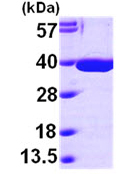
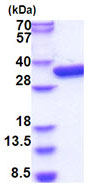
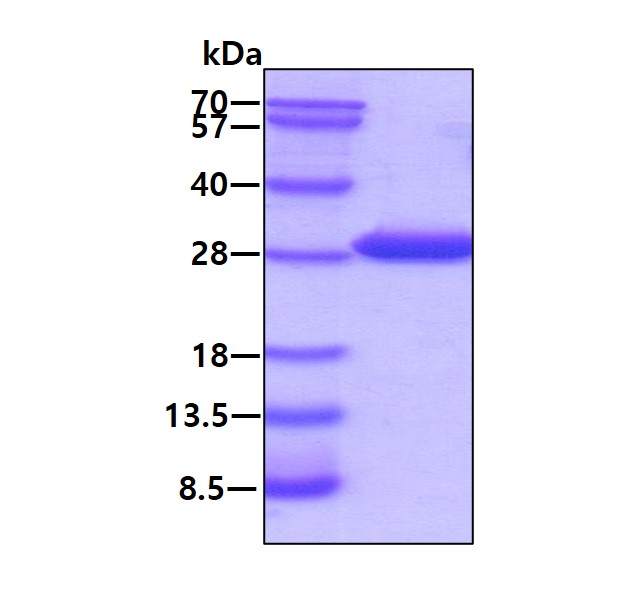
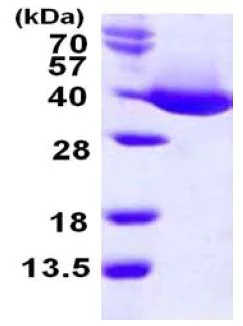
SDS-PAGE - Recombinant E. coli mdh protein (His tag N-Terminus) (AB124594)
  • SDS-PAGE

Unknown

SDS-PAGE - Recombinant E. coli mdh protein (His tag N-Terminus) (AB124594)

15% SDS-PAGE showing ab124594 (3μg).

关键信息

纯度

>95% SDS-PAGE

ab124594 is purified using conventional chromatography techniques.

表达系统

Escherichia coli

标签

His tag N-Terminus

应用

Mass Spec, SDS-PAGE

applications

生物活性

No

访问

P61889

不含动物源

No

不含载体蛋白

No

种属

Escherichia coli K-12

存储溶液

pH: 8 Constituents: 10% Glycerol (glycerin, glycerine), 0.32% Tris HCl, 0.29% Sodium chloride, 0.02% (R*,R*)-1,4-Dimercaptobutan-2,3-diol

storage-buffer

反应性数据

{ "title": "Reactivity Data", "filters": { "stats": ["", "Reactivity", "Dilution Info", "Notes"] }, "values": { "SDS-PAGE": { "reactivity":"TESTED_AND_REACTS", "dilution-info":"", "notes":"<p></p>" }, "Mass Spec": { "reactivity":"TESTED_AND_REACTS", "dilution-info":"", "notes":"<p></p>" } } }

序列信息

[{"linker":null,"sequence":"MGSSHHHHHHSSGLVPRGSHMGSHMKVAVLGAAGGIGQALALLLKTQLPSGSELSLYDIAPVTPGVAVDLSHIPTAVKIKGFSGEDATPALEGADVVLISAGVARKPGMDRSDLFNVNAGIVKNLVQQVAKTCPKACIGIITNPVNTTVAIAAEVLKKAGVYDKNKLFGVTTLDIIRSNTFVAELKGKQPGEVEVPVIGGHSGVTILPLLSQVPGVSFTEQEVADLTKRIQNAGTEVVEAKAGGGSATLSMGQAAARFGLSLVRALQGEQGVVECAYVEGDGQYARFFSQPLLLGKNGVEERKSIGTLSAFEQNALEGMLDTLKKDIALGEEFVNK","proteinLength":"Full Length","predictedMolecularWeight":"34.9 kDa","actualMolecularWeight":null,"aminoAcidEnd":312,"aminoAcidStart":1,"nature":"Recombinant","expressionSystem":"Escherichia coli","accessionNumber":"P61889","tags":[{"tag":"His","terminus":"N-Terminus"}]}]

性能和储存信息

形式
Liquid
运输条件
Blue Ice
推荐的短期储存条件
-20°C
推荐的长期储存条件
-20°C
分装信息
Upon delivery aliquot
储存信息
Avoid freeze / thaw cycle
False

补充信息

This supplementary information is collated from multiple sources and compiled automatically.

The protein known as malate dehydrogenase often abbreviated as MDH functions mechanically as an enzyme involved in oxidoreductase activity. It catalyzes the conversion of malate into oxaloacetate using the cofactor NAD⁺ playing an important role in the citric acid cycle. MDH exists in different isoforms one of which is located in the mitochondria and another in the cytoplasm. Its molecular weight is approximately 36 kDa. This enzyme is expressed in various tissues reflecting its importance in cellular metabolic processes.
Biological function summary

Malate dehydrogenase is essential in energy production and cellular respiration. The enzyme operates in both the mitochondria and cytosol indicating its ability to shuttle metabolic intermediates between different cellular compartments. MDH does not typically form part of a multi-subunit complex but can interact closely with other dehydrogenases to facilitate metabolic flux. By efficiently interchanging between malate and oxaloacetate MDH maintains the balance of redox states and supports ATP generation.

Pathways

Malate dehydrogenase plays a role in the citric acid cycle and the malate-aspartate shuttle which are central metabolic pathways. In the citric acid cycle it influences the homeostasis of NAD⁺ and NADH which is important for effective energy yield. The malate-aspartate shuttle where MDH works alongside aspartate aminotransferase aids in transferring reducing equivalents across the mitochondrial membrane. This cooperation assists in maintaining the efficiency of oxidative phosphorylation and ATP synthesis.

Malate dehydrogenase imbalance associates with metabolic disorders and specific cancers. Alterations in MDH activity are observed in metabolic syndrome impacting the regulation of glucose and lipid metabolism. Furthermore abnormal expression or function of MDH connects with tumor progression where it potentially aids in the metabolic adaptation of cancer cells. Researchers also explore interactions between MDH and succinate dehydrogenase in the context of cancer metabolism indicating a complex network of enzyme interactions driving pathophysiology.

常规信息

功能

Catalyzes the reversible oxidation of malate to oxaloacetate.

序列相似性

Belongs to the LDH/MDH superfamily. MDH type 1 family.

产品实验方案

靶点信息

Catalyzes the reversible oxidation of malate to oxaloacetate.
See full target information mdh

文献 (1)

Recent publications for all applications. Explore the full list and refine your search

PLoS pathogens 14:e1007295 PubMed30308066

2018

Escherichia coli mediated resistance of Entamoeba histolytica to oxidative stress is triggered by oxaloacetate.

Applications

Unspecified application

Species

Unspecified reactive species

Yana Shaulov,Chikako Shimokawa,Meirav Trebicz-Geffen,Shruti Nagaraja,Karen Methling,Michael Lalk,Lea Weiss-Cerem,Ayelet T Lamm,Hajime Hisaeda,Serge Ankri
View all publications

Abcam Product Promise

我们致力于为您的研究提供高质量的试剂,为您科研的每一步提供支持。若我们的产品未能达到预期性能,我们向您提供 Abcam Product Promise 保障。
详情请参阅我们的条款与条件。

Please note: All products are 'FOR RESEARCH USE ONLY. NOT FOR USE IN DIAGNOSTIC OR THERAPEUTIC PROCEDURES'.

For licensing inquiries, please contact partnerships@abcam.com