重组Anti-ZO-1抗体[HL1185] - BSA and Azide free
Anti-ZO-1 antibody [HL1185] - BSA and Azide free
- Recombinant
- 了解详情
1
(1 Review)
|
(22 Publications)
Rabbit Recombinant Monoclonal ZO1 tight junction protein antibody. Carrier free. Suitable for WB, ICC/IF and reacts with Human, Mouse, Dog, Cat, Rat samples. Cited in 22 publications. Immunogen corresponding to Recombinant Fragment Protein within Human TJP1.
查看别名
ZO1, TJP1, Tight junction protein 1, Tight junction protein ZO-1, Zona occludens protein 1, Zonula occludens protein 1

- ICC/IF
Supplier Data
Immunocytochemistry/ Immunofluorescence - Anti-ZO-1 antibody [HL1185] - BSA and Azide free (AB307799)
ZO-1 antibody [HL1185] (ab307799) detects ZO-1 protein at cell membrane by immunofluorescent analysis in A341 cells fixed in 4% paraformaldehyde at RT for 15 min. ZO-1 stained by ab307799 diluted at 1/500 (green). Fluoroshield with DAPI (blue)
搭配使用产品
Sample Prep & Detection Kits
AB269901
Alkaline Phosphatase Conjugation Kit (Animal Free) - Lightning-Link®
- 0
- 0

Primary Antibodies
AB216327
Anti-Occludin antibody [EPR20992]
RabMAb|Recombinant|KO Validated|20ul selling size

- 4
- 7

Primary Antibodies
AB131259
Anti-Claudin 5 antibody [EPR7583]
RabMAb|Recombinant|20ul selling size

- 4
- 7

反应性数据
产品详情
What are the advantages of a recombinant monoclonal antibody?
This product is a recombinant monoclonal antibody, which offers several advantages including:
- - High batch-to-batch consistency and reproducibility
- - Improved sensitivity and specificity
- - Long-term security of supply
- - Animal-free batch production
For more information, read more on recombinant antibodies.
Conjugation ready
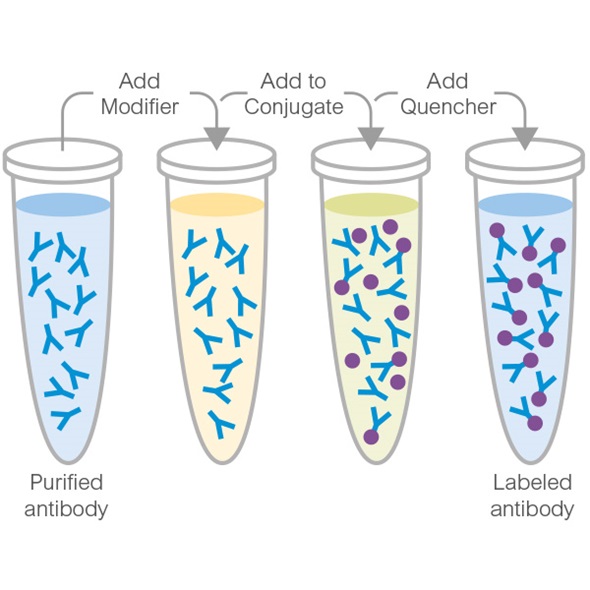
Our carrier-free antibodies are typically supplied in a PBS-only formulation, purified and free of BSA, sodium azide and glycerol. This conjugation-ready format is designed for use with fluorochromes, metal isotopes, oligonucleotides, and enzymes, which makes them ideal for antibody labelling, functional and cell-based assays, flow-based assays (e.g. mass cytometry) and Multiplex Imaging applications.
Use our conjugation kits for antibody conjugates that are ready-to-use in as little as 20 minutes with 1 minute hands-on-time and 100% antibody recovery: available for fluorescent dyes, HRP, biotin and gold.
性能和储存信息
形式
纯化工艺
存储溶液
运输条件
推荐的短期储存时间
推荐的短期储存条件
推荐的长期储存条件
分装信息
储存信息
补充信息
This supplementary information is collated from multiple sources and compiled automatically.
Biological function summary
ZO1 tight junction protein maintains cellular barriers and regulates paracellular permeability. This protein forms part of the tight junction complex with other proteins like occludin and claudins contributing to cellular integrity. ZO1's presence at tight junctions helps control the passage of ions and molecules between cells therefore ensuring selective permeability while protecting tissue function. Its ability to interact with multiple proteins enables it to coordinate complex signaling mechanisms that are important for cell adhesion and communication.
Pathways
The tight junction protein ZO1 participates in important signaling pathways like the epithelial barrier formation pathway and the actin cytoskeleton regulation pathway. It interacts with proteins like ZO2 and ZO3 which are critical for enhancing barrier function and cytoskeletal dynamics. By participating in these pathways ZO1 helps mediate both the structural and signaling functions necessary for maintaining tissue homeostasis and responding to cellular stress or injury.
产品实验方案
- Visit the General protocols
- Visit the Troubleshooting
靶点信息
文献 (22)
Recent publications for all applications. Explore the full list and refine your search
CNS neuroscience & therapeutics 31:e70606 PubMed40916543
2025
Applications
Unspecified application
Species
Unspecified reactive species
Cell death discovery 11:417 PubMed40883266
2025
Applications
Unspecified application
Species
Unspecified reactive species
Cellular and molecular life sciences : CMLS 82:262 PubMed40580316
2025
Applications
Unspecified application
Species
Unspecified reactive species
Antioxidants (Basel, Switzerland) 14: PubMed40563324
2025
Applications
Unspecified application
Species
Unspecified reactive species
Frontiers in physiology 16:1538733 PubMed40529994
2025
Applications
Unspecified application
Species
Unspecified reactive species
Diabetology & metabolic syndrome 17:182 PubMed40448159
2025
Applications
Unspecified application
Species
Unspecified reactive species
BMC medicine 23:285 PubMed40361123
2025
Applications
Unspecified application
Species
Unspecified reactive species
Glia 73:1565-1588 PubMed40183383
2025
Applications
Unspecified application
Species
Unspecified reactive species
Drug design, development and therapy 19:771-791 PubMed39925879
2025
Applications
Unspecified application
Species
Unspecified reactive species
iScience 27:111517 PubMed39759008
2025
Applications
Unspecified application
Species
Unspecified reactive species
Abcam Product Promise
Please note: All products are 'FOR RESEARCH USE ONLY. NOT FOR USE IN DIAGNOSTIC OR THERAPEUTIC PROCEDURES'.
For licensing inquiries, please contact partnerships@abcam.com