重组Anti-Zika virus Envelope蛋白抗体[HL1699] - BSA and Azide free
Anti-Zika virus Envelope protein antibody [HL1699] - BSA and Azide free
- Recombinant
- 了解详情
Be the first to review this product! Submit a review
|
(0 Publication)
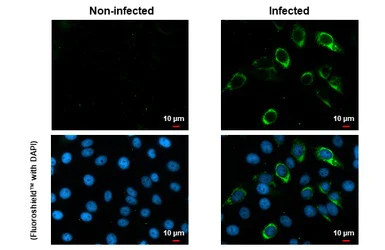
- ICC/IF
Supplier Data
Immunocytochemistry/ Immunofluorescence - Anti-Zika virus Envelope protein antibody [HL1699] - BSA and Azide free (AB308186)
For immunofluorescence analysis, Zika virus non-infected (left) and infected cells (right) were fixed and permeabilized for detection of Zika virus Envelope protein using ab308186 at 1/100 dilution (green). Nuclei (blue) is stained with fluoroshield with DAPI.
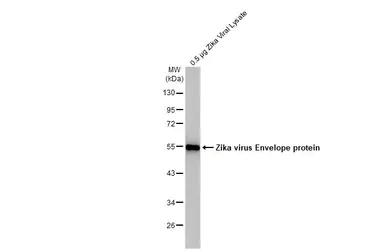
- WB
Supplier Data
Western blot - Anti-Zika virus Envelope protein antibody [HL1699] - BSA and Azide free (AB308186)
Separated by 10% SDS-PAGE.
All lanes:
Western blot - Anti-Zika virus Envelope protein antibody [HL1699] - BSA and Azide free (ab308186) at 1/2000 dilution
All lanes:
Zika viral lysate at 0.5 µg
Secondary
All lanes:
HRP-conjugated anti-rabbit IgG antibody
Predicted band size: 54 kDa
false
搭配使用产品

Sample Prep & Detection Kits
AB270705
5’ Feature Barcode Antibody Conjugation Kit - Lightning-Link® - Oligos 11-20

- 0
- 0

Primary Antibodies
AB308183
Anti-Zika virus NS4B protein antibody [HL1663] - BSA and Azide free
Recombinant

- 0
- 0
Primary Antibodies
AB181602
Anti-GAPDH antibody [EPR16891] - Loading Control
KD Validated|RabMAb|Recombinant|Lab Essentials|20ul selling size

- 5
- 23
Primary Antibodies
AB308399
Anti-Zika virus NS4B protein antibody [HL1664] - BSA and Azide free
Recombinant

- 0
- 0
反应性数据
产品详情
What are the advantages of a recombinant monoclonal antibody?
This product is a recombinant monoclonal antibody, which offers several advantages including:
- - High batch-to-batch consistency and reproducibility
- - Improved sensitivity and specificity
- - Long-term security of supply
- - Animal-free batch production
For more information, read more on recombinant antibodies.
Conjugation ready
Our carrier-free antibodies are typically supplied in a PBS-only formulation, purified and free of BSA, sodium azide and glycerol. This conjugation-ready format is designed for use with fluorochromes, metal isotopes, oligonucleotides, and enzymes, which makes them ideal for antibody labelling, functional and cell-based assays, flow-based assays (e.g. mass cytometry) and Multiplex Imaging applications.
Use our conjugation kits for antibody conjugates that are ready-to-use in as little as 20 minutes with 1 minute hands-on-time and 100% antibody recovery: available for fluorescent dyes, HRP, biotin and gold.
性能和储存信息
形式
纯化工艺
存储溶液
运输条件
推荐的短期储存时间
推荐的短期储存条件
推荐的长期储存条件
分装信息
储存信息
补充信息
This supplementary information is collated from multiple sources and compiled automatically.
Biological function summary
The Zika virus envelope protein initiates fusion with the host cell membrane enabling the release of viral RNA into the host cytoplasm. This process is not solitary; it works as part of a complex involving other viral proteins like the membrane protein (M protein). The E protein has a role in immune system evasion by altering its structure and glycan shielding which complicates recognition by host antibodies. These aspects help the virus persist and replicate within its host.
Pathways
The Zika virus envelope protein engages in the viral entry and replication pathways. A critical pathway involves receptor-mediated endocytosis reliant on host cell receptors to internalize the virus. The E protein works alongside the prM protein a precursor of the M protein to facilitate structural rearrangement necessary for the membrane fusion. The protein also impacts signaling pathways that influence the host's cell cycle which provides a favorable environment for viral replication and expression.
产品实验方案
- Visit the General protocols
- Visit the Troubleshooting
Abcam Product Promise
Please note: All products are 'FOR RESEARCH USE ONLY. NOT FOR USE IN DIAGNOSTIC OR THERAPEUTIC PROCEDURES'.
For licensing inquiries, please contact partnerships@abcam.com