JavaScript is disabled in your browser. Please enable JavaScript to view this website.
AB150362

重组Anti-XPD抗体[EPR9674]

Anti-XPD antibody [EPR9674]

Be the first to review this product! Submit a review

|

(4 Publications)

Rabbit Recombinant Monoclonal XPD antibody. Suitable for WB and reacts with Human, Mouse, Rat samples. Cited in 4 publications.

查看别名

XPD, XPDC, ERCC2, General transcription and DNA repair factor IIH helicase subunit XPD, TFIIH subunit XPD, Basic transcription factor 2 80 kDa subunit, CXPD, DNA 5'-3' helicase XPD, DNA excision repair protein ERCC-2, DNA repair protein complementing XP-D cells, TFIIH basal transcription factor complex 80 kDa subunit, Xeroderma pigmentosum group D-complementing protein, BTF2 p80, TFIIH 80 kDa subunit, TFIIH p80
1 Images
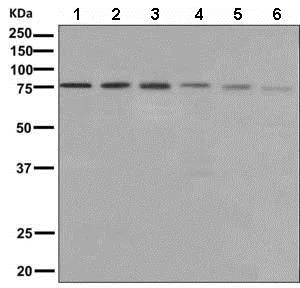
Western blot - Anti-XPD antibody [EPR9674] (AB150362)
  • WB

Unknown

Western blot - Anti-XPD antibody [EPR9674] (AB150362)

All lanes:

Western blot - Anti-XPD antibody [EPR9674] (ab150362) at 1/1000 dilution

Lane 1:

K562 cell lysate at 10 µg

Lane 2:

HeLa cell lysate at 10 µg

Lane 3:

A431 cell lysate at 10 µg

Lane 4:

MCF7 cell lysate at 10 µg

Lane 5:

Raw 264.7 cell lysate at 10 µg

Lane 6:

PC12 cell lysate at 10 µg

Secondary

All lanes:

HRP labelled goat anti-rabbit at 1/2000 dilution

Predicted band size: 87 kDa

false

不同偶联物与剂型 (1)

  • Carrier free

    Anti-XPD antibody [EPR9674] - BSA and Azide free

关键信息

宿主种属

Rabbit

克隆

Monoclonal

克隆号

EPR9674

亚型

IgG

不含载体蛋白

No

反应种属

Mouse, Rat, Human

应用

WB

applications

免疫原

The exact immunogen used to generate this antibody is proprietary information.

反应性数据

{ "title": "Reactivity Data", "filters": { "stats": ["", "Species", "Dilution Info", "Notes"], "tabs": { "all-applications": {"fullname" : "All Applications", "shortname": "All Applications"}, "FlowCyt" : {"fullname" : "Flow Cytometry", "shortname":"Flow Cyt"}, "WB" : {"fullname" : "Western blot", "shortname":"WB"}, "IHCP" : {"fullname" : "Immunohistochemistry (Formalin/PFA-fixed paraffin-embedded sections)", "shortname":"IHC-P"}, "ICCIF" : {"fullname" : "Immunocytochemistry/ Immunofluorescence", "shortname":"ICC/IF"} }, "product-promise": { "all": "all", "testedAndGuaranteed": "tested", "guaranteed": "expected", "predicted": "predicted", "notRecommended": "not-recommended" } }, "values": { "Human": { "FlowCyt-species-checked": "notRecommended", "FlowCyt-species-dilution-info": "", "FlowCyt-species-notes": "<p></p>", "WB-species-checked": "testedAndGuaranteed", "WB-species-dilution-info": "1/1000 - 1/10000", "WB-species-notes": "<p></p>", "IHCP-species-checked": "notRecommended", "IHCP-species-dilution-info": "", "IHCP-species-notes": "<p></p>", "ICCIF-species-checked": "notRecommended", "ICCIF-species-dilution-info": "", "ICCIF-species-notes": "<p></p>" }, "Mouse": { "FlowCyt-species-checked": "notRecommended", "FlowCyt-species-dilution-info": "", "FlowCyt-species-notes": "<p></p>", "WB-species-checked": "testedAndGuaranteed", "WB-species-dilution-info": "1/1000 - 1/10000", "WB-species-notes": "<p></p>", "IHCP-species-checked": "notRecommended", "IHCP-species-dilution-info": "", "IHCP-species-notes": "<p></p>", "ICCIF-species-checked": "notRecommended", "ICCIF-species-dilution-info": "", "ICCIF-species-notes": "<p></p>" }, "Rat": { "FlowCyt-species-checked": "notRecommended", "FlowCyt-species-dilution-info": "", "FlowCyt-species-notes": "<p></p>", "WB-species-checked": "testedAndGuaranteed", "WB-species-dilution-info": "1/1000 - 1/10000", "WB-species-notes": "<p></p>", "IHCP-species-checked": "notRecommended", "IHCP-species-dilution-info": "", "IHCP-species-notes": "<p></p>", "ICCIF-species-checked": "notRecommended", "ICCIF-species-dilution-info": "", "ICCIF-species-notes": "<p></p>" } } }

产品详情

Patented technology
Our RabMAb® technology is a patented hybridoma-based technology for making rabbit monoclonal antibodies. For details on our patents, please refer to RabMAb® patents.

What are the advantages of a recombinant monoclonal antibody?
This product is a recombinant monoclonal antibody, which offers several advantages including:

  • - High batch-to-batch consistency and reproducibility
  • - Improved sensitivity and specificity
  • - Long-term security of supply
  • - Animal-free batch production

For more information, read more on recombinant antibodies.

性能和储存信息

形式
Liquid
纯化工艺
Affinity purification Protein A
存储溶液
pH: 7.2 - 7.4 Preservative: 0.01% Sodium azide Constituents: PBS, 40% Glycerol (glycerin, glycerine), 0.05% BSA
运输条件
Conditional Ambient
推荐的短期储存条件
+4°C
推荐的长期储存条件
-20°C
分装信息
Upon delivery aliquot
储存信息
Avoid freeze / thaw cycle

补充信息

This supplementary information is collated from multiple sources and compiled automatically.

XPD also known as ERCC2 is an essential helicase enzyme belonging to the family of ATP-dependent DNA helicases. It consists of approximately 761 amino acids and has a mass of around 87 kDa. XPD functions mechanically by unwinding double-stranded DNA which is important for various DNA repair processes. This protein is expressed ubiquitously in human tissues highlighting its critical role in maintaining genomic integrity.
Biological function summary

XPD catalyzes the unwinding of DNA within the transcription factor IIH (TFIIH) complex. This complex facilitates DNA repair and transcription initiation. XPD participates in the nucleotide excision repair (NER) pathway where it contributes to repairing damaged DNA by excising damaged nucleotides. Its role in transcription-coupled repair and general transcription initiation underlines its importance in cellular homeostasis.

Pathways

DNA repair and general transcription processes are significantly affected by XPD. It plays an integral role in nucleotide excision repair (NER) and transcription. Within these pathways XPD works closely with other proteins such as XPA which assists in damage verification and incision near DNA lesions. XPD's unwinding function is essential for the correct orientation of DNA during transcription and repair events ensuring accurate gene expression and stability.

XPD mutations link to xeroderma pigmentosum (XP) and trichothiodystrophy (TTD). These conditions often result in increased sensitivity to ultraviolet (UV) radiation and various developmental abnormalities. XPD mutations impair the repair of UV-induced DNA damage causing symptoms in both XP and TTD. XPD also connects with ERCC1 a protein important for repair synthesis and DNA incision highlighting its broad impact on human health when its function is compromised.

产品实验方案

For this product, it's our understanding that no specific protocols are required. You can visit:

靶点信息

ATP-dependent 5'-3' DNA helicase (PubMed : 31253769, PubMed : 8413672, PubMed : 9771713). Component of the general transcription and DNA repair factor IIH (TFIIH) core complex, not absolutely essential for minimal transcription in vitro (PubMed : 10024882, PubMed : 17466626, PubMed : 9771713). Required for transcription-coupled nucleotide excision repair (NER) of damaged DNA; recognizes damaged bases (PubMed : 17466626, PubMed : 23352696, PubMed : 9771713). Sequestered in chromatin on UV-damaged DNA (PubMed : 23352696). When complexed to CDK-activating kinase (CAK), involved in transcription by RNA polymerase II. In NER, TFIIH acts by opening DNA around the lesion to allow the excision of the damaged oligonucleotide and its replacement by a new DNA fragment. The ATP-dependent helicase activity of XPD/ERCC2 is required for DNA opening. Involved in DNA lesion verification (PubMed : 31253769). In transcription, TFIIH has an essential role in transcription initiation. When the pre-initiation complex (PIC) has been established, TFIIH is required for promoter opening and promoter escape. Phosphorylation of the C-terminal tail (CTD) of the largest subunit of RNA polymerase II by the kinase module CAK controls the initiation of transcription. XPD/ERCC2 acts by forming a bridge between CAK and the core-TFIIH complex. The structure of the TFIIH transcription complex differs from the NER-TFIIH complex; large movements by XPD/ERCC2 and XPB/ERCC3 are stabilized by XPA which allow this subunit to contact ssDNA (PubMed : 31253769, PubMed : 33902107). Involved in the regulation of vitamin-D receptor activity. As part of the mitotic spindle-associated MMXD complex it plays a role in chromosome segregation. Might have a role in aging process and could play a causative role in the generation of skin cancers.
See full target information ERCC2

文献 (4)

Recent publications for all applications. Explore the full list and refine your search

Nature communications 16:7287 PubMed40775187

2025

Galectin-3-integrin α5β1 phase separation disrupted by advanced glycation end-products impairs diabetic wound healing in rodents.

Applications

Unspecified application

Species

Unspecified reactive species

Zhongyu Zhang,Zhengde Zhao,Xiuyi Huang,Lifang Zhou,Xin Jiang,Haoliang Wu,Chenshu Liu,Kan Huang,Jielu Wen,Yunchong Liu,Michelle C Miller,Zihan Zhao,Zhen He,Yuxin Wang,Siyu Liu,Lijin Huang,Lining Yuan,Renli Zeng,Zhipeng Cen,Anning Chen,Yanbo Chen,Gang Zeng,Wenzhou Liu,Xiaosi Hong,Meng Ren,Li Yan,Yang Zhang,Dongxian Guan,Xiaoyu Tian,Weikang Cai,Guihua Tai,Kevin H Mayo,Yifa Zhou,Zilun Li,Sifan Chen

Neoplasma 70:340-349 PubMed37498063

2023

NOP2-mediated m5C methylation of XPD is associated with hepatocellular carcinoma progression.

Applications

Unspecified application

Species

Unspecified reactive species

Guo-Fang Sun,Hao Ding

iScience 25:104957 PubMed36065184

2022

Ercc2/Xpd deficiency results in failure of digestive organ growth in zebrafish with elevated nucleolar stress.

Applications

Unspecified application

Species

Unspecified reactive species

Jinmin Ma,Xuelian Shao,Fang Geng,Shuzhang Liang,Chunxiao Yu,Ruilin Zhang

Cell 180:1245-1261.e21 PubMed32142654

2020

Regulation of the RNAPII Pool Is Integral to the DNA Damage Response.

Applications

Unspecified application

Species

Unspecified reactive species

Ana Tufegdžić Vidaković,Richard Mitter,Gavin P Kelly,Michelle Neumann,Michelle Harreman,Marta Rodríguez-Martínez,Anna Herlihy,Juston C Weems,Stefan Boeing,Vesela Encheva,Liam Gaul,Laura Milligan,David Tollervey,Ronald C Conaway,Joan W Conaway,Ambrosius P Snijders,Aengus Stewart,Jesper Q Svejstrup
View all publications

Abcam Product Promise

我们致力于为您的研究提供高质量的试剂,为您科研的每一步提供支持。若我们的产品未能达到预期性能,我们向您提供 Abcam Product Promise 保障。
详情请参阅我们的条款与条件。

Please note: All products are 'FOR RESEARCH USE ONLY. NOT FOR USE IN DIAGNOSTIC OR THERAPEUTIC PROCEDURES'.

For licensing inquiries, please contact partnerships@abcam.com