JavaScript is disabled in your browser. Please enable JavaScript to view this website.
AB242262

violetFluor™ 450 Anti-MHC Class II (I-A/I-E)抗体[M5/114.15.2]

violetFluor™ 450 Anti-MHC Class II (I-A/I-E) antibody [M5/114.15.2]

Be the first to review this product! Submit a review

|

(2 Publications)

Anti-MHC Class II antibody [M5/114.15.2] conjugated to violetFluor™ 450 - suitable for flow cytometry, and reacts with mouse samples. Clone [M5/114.15.2] is a rat monoclonal antibody and one of the most commonly used clones for flow cytometry.

Design your panel with our interactive flow cytometry panel builder. Click here.

查看别名

HLA-DP1B, HLA-DPB1, MHC class II antigen DPB1
1 Images
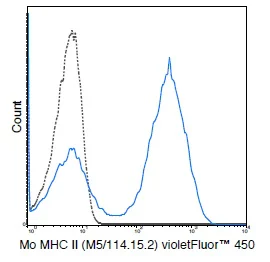
Flow Cytometry - violetFluor™ 450 Anti-MHC Class II (I-A/I-E) antibody [M5/114.15.2] (AB242262)
  • Flow Cyt

Supplier Data

Flow Cytometry - violetFluor™ 450 Anti-MHC Class II (I-A/I-E) antibody [M5/114.15.2] (AB242262)

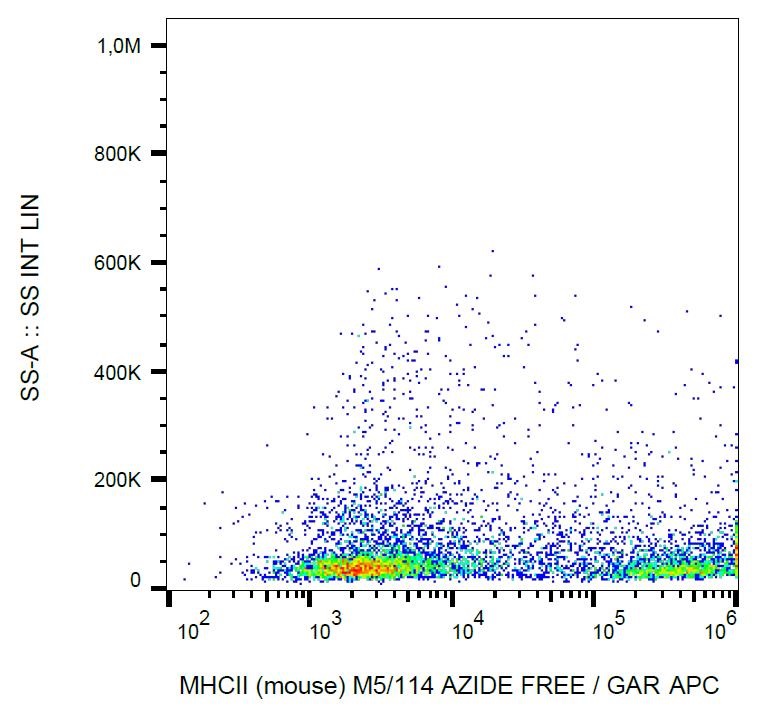
Flow cytometric analysis of C57Bl/6 splenocytes labeling MHC Class II using ab242262 at 0.25 μg (Solid line) compared with 0.25 μg violetFluor™ 450 Rat IgG2b isotype control (Dotted line).

不同偶联物与剂型 (4)

  • 660 APC

    APC Anti-MHC Class II (I-A/I-E) antibody [M5/114.15.2]

  • 519 FITC

    FITC Anti-MHC Class II (I-A/I-E) antibody [M5/114.15.2]

  • 578 PE

    PE Anti-MHC Class II (I-A/I-E) antibody [M5/114.15.2]

  • violetFluor™ 500

    violetFluor™ 500 Anti-MHC Class II (I-A/I-E) antibody [M5/114.15.2]

关键信息

宿主种属

Rat

克隆

Monoclonal

克隆号

M5/114.15.2

亚型

IgG2b

轻链类型

kappa

偶联物

violetFluor™ 450

激发波长/发射波长

Ex: 405nm, Em: 450nm

不含载体蛋白

No

反应种属

Mouse

应用

Flow Cyt

applications

特异性

ab242262 reacts with mouse MHC Class II alloantigens I-Ab, I-Ad, I-Aq, I-Ed, and I-Ek, as well as being cross-reactive with mouse cells of H-2p and H-2r haplotype. <p>The antibody does not react with the following alloantigens: I-Af, I-Ak, I-As, or NOD H-2g.</p>

反应性数据

{ "title": "Reactivity Data", "filters": { "stats": ["", "Species", "Dilution Info", "Notes"], "tabs": { "all-applications": {"fullname" : "All Applications", "shortname": "All Applications"}, "FlowCyt" : {"fullname" : "Flow Cytometry", "shortname":"Flow Cyt"} }, "product-promise": { "all": "all", "testedAndGuaranteed": "tested", "guaranteed": "expected", "predicted": "predicted", "notRecommended": "not-recommended" } }, "values": { "Mouse": { "FlowCyt-species-checked": "testedAndGuaranteed", "FlowCyt-species-dilution-info": "", "FlowCyt-species-notes": "<p>The amount of antibody required for optimal staining of a cell sample should be determined empirically in your system.</p>" } } }

性能和储存信息

形式
Liquid
纯化工艺
Affinity purification
纯化说明
This monoclonal antibody was purified from tissue culture supernatant via affinity chromatography.
存储溶液
pH: 7.2 Preservative: 0.09% Sodium azide Constituents: 0.87% Sodium chloride, 0.12% Sodium dihydrogen phosphate, 0.1% Gelatin
运输条件
Blue Ice
推荐的短期储存条件
+4°C
推荐的长期储存条件
+4°C
储存信息
Store in the dark

补充信息

This supplementary information is collated from multiple sources and compiled automatically.

MHC Class II also known as MHC II or human leukocyte antigen (HLA) class II is a protein complex with a molecular mass generally around 55 kDa. This protein is mainly expressed on the surface of antigen-presenting cells such as dendritic cells macrophages and B cells. It plays an important role in the immune system by presenting extracellular antigens to T helper cells. MHC II molecules are composed of two polypeptide chains alpha and beta which associate to form a heterodimer on the cell surface.
Biological function summary

MHC Class II molecules facilitate the immune system's recognition and response to pathogens by presenting processed antigenic peptides to CD4+ T lymphocytes. This activity involves their assembly within the endosomal-lysosomal system where they bind peptides derived from endocytosed proteins. MHC II is part of the major histocompatibility complex which includes other related molecules such as MHC Class I (HLA class I). The binding and presentation of peptides are central for the coordination of adaptive immune responses enhancing pathogen clearance and maintaining immunological memory.

Pathways

MHC Class II operates within the antigen processing and presentation pathway important for adaptive immunity. Its interaction with CD4+ T cells stimulates downstream signaling pathways leading to T cell activation and differentiation. Related proteins in the antigen presentation pathway include invariant chain (Ii) which guides MHC II to the endosome and HLA-DM which facilitates peptide loading. Together these proteins and pathways work to ensure effective immune surveillance and response.

Alterations in MHC Class II expression or function are associated with autoimmune diseases such as rheumatoid arthritis and type 1 diabetes. In these conditions improper antigen presentation may lead to an inappropriate immune response against self-proteins. The involvement of MHC II in disease is often linked to specific HLA alleles which vary among individuals and influence susceptibility to autoimmune disorders. Additionally the abnormal function of connected proteins like cytokines from activated T helper cells can exacerbate these immune conditions.

产品实验方案

For this product, it's our understanding that no specific protocols are required. You can visit:

靶点信息

Binds peptides derived from antigens that access the endocytic route of antigen presenting cells (APC) and presents them on the cell surface for recognition by the CD4 T-cells. The peptide binding cleft accommodates peptides of 10-30 residues. The peptides presented by MHC class II molecules are generated mostly by degradation of proteins that access the endocytic route, where they are processed by lysosomal proteases and other hydrolases. Exogenous antigens that have been endocytosed by the APC are thus readily available for presentation via MHC II molecules, and for this reason this antigen presentation pathway is usually referred to as exogenous. As membrane proteins on their way to degradation in lysosomes as part of their normal turn-over are also contained in the endosomal/lysosomal compartments, exogenous antigens must compete with those derived from endogenous components. Autophagy is also a source of endogenous peptides, autophagosomes constitutively fuse with MHC class II loading compartments. In addition to APCs, other cells of the gastrointestinal tract, such as epithelial cells, express MHC class II molecules and CD74 and act as APCs, which is an unusual trait of the GI tract. To produce a MHC class II molecule that presents an antigen, three MHC class II molecules (heterodimers of an alpha and a beta chain) associate with a CD74 trimer in the ER to form a heterononamer. Soon after the entry of this complex into the endosomal/lysosomal system where antigen processing occurs, CD74 undergoes a sequential degradation by various proteases, including CTSS and CTSL, leaving a small fragment termed CLIP (class-II-associated invariant chain peptide). The removal of CLIP is facilitated by HLA-DM via direct binding to the alpha-beta-CLIP complex so that CLIP is released. HLA-DM stabilizes MHC class II molecules until primary high affinity antigenic peptides are bound. The MHC II molecule bound to a peptide is then transported to the cell membrane surface. In B-cells, the interaction between HLA-DM and MHC class II molecules is regulated by HLA-DO. Primary dendritic cells (DCs) also to express HLA-DO. Lysosomal microenvironment has been implicated in the regulation of antigen loading into MHC II molecules, increased acidification produces increased proteolysis and efficient peptide loading.
See full target information HLA-DPB1

文献 (2)

Recent publications for all applications. Explore the full list and refine your search

iScience 27:109439 PubMed38523774

2024

A tetravalent nanovaccine that inhibits growth of HPV-associated head and neck carcinoma via dendritic and T cell activation.

Applications

Unspecified application

Species

Unspecified reactive species

Romano Josi,Daniel E Speiser,Simone de Brot,Anne-Cathrine Vogt,Eva M Sevick-Muraca,Genrich V Tolstonog,Martin F Bachmann,Mona O Mohsen

Cell communication and signaling : CCS 17:173 PubMed31881947

2019

The let-7 family of microRNAs suppresses immune evasion in head and neck squamous cell carcinoma by promoting PD-L1 degradation.

Applications

Unspecified application

Species

Unspecified reactive species

Dan Yu,Xueshibojie Liu,Guanghong Han,Yan Liu,Xue Zhao,Di Wang,Xiaomin Bian,Tingting Gu,Lianji Wen
View all publications

Abcam Product Promise

我们致力于为您的研究提供高质量的试剂,为您科研的每一步提供支持。若我们的产品未能达到预期性能,我们向您提供 Abcam Product Promise 保障。
详情请参阅我们的条款与条件。

Please note: All products are 'FOR RESEARCH USE ONLY. NOT FOR USE IN DIAGNOSTIC OR THERAPEUTIC PROCEDURES'.

For licensing inquiries, please contact partnerships@abcam.com