重组Anti-TARC/CCL17抗体[EPR15861]
Anti-TARC/CCL17 antibody [EPR15861]
- RabMAb
- Recombinant
- 了解详情
4
(1 Review)
|
(4 Publications)
Anti-TARC/CCL17 antibody [EPR15861] (ab195044) is a rabbit monoclonal antibody detecting TARC/CCL17 in IHC-P. Suitable for Human.
- Biophysical QC for unrivalled batch-batch consistency
查看别名
SCYA17, TARC, CCL17, C-C motif chemokine 17, CC chemokine TARC, Small-inducible cytokine A17, Thymus and activation-regulated chemokine
- IHC-P
Supplier Data
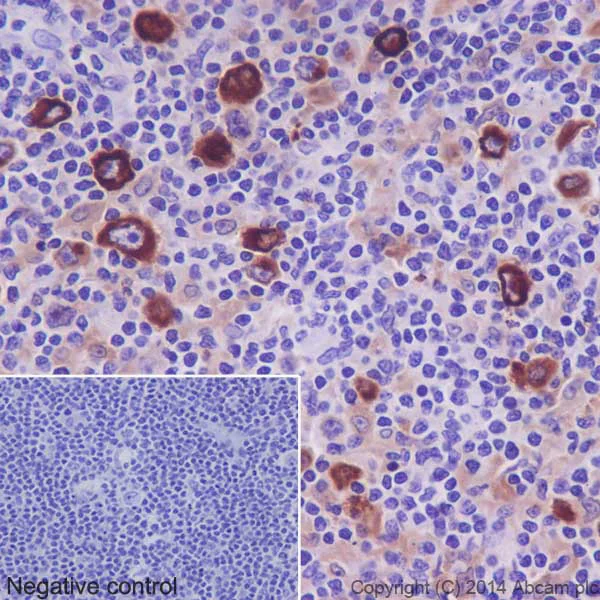
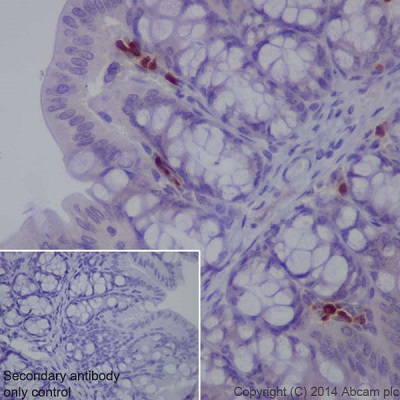
Immunohistochemistry (Formalin/PFA-fixed paraffin-embedded sections) - Anti-TARC/CCL17 antibody [EPR15861] (AB195044)
Immunohistochemical analysis of paraffin-embedded Human Hodgkin lymphoma tissue labeling TARC/CCL17 with ab195044 at 1/500 dilution, followed by Goat Anti-Rabbit IgG H&L (HRP) (ab97051) secondary antibody at 1/500 and counter-stained with Hematoxylin.
Inset : Negative control.
Note : Cytoplasm staining on humanHodgkin's lymphoma tissue was observed.
Perform heat mediated antigen retrieval with Tris/EDTA buffer pH 9.0 before commencing with IHC staining protocol.
- IHC-P
Supplier Data
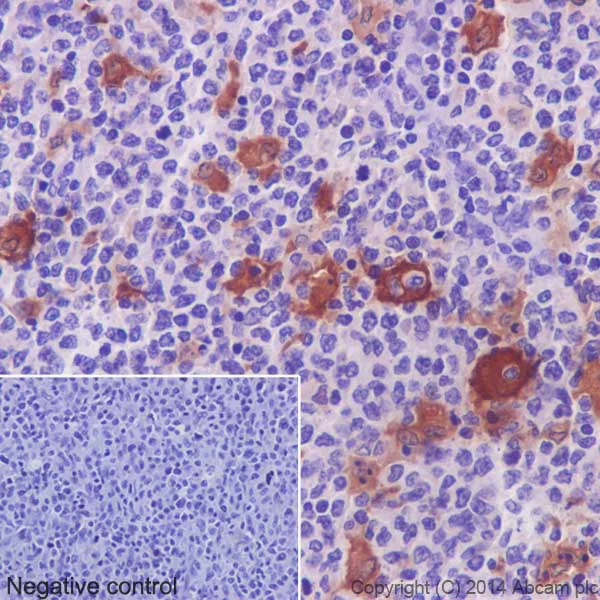
Immunohistochemistry (Formalin/PFA-fixed paraffin-embedded sections) - Anti-TARC/CCL17 antibody [EPR15861] (AB195044)
Immunohistochemical analysis of paraffin-embedded Human non-Hodgkin lymphoma tissue labeling TARC/CCL17 with ab195044 at 1/500 dilution, followed by Goat Anti-Rabbit IgG H&L (HRP) (ab97051) secondary antibody at 1/500 and counter-stained with Hematoxylin.
Inset : Negative control.
Note : Cytoplasm staining on human non-Hodgkin lymphoma tissue was observed.
Perform heat mediated antigen retrieval with Tris/EDTA buffer pH 9.0 before commencing with IHC staining protocol.
- IHC-P
Supplier Data
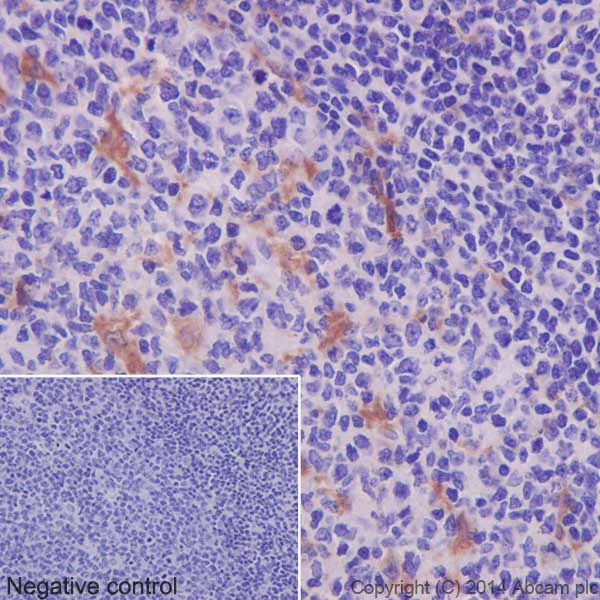
Immunohistochemistry (Formalin/PFA-fixed paraffin-embedded sections) - Anti-TARC/CCL17 antibody [EPR15861] (AB195044)
Immunohistochemical analysis of paraffin-embedded Human tonsil tissue labeling TARC/CCL17 with ab195044 at 1/500 dilution, followed byGoat Anti-Rabbit IgG H&L (HRP) (ab97051) secondary antibody at 1/500 and counter-stained with Hematoxylin.
Inset : Negative control.
Note : Cytoplasm staining on human tonsil tissue was observed.
Perform heat mediated antigen retrieval with Tris/EDTA buffer pH 9.0 before commencing with IHC staining protocol.
不同偶联物与剂型 (1)
-
Anti-TARC/CCL17 antibody [EPR15861] - BSA and Azide free
替代产品
搭配使用产品
Primary Antibodies
AB133616
BOND RX™ Validated|RabMAb|Recombinant|Lab Essentials|20ul selling size
- 5
- 20
Primary Antibodies
AB133357
BOND RX™ Validated|RabMAb|Advanced Validation|Recombinant|Lab Essentials|20ul selling size

- 4
- 37
反应性数据
产品详情
What is this antibody validated in?
Anti-TARC/CCL17 antibody [EPR15861] (ab195044) is a rabbit recombinant monoclonal antibody and is validated for use in Immunohistochemistry (IHC-P) in Human samples.
Other related products
We have a range of other formats of antibody clone [EPR15861] also available for your convenience: ab195044, Carrier free - ab232659
Patented technology
Our RabMAb® technology is a patented hybridoma-based technology for making rabbit monoclonal antibodies. For details on our patents, please refer to RabMAb® patents.
What are the advantages of a recombinant monoclonal antibody?
This product is a recombinant monoclonal antibody, which offers several advantages including:
- - High batch-to-batch consistency and reproducibility
- - Improved sensitivity and specificity
- - Long-term security of supply
- - Animal-free batch production
For more information, read more on recombinant antibodies.
性能和储存信息
形式
纯化工艺
存储溶液
运输条件
推荐的短期储存时间
推荐的短期储存条件
推荐的长期储存条件
分装信息
储存信息
补充信息
This supplementary information is collated from multiple sources and compiled automatically.
Biological function summary
CCL17 acts as a chemotactic agent attracting specific immune cells especially T lymphocytes to inflammatory regions. This protein does not operate as part of a larger protein complex but engages directly by binding to receptors on the target immune cells. Localized expression of CCL17 increases in conditions where enhanced Th2 cell response is needed such as allergic or autoimmune responses.
Pathways
CCL17 plays a significant role in the cell signaling pathway called the chemokine signaling pathway. Through this pathway CCL17 interacts with the CCR4 receptor which helps mediate immune cell migration and adhesion. This interaction is critical for establishing the adaptive immune response. CCL17 and CCR4 support the trafficking of Th2 cells during immune reactions and pathogen defense.
产品实验方案
- Visit the General protocols
- Visit the Troubleshooting
靶点信息
文献 (4)
Recent publications for all applications. Explore the full list and refine your search
Scientific reports 14:31580 PubMed39738081
2024
Applications
Unspecified application
Species
Unspecified reactive species
Journal for immunotherapy of cancer 12: PubMed38816233
2024
Applications
Unspecified application
Species
Unspecified reactive species
Liver international : official journal of the International Association for the Study of the Liver 40:1327-1338 PubMed32187823
2020
Applications
Unspecified application
Species
Unspecified reactive species
The Journal of clinical investigation 128:5235-5250 PubMed30204129
2018
Applications
Unspecified application
Species
Unspecified reactive species
Abcam Product Promise
Please note: All products are 'FOR RESEARCH USE ONLY. NOT FOR USE IN DIAGNOSTIC OR THERAPEUTIC PROCEDURES'.
For licensing inquiries, please contact partnerships@abcam.com