JavaScript is disabled in your browser. Please enable JavaScript to view this website.
AB22654

Anti-Sumo 2 + Sumo 3抗体

Anti-Sumo 2 + Sumo 3 antibody

Be the first to review this product! Submit a review

|

(8 Publications)

Rabbit Polyclonal Sumo 2 antibody. Suitable for IHC-P, WB, ICC/IF and reacts with Human, Recombinant fragment - Human samples. Cited in 8 publications. Immunogen corresponding to Synthetic Peptide within Human SUMO2 aa 1-50.

查看别名

SMT3B, SMT3H2, SUMO2, Small ubiquitin-related modifier 2, SUMO-2, HSMT3, SMT3 homolog 2, SUMO-3, Sentrin-2, Ubiquitin-like protein SMT3B, Smt3B, SMT3A, SMT3H1, SUMO3, Small ubiquitin-related modifier 3, SUMO-3, SMT3 homolog 1, SUMO-2, Ubiquitin-like protein SMT3A, Smt3A
3 Images
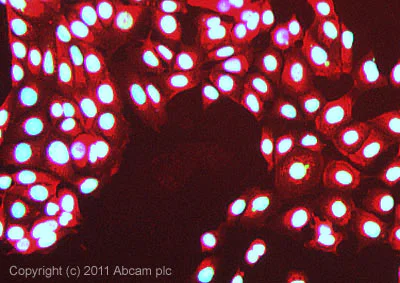
Immunocytochemistry/ Immunofluorescence - Anti-Sumo 2 + Sumo 3 antibody (AB22654)
  • ICC/IF

Unknown

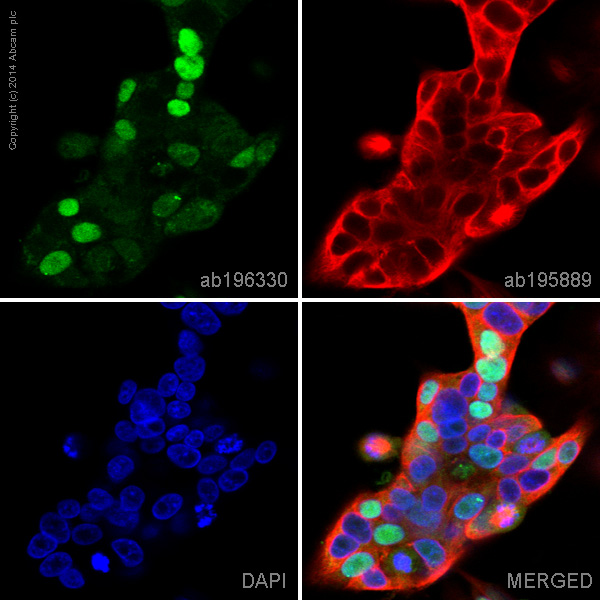
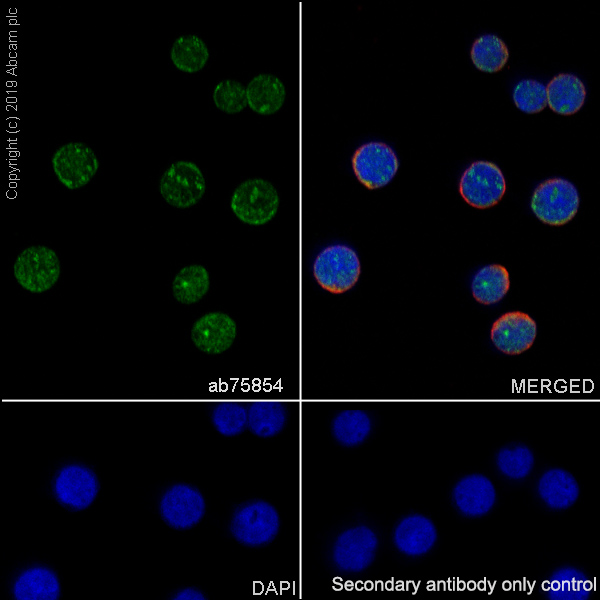
Immunocytochemistry/ Immunofluorescence - Anti-Sumo 2 + Sumo 3 antibody (AB22654)

ICC/IF image of ab22654 stained MCF7 cells. The cells were 100% methanol fixed (5 min) and then incubated in 1%BSA / 10% normal goat serum / 0.3M glycine in 0.1% PBS-Tween for 1h to permeabilise the cells and block non-specific protein-protein interactions. The cells were then incubated with the antibody (ab22654, 1µg/ml) overnight at +4°C. The secondary antibody (green) was ab96899, DyLight® 488 goat anti-rabbit IgG (H+L) used at a 1/250 dilution for 1h.Alexa Fluor® 594 WGA was used to label plasma membranes (red) at a 1/200 dilution for 1h. DAPI was used to stain the cell nuclei (blue) at a concentration of 1.43µM.
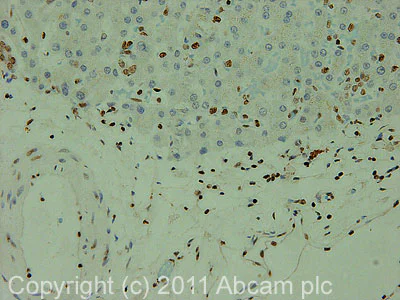
Immunohistochemistry (Formalin/PFA-fixed paraffin-embedded sections) - Anti-Sumo 2 + Sumo 3 antibody (AB22654)
  • IHC-P

Unknown

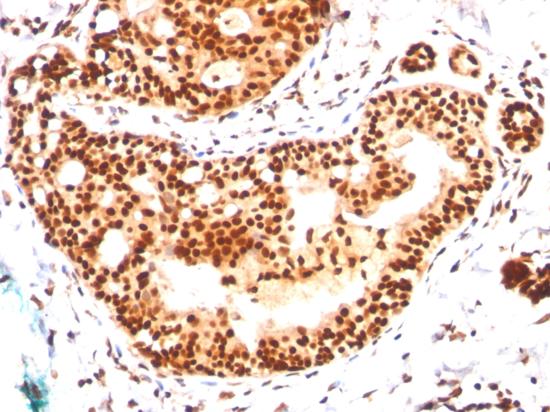
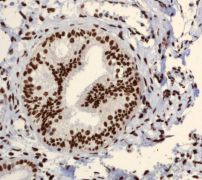
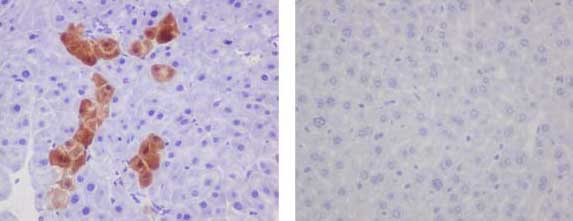
Immunohistochemistry (Formalin/PFA-fixed paraffin-embedded sections) - Anti-Sumo 2 + Sumo 3 antibody (AB22654)

IHC image of ab22654 staining in human normal liver formalin fixed paraffin embedded tissue section, performed on a Leica BondTM system using the standard protocol F. The section was pre-treated using heat mediated antigen retrieval with sodium citrate buffer (pH6, epitope retrieval solution 1) for 20 mins. The section was then incubated with ab22654, 1µg/ml, for 15 mins at room temperature and detected using an HRP conjugated compact polymer system. DAB was used as the chromogen. The section was then counterstained with haematoxylin and mounted with DPX.

For other IHC staining systems (automated and non-automated) customers should optimize variable parameters such as antigen retrieval conditions, primary antibody concentration and antibody incubation times.
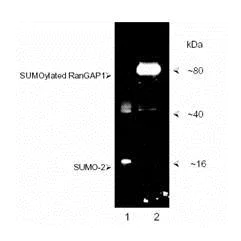
Western blot - Anti-Sumo 2 + Sumo 3 antibody (AB22654)
  • WB

Unknown

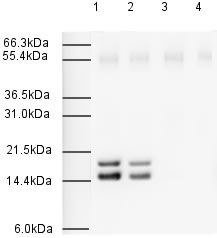
Western blot - Anti-Sumo 2 + Sumo 3 antibody (AB22654)

SUMOylation assay utilising His6-tagged SUMO 2, SUMO E1, SUMO E2 and RANGAP1 as substrate in presence (lane 2) and absence (lanes (1) of ATP after SDS-PAGE and blotting to PVDF with subsequent probing with ab22654. SUMOylation assay utilising His6-tagged SUMO 2, SUMO E1, SUMO E2 and RANGAP1 as substrate in presence (lane 2) and absence (lanes (1) of ATP after SDS-PAGE and blotting to PVDF with subsequent probing with ab22654.

All lanes:

Western blot - Anti-Sumo 2 + Sumo 3 antibody (ab22654)

Predicted band size: 12 kDa

false

关键信息

宿主种属

Rabbit

克隆

Polyclonal

亚型

IgG

不含载体蛋白

No

反应种属

Human

应用

IHC-P, ICC/IF, WB

applications

免疫原

Synthetic Peptide within Human SUMO2 aa 1-50. The exact immunogen used to generate this antibody is proprietary information.

P61956

特异性

This antibody recognizes Human Sumo 2 and Sumo 3&#46; <p>This antibody shows no cross-reactivity with related proteins SUMO1, UCRP, Nedd8, and FAT10 in Western blotting.</p>

反应性数据

{ "title": "Reactivity Data", "filters": { "stats": ["", "Species", "Dilution Info", "Notes"], "tabs": { "all-applications": {"fullname" : "All Applications", "shortname": "All Applications"}, "IHCP" : {"fullname" : "Immunohistochemistry (Formalin/PFA-fixed paraffin-embedded sections)", "shortname":"IHC-P"}, "WB" : {"fullname" : "Western blot", "shortname":"WB"}, "ICCIF" : {"fullname" : "Immunocytochemistry/ Immunofluorescence", "shortname":"ICC/IF"} }, "product-promise": { "all": "all", "testedAndGuaranteed": "tested", "guaranteed": "expected", "predicted": "predicted", "notRecommended": "not-recommended" } }, "values": { "Human": { "IHCP-species-checked": "testedAndGuaranteed", "IHCP-species-dilution-info": "1 µg/mL", "IHCP-species-notes": "<p></p>", "WB-species-checked": "guaranteed", "WB-species-dilution-info": "", "WB-species-notes": "", "ICCIF-species-checked": "testedAndGuaranteed", "ICCIF-species-dilution-info": "1 µg/mL", "ICCIF-species-notes": "<p></p>" }, "Mouse": { "IHCP-species-checked": "predicted", "IHCP-species-dilution-info": "", "IHCP-species-notes": "", "WB-species-checked": "predicted", "WB-species-dilution-info": "", "WB-species-notes": "", "ICCIF-species-checked": "predicted", "ICCIF-species-dilution-info": "", "ICCIF-species-notes": "" }, "Rat": { "IHCP-species-checked": "predicted", "IHCP-species-dilution-info": "", "IHCP-species-notes": "", "WB-species-checked": "predicted", "WB-species-dilution-info": "", "WB-species-notes": "", "ICCIF-species-checked": "predicted", "ICCIF-species-dilution-info": "", "ICCIF-species-notes": "" }, "Dog": { "IHCP-species-checked": "predicted", "IHCP-species-dilution-info": "", "IHCP-species-notes": "", "WB-species-checked": "predicted", "WB-species-dilution-info": "", "WB-species-notes": "", "ICCIF-species-checked": "predicted", "ICCIF-species-dilution-info": "", "ICCIF-species-notes": "" }, "Recombinant fragment - Human": { "IHCP-species-checked": "notRecommended", "IHCP-species-dilution-info": "", "IHCP-species-notes": "", "WB-species-checked": "testedAndGuaranteed", "WB-species-dilution-info": "", "WB-species-notes": "<p>Dilute to working strength with 50mM sodium phosphate buffer (pH 7.4) containing 1.5% sodium chloride and 1% normal goat serum (if a goat anti-rabbit IgG linker antibody is to be used).</p>", "ICCIF-species-checked": "notRecommended", "ICCIF-species-dilution-info": "", "ICCIF-species-notes": "" }, "Xenopus laevis": { "IHCP-species-checked": "predicted", "IHCP-species-dilution-info": "", "IHCP-species-notes": "", "WB-species-checked": "predicted", "WB-species-dilution-info": "", "WB-species-notes": "", "ICCIF-species-checked": "predicted", "ICCIF-species-dilution-info": "", "ICCIF-species-notes": "" }, "Zebrafish": { "IHCP-species-checked": "predicted", "IHCP-species-dilution-info": "", "IHCP-species-notes": "", "WB-species-checked": "predicted", "WB-species-dilution-info": "", "WB-species-notes": "", "ICCIF-species-checked": "predicted", "ICCIF-species-dilution-info": "", "ICCIF-species-notes": "" } } }

性能和储存信息

形式
Liquid
纯化说明
This antibody has been partially purified by salt precipitation.
存储溶液
Preservative: 0.01% Sodium azide Constituents: PBS
运输条件
Blue Ice
推荐的短期储存条件
+4°C
推荐的长期储存条件
-20°C
分装信息
Upon delivery aliquot
储存信息
Avoid freeze / thaw cycle

补充信息

This supplementary information is collated from multiple sources and compiled automatically.

Sumo 2 and Sumo 3 are small ubiquitin-like modifier proteins involved in post-translational modification often referred to as SUMOylation. Alternately known as SUMO-2 and SUMO-3 these proteins weigh approximately 11 kDa each and are widely expressed across various tissues including the heart and brain. During stress conditions cells significantly increase the conjugation of these proteins to other cellular proteins thereby altering their functions subcellular localization or interactions.
Biological function summary

Sumo 2 and Sumo 3 play essential roles in numerous cellular processes by modifying several target proteins in the nucleus and cytoplasm. They are part of a complex regulatory system that modulates processes like nuclear transport chromosome segregation and DNA repair. Sumo 2/3 often work in tandem with other members of the SUMO family including SUMO-1 to ensure proper cellular homeostasis.

Pathways

Sumo 2 and Sumo 3 are intimately involved in fundamental cellular signaling pathways such as the p53 pathway and NF-κB pathway. These proteins modulate the activity of key proteins within these pathways including the tumor suppressor p53 and the transcription factor NF-κB which regulate cell survival proliferation and apoptosis. Sumo 2/3-related modifications can alter the stability and function of these proteins thereby influencing cellular response to stimuli.

Alterations in Sumo 2 and Sumo 3 functionality have been associated with neurodegenerative diseases and various cancers. In neurodegenerative disorders like Huntington's disease abnormal SUMOylation of specific proteins affects neuronal survival and function. Similarly in cancer dysregulation of SUMOylation pathways can affect the expression and activity of the oncogenic protein c-Myc contributing to tumor progression. These associations underline the significant role of Sumo 2/3 in pathophysiology.

产品实验方案

For this product, it's our understanding that no specific protocols are required. You can visit:

靶点信息

Ubiquitin-like protein that can be covalently attached to proteins as a monomer or as a lysine-linked polymer. Covalent attachment via an isopeptide bond to its substrates requires prior activation by the E1 complex SAE1-SAE2 and linkage to the E2 enzyme UBE2I, and can be promoted by an E3 ligase such as PIAS1-4, RANBP2, CBX4 or ZNF451 (PubMed : 26524494). This post-translational modification on lysine residues of proteins plays a crucial role in a number of cellular processes such as nuclear transport, DNA replication and repair, mitosis and signal transduction. Polymeric SUMO2 chains are also susceptible to polyubiquitination which functions as a signal for proteasomal degradation of modified proteins (PubMed : 18408734, PubMed : 18538659, PubMed : 21965678, PubMed : 9556629). Plays a role in the regulation of sumoylation status of SETX (PubMed : 24105744).
See full target information SUMO2

其他靶点

SUMO3

文献 (8)

Recent publications for all applications. Explore the full list and refine your search

EMBO reports 25:68-81 PubMed38182817

2024

1,10-phenanthroline inhibits sumoylation and reveals that yeast SUMO modifications are highly transient.

Applications

Unspecified application

Species

Unspecified reactive species

J Bryan McNeil,Su-Kyong Lee,Anna Oliinyk,Sehaj Raina,Jyoti Garg,Marjan Moallem,Verne Urquhart-Cox,Jeffrey Fillingham,Peter Cheung,Emanuel Rosonina

eLife 11: PubMed35319461

2022

Dual signaling via interferon and DNA damage response elicits entrapment by giant PML nuclear bodies.

Applications

Unspecified application

Species

Unspecified reactive species

Myriam Scherer,Clarissa Read,Gregor Neusser,Christine Kranz,Anna K Kuderna,Regina Müller,Florian Full,Sonja Wörz,Anna Reichel,Eva-Maria Schilling,Paul Walther,Thomas Stamminger

PLoS pathogens 14:e1006769 PubMed29309427

2018

Distinct temporal roles for the promyelocytic leukaemia (PML) protein in the sequential regulation of intracellular host immunity to HSV-1 infection.

Applications

Unspecified application

Species

Unspecified reactive species

Thamir Alandijany,Ashley P E Roberts,Kristen L Conn,Colin Loney,Steven McFarlane,Anne Orr,Chris Boutell

Methods in molecular biology (Clifton, N.J.) 1510:329-337 PubMed27761832

2016

Assessing the Role of Paralog-Specific Sumoylation of HDAC1.

Applications

Unspecified application

Species

Unspecified reactive species

Simona Citro,Susanna Chiocca

Journal of virology 90:4807-4826 PubMed26937035

2016

Novel Role for Protein Inhibitor of Activated STAT 4 (PIAS4) in the Restriction of Herpes Simplex Virus 1 by the Cellular Intrinsic Antiviral Immune Response.

Applications

Unspecified application

Species

Unspecified reactive species

Kristen L Conn,Peter Wasson,Steven McFarlane,Lily Tong,James R Brown,Kyle G Grant,Patricia Domingues,Chris Boutell

PloS one 9:e91072 PubMed24608896

2014

SUMOylation of Myc-family proteins.

Applications

WB

Species

Human

Arianna Sabò,Mirko Doni,Bruno Amati

Methods in molecular biology (Clifton, N.J.) 832:111-23 PubMed22350879

2012

Reconstitution of SUMO-dependent ubiquitylation in vitro.

Applications

Unspecified application

Species

Unspecified reactive species

Kirstin Keusekotten,Gerrit J K Praefcke

FEBS letters 582:3174-8 PubMed18708055

2008

Arsenic trioxide stimulates SUMO-2/3 modification leading to RNF4-dependent proteolytic targeting of PML.

Applications

Unspecified application

Species

Unspecified reactive species

Stefan R Weisshaar,Kirstin Keusekotten,Anke Krause,Christiane Horst,Helen M Springer,Kerstin Göttsche,R Jürgen Dohmen,Gerrit J K Praefcke
View all publications

Abcam Product Promise

我们致力于为您的研究提供高质量的试剂,为您科研的每一步提供支持。若我们的产品未能达到预期性能,我们向您提供 Abcam Product Promise 保障。
详情请参阅我们的条款与条件。

Please note: All products are 'FOR RESEARCH USE ONLY. NOT FOR USE IN DIAGNOSTIC OR THERAPEUTIC PROCEDURES'.

For licensing inquiries, please contact partnerships@abcam.com