JavaScript is disabled in your browser. Please enable JavaScript to view this website.
AB181138

重组Anti-SLU7抗体[EPR11111]

Anti-SLU7 antibody [EPR11111]

Be the first to review this product! Submit a review

|

(1 Publication)

Rabbit Recombinant Monoclonal SLU7 antibody. Suitable for WB, ICC/IF and reacts with Human samples. Cited in 1 publication.

查看别名

Pre-mRNA-splicing factor SLU7, hSlu7, SLU7
3 Images
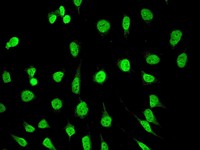
Immunocytochemistry/ Immunofluorescence - Anti-SLU7 antibody [EPR11111] (AB181138)
  • ICC/IF

Supplier Data

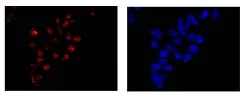
Immunocytochemistry/ Immunofluorescence - Anti-SLU7 antibody [EPR11111] (AB181138)

Immunofluorescent analysis of 293 cells (paraformaldehyde-fixed 4%) labeling SLU7 with ab181138 at 1/250 dilution followed by Goat anti rabbit IgG (Alexa Fluor® 555) secondary at 1/200 dilution and counter-stained with DAPI (blue).
Western blot - Anti-SLU7 antibody [EPR11111] (AB181138)
  • WB

Supplier Data

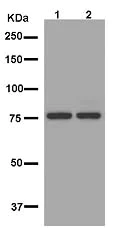
Western blot - Anti-SLU7 antibody [EPR11111] (AB181138)

All lanes:

Western blot - Anti-SLU7 antibody [EPR11111] (ab181138) at 1/2000 dilution

Lane 1:

HeLa cell lysate at 20 µg

Lane 2:

293 cell lysate at 20 µg

Secondary

All lanes:

Goat Anti-Rabbit IgG, (H+L), Peroxidase conjugate at 1/1000 dilution

Predicted band size: 68 kDa

false
Western blot - Anti-SLU7 antibody [EPR11111] (AB181138)
  • WB

Supplier Data

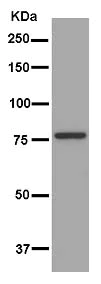
Western blot - Anti-SLU7 antibody [EPR11111] (AB181138)

All lanes:

Western blot - Anti-SLU7 antibody [EPR11111] (ab181138) at 1/10000 dilution

All lanes:

Jurkat cell lysate at 20 µg

Secondary

All lanes:

Goat Anti-Rabbit IgG, (H+L), Peroxidase conjugate at 1/1000 dilution

Predicted band size: 68 kDa

false

不同偶联物与剂型 (1)

  • Carrier free

    Anti-SLU7 antibody [EPR11111] - BSA and Azide free

关键信息

宿主种属

Rabbit

克隆

Monoclonal

克隆号

EPR11111

亚型

IgG

不含载体蛋白

No

反应种属

Human

应用

ICC/IF, WB

applications

免疫原

The exact immunogen used to generate this antibody is proprietary information.

反应性数据

{ "title": "Reactivity Data", "filters": { "stats": ["", "Species", "Dilution Info", "Notes"], "tabs": { "all-applications": {"fullname" : "All Applications", "shortname": "All Applications"}, "WB" : {"fullname" : "Western blot", "shortname":"WB"}, "ICCIF" : {"fullname" : "Immunocytochemistry/ Immunofluorescence", "shortname":"ICC/IF"} }, "product-promise": { "all": "all", "testedAndGuaranteed": "tested", "guaranteed": "expected", "predicted": "predicted", "notRecommended": "not-recommended" } }, "values": { "Human": { "WB-species-checked": "testedAndGuaranteed", "WB-species-dilution-info": "1/1000 - 1/10000", "WB-species-notes": "<p></p>", "ICCIF-species-checked": "testedAndGuaranteed", "ICCIF-species-dilution-info": "1/100 - 1/250", "ICCIF-species-notes": "<p></p>" }, "Rat": { "WB-species-checked": "predicted", "WB-species-dilution-info": "", "WB-species-notes": "", "ICCIF-species-checked": "predicted", "ICCIF-species-dilution-info": "", "ICCIF-species-notes": "" } } }

产品详情

Patented technology
Our RabMAb® technology is a patented hybridoma-based technology for making rabbit monoclonal antibodies. For details on our patents, please refer to RabMAb® patents.

What are the advantages of a recombinant monoclonal antibody?
This product is a recombinant monoclonal antibody, which offers several advantages including:

  • - High batch-to-batch consistency and reproducibility
  • - Improved sensitivity and specificity
  • - Long-term security of supply
  • - Animal-free batch production

For more information, read more on recombinant antibodies.

性能和储存信息

形式
Liquid
纯度
Tissue culture supernatant
存储溶液
Preservative: 0.01% Sodium azide Constituents: PBS, 40% Glycerol (glycerin, glycerine), 0.05% BSA
运输条件
Conditional Ambient
推荐的短期储存时间
1-2 weeks
推荐的短期储存条件
+4°C
推荐的长期储存条件
-20°C
分装信息
Upon delivery aliquot
储存信息
Avoid freeze / thaw cycle

补充信息

This supplementary information is collated from multiple sources and compiled automatically.

SLU7 also known as Splicing Factor SLU7 is an essential component of the pre-mRNA splicing process. Weighing approximately 65 kDa SLU7 is mainly found in the nucleus of cells where splicing occurs. It plays an important role in the second catalytic step of alternative splicing by ensuring accurate 3' splice site selection. SLU7 assists in proper intron removal and exon joining during mRNA processing ensuring the production of mature mRNA. Expression of SLU7 is observed in various tissues but high levels are noted in the brain and liver.
Biological function summary

SLU7 influences the regulation of gene expression by participating in mRNA splicing. As part of the larger spliceosome complex SLU7 helps with the recognition of splice sites addressing both simple and more complex pre-mRNA structures. Its function impacts various cellular processes by modulating the diversity of protein products through alternative splicing. This diversity is important for cells to adapt to developmental cues and environmental changes impacting cell differentiation and the response to stress.

Pathways

SLU7 functions significantly in mRNA processing and RNA transport pathways. It interacts with other splicing factors such as U2AF35 and U2AF65 forming a network important for the precise removal of introns from pre-mRNA. SLU7's involvement in these pathways affects numerous cellular transcription-related processes and connects with gene regulatory networks influencing the broader system of gene expression.

Errors in SLU7 function have links to neurodegenerative diseases and certain cancers. In neurodegenerative conditions such as Alzheimer's disease altered splicing patterns due to SLU7 malfunction may contribute to the pathology. In cancer aberrant expression or mutations in SLU7 could disrupt normal splicing affecting cellular growth and tumor progression. Connections are seen with RBM17 and other spliceosomal proteins where deregulation can exacerbate disease development and progression.

产品实验方案

For this product, it's our understanding that no specific protocols are required. You can visit:

靶点信息

Required for pre-mRNA splicing as component of the spliceosome (PubMed : 10197984, PubMed : 28502770, PubMed : 30705154). Participates in the second catalytic step of pre-mRNA splicing, when the free hydroxyl group of exon I attacks the 3'-splice site to generate spliced mRNA and the excised lariat intron. Required for holding exon 1 properly in the spliceosome and for correct AG identification when more than one possible AG exists in 3'-splicing site region. May be involved in the activation of proximal AG. Probably also involved in alternative splicing regulation.
See full target information Pre-mRNA-splicing factor SLU7

文献 (1)

Recent publications for all applications. Explore the full list and refine your search

The Journal of clinical investigation 135: PubMed40955663

2025

Elevated NR2F1 underlies the persistence of invasive disease after treatment of BRAF-mutant melanoma.

Applications

Unspecified application

Species

Unspecified reactive species

Manoela Tiago,Timothy J Purwin,Casey D Stefanski,Renaira Oliveira da Silva,Mitchell E Fane,Yash Chhabra,Jelan I Haj,Jessica Lf Teh,Rama Kadamb,Weijia Cai,Sheera R Rosenbaum,Vivian Chua,Nir Hacohen,Michael A Davies,Jessie Villanueva,Inna Chervoneva,Ashani T Weeraratna,Dan A Erkes,Claudia Capparelli,Julio A Aguirre-Ghiso,Andrew E Aplin
View all publications

Abcam Product Promise

我们致力于为您的研究提供高质量的试剂,为您科研的每一步提供支持。若我们的产品未能达到预期性能,我们向您提供 Abcam Product Promise 保障。
详情请参阅我们的条款与条件。

Please note: All products are 'FOR RESEARCH USE ONLY. NOT FOR USE IN DIAGNOSTIC OR THERAPEUTIC PROCEDURES'.

For licensing inquiries, please contact partnerships@abcam.com