重组Anti-SDF1抗体[EPR1216]
Anti-SDF1 antibody [EPR1216]
- RabMAb
- Recombinant
- KO Validated
- 20ul selling size
- 了解详情
5
(3 Reviews)
|
(37 Publications)
Anti-SDF1 antibody [EPR1216] (ab155090) is a rabbit monoclonal antibody detecting SDF1 in Western Blot, Flow Cytometry (Intra), ICC/IF. Suitable for Human.
- KO validated for confirmed specificity
- Biophysical QC for unrivalled batch-batch consistency
- Over 20 publications
查看别名
SDF1, SDF1A, SDF1B, CXCL12, Stromal cell-derived factor 1, SDF-1, hSDF-1, C-X-C motif chemokine 12, Intercrine reduced in hepatomas, Pre-B cell growth-stimulating factor, IRH, hIRH, PBSF

- ICC/IF
Unknown
Immunocytochemistry/ Immunofluorescence - Anti-SDF1 antibody [EPR1216] (AB155090)
Immunofluorescent analysis of Jurkat cells labeling SDF1 with ab155090 at 1/100 dilution.

- ICC/IF
Unknown
Immunocytochemistry/ Immunofluorescence - Anti-SDF1 antibody [EPR1216] (AB155090)
Immunocytochemistry/Immunofluorescence analysis of THP-1 (Human monocytic leukemia cell line) labeling SDF1 with Purified ab155090 at 1/500 dilution (5 μg/ml). Cells were fixed with 4% PFA and permeabilized with 0.1% tritonX-100. ab150077 Goat anti rabbit IgG(Alexa Fluor® 488) at 1/1000 dilution was used as the secondary antibody. Nuclei were counterstained with DAPI. PBS was used instead of the primary antibody as the negative control.

- Flow Cyt (Intra)
Unknown
Flow Cytometry (Intracellular) - Anti-SDF1 antibody [EPR1216] (AB155090)
Intracellular Flow Cytometry analysis of Jurkat (human acute T cell leukemia) cells labeling SDF1 with purified ab155090 at 1/20 dilution (10ug/ml) (red). Cells were fixed with 4% paraformaldehyde and permeabilised with 90% methanol. A Goat anti rabbit IgG (Alexa Fluor® 488) (1/2000 dilution) was used as the secondary antibody. Rabbit monoclonal IgG (Black) was used as the isotype control, cells without incubation with primary antibody and secondary antibody (Blue) was used as the unlabeled control.

- ICC/IF
Supplier Data
Immunocytochemistry/ Immunofluorescence - Anti-SDF1 antibody [EPR1216] (AB155090)
Immunofluorescent analysis of 4% paraformaldehyde-fixed, 0.1% Triton X-100 permeabilized Human PBMC (Human primary peripheral blood mononuclear cell) cells labelling SDF1 with primary antibody anti-SDF1 (ab155090) at 1/100 dilution, followed by Alexa Fluor® 488 Goat anti-Rabbit secondary (ab150077) secondary antibody at 1/1000 dilution. Anti-alpha Tubulin antibody (DM1A) - Microtubule Marker (Alexa Fluor® 594) (ab195889) was used to counterstain tubulin at 1/200 dilution. The nuclear counter stain is DAPI (blue). Confocal image showing cytoplasmic staining in Human PBMC. Image was taken with a confocal microscope (Leica-Microsystems, TCS SP8).
Low expression control : K562 (PMID : 23473997)
- WB
Lab
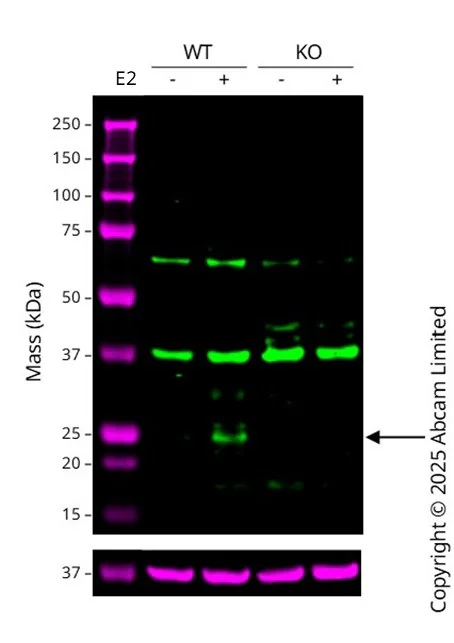
Western blot - Anti-SDF1 antibody [EPR1216] (AB155090)
Western blot : Rabbit monoclonal [EPR1216] to SDF1 ab155090 staining at 1/500 dilution, shown in green; Mouse anti GAPDH (ab8245) loading control staining at 1/20,000 dilution, shown in magenta.
A band was observed at 25 kDa in E2 treated wild-type cell lysates with no signal observed at this size in E2 treated CXCL12 knockout MCF7.
To generate this image, samples were run on an SDS-PAGE gel then transferred onto a nitrocellulose membrane. Membranes were blocked in 3 % Milk in TBS-0.1 % Tween® 20 (TBS-T) before incubation with primary antibodies overnight at 4 °C. Blots were washed four times in TBS-T, incubated with secondary antibodies for 1 h at room temperature, washed again four times then imaged.
Secondary antibodies used were Goat anti-Rabbit 800CW & Goat anti-Mouse 680RD at 1/20,000 dilution.
All lanes:
Western blot - Anti-SDF1 antibody [EPR1216] (ab155090) at 1/500 dilution
Lane 1:
Untreated Wild-type MCF7 cell lysates at 20 µg
Lane 2:
E2 treated wild-type MCF7 cell lysates at 20 µg
Lane 3:
Untreated CXCL12 knockout MCF7 cell lysate at 20 µg
Lanes 3 - 4:
Western blot - Human CXCL12 knockout MCF7 cell line (ab281609)
Lane 4:
E2 treated CXCL12 knockout MCF7 cell lysate at 20 µg
Secondary
All lanes:
Goat anti-Rabbit 800CW & Goat anti-Mouse 680RD at 1/20000 dilution
Predicted band size: 25 kDa
Observed band size: 25 kDa,36 kDa
false

- WB
Unknown
Western blot - Anti-SDF1 antibody [EPR1216] (AB155090)
All lanes:
Western blot - Anti-SDF1 antibody [EPR1216] (ab155090) at 1/10000 dilution
All lanes:
Human CXCL12 recombinant protein at 0.01 µg
Secondary
All lanes:
Goat anti-rabbit HRP at 1/2000 dilution
Predicted band size: 10 kDa
false
不同偶联物与剂型 (5)
-
Anti-SDF1 antibody [EPR1216] - Low endotoxin, Azide free
-
Anti-SDF1 antibody [EPR1216] - BSA and Azide free
-
519 Alexa Fluor® 488
Alexa Fluor® 488 Anti-SDF1 antibody [EPR1216]
-
565 Alexa Fluor® 555
Alexa Fluor® 555 Anti-SDF1 antibody [EPR1216]
-
617 Alexa Fluor® 594
Alexa Fluor® 594 Anti-SDF1 antibody [EPR1216]
替代产品


搭配使用产品

Primary Antibodies
AB124824
BOND RX™ Validated|RabMAb|Recombinant|20ul selling size

- 4
- 17
Primary Antibodies
AB181602
Anti-GAPDH antibody [EPR16891] - Loading Control
KD Validated|RabMAb|Recombinant|Lab Essentials|20ul selling size

- 5
- 23
Primary Antibodies
AB124964
Anti-alpha smooth muscle Actin antibody [EPR5368]
BOND RX™ Validated|RabMAb|Recombinant|KO Validated|20ul selling size

- 5
- 19
反应性数据
产品详情
What is this antibody validated in?
Anti-SDF1 antibody [EPR1216] (ab155090) is a rabbit recombinant monoclonal antibody and is validated for use in Western Blot (WB), Flow Cytometry (Intra), Immunocytochemistry/immunofluorescence (ICC/IF) in Human samples.
What is the molecular weight of SDF1?
Anti-SDF1 [EPR1216] (ab155090) specifically detects a band for SDF1 (UniProt: P48061) at a molecular weight of 11kDa.
Trusted by the scientific community
Anti-SDF1 [EPR1216] (ab155090) was first used in a scientific publication in 2013 and has been cited over 20 times in peer-reviewed journals.
Other related products
We have a range of other formats of antibody clone [EPR1216] also available for your convenience: ab155090, Carrier free - ab157772, Alexa Fluor® 488 - ab217985, Alexa Fluor® 594 - ab218284, Alexa Fluor® 555 - ab218285, Carrier free - ab271917
Patented technology
Our RabMAb® technology is a patented hybridoma-based technology for making rabbit monoclonal antibodies. For details on our patents, please refer to RabMAb® patents.
What are the advantages of a recombinant monoclonal antibody?
This product is a recombinant monoclonal antibody, which offers several advantages including:
- - High batch-to-batch consistency and reproducibility
- - Improved sensitivity and specificity
- - Long-term security of supply
- - Animal-free batch production
For more information, read more on recombinant antibodies.
Species reactivity
Rat: We have preliminary internal testing data to indicate this antibody may not react with this species.
Please contact us for more information.
Trial sizes available!
Test your antibody or perform pre-screening before committing to a larger quantity. Sold in 20µl. Discover our selection of trial-size antibodies.
性能和储存信息
形式
纯化工艺
存储溶液
运输条件
推荐的短期储存时间
推荐的短期储存条件
推荐的长期储存条件
分装信息
储存信息
补充信息
This supplementary information is collated from multiple sources and compiled automatically.
Biological function summary
SDF1 influences the migration and survival of hematopoietic progenitor cells. It plays a pivotal role in heart development angiogenesis and neuronal protein regulation. SDF1 binds with high affinity to its receptor CXCR4 forming a critical signal transduction complex that modulates cellular movement and growth responses. This interaction is important in the regulation of cell positioning and potential pathways of pathological changes.
Pathways
SDF1 has an important role in the chemokine signaling pathway and is involved in the pathways controlling hematopoietic stem cell migration and homing. The interaction between SDF1 and CXCR4 triggers downstream signaling events engaging proteins like PI3K and MAPK which promote cell survival and proliferation. Furthermore the SDF1/CXCR4 axis is central to the vascular endothelial growth factor (VEGF) pathway facilitating angiogenesis and tissue repair mechanisms.
产品实验方案
- Visit the General protocols
- Visit the Troubleshooting
靶点信息
文献 (37)
Recent publications for all applications. Explore the full list and refine your search
Cellular oncology (Dordrecht, Netherlands) : PubMed41037222
2025
Applications
Unspecified application
Species
Unspecified reactive species
Acta pharmaceutica Sinica. B 15:4248-4264 PubMed40893673
2025
Applications
Unspecified application
Species
Unspecified reactive species
Journal of nanobiotechnology 23:519 PubMed40671009
2025
Applications
Unspecified application
Species
Unspecified reactive species
Stem cell research & therapy 16:253 PubMed40394699
2025
Applications
Unspecified application
Species
Unspecified reactive species
Frontiers in pharmacology 16:1577201 PubMed40371331
2025
Applications
Unspecified application
Species
Unspecified reactive species
Communications biology 8:514 PubMed40155473
2025
Applications
Unspecified application
Species
Unspecified reactive species
Aging 17:497-523 PubMed39992207
2025
Applications
Unspecified application
Species
Unspecified reactive species
FASEB journal : official publication of the Federation of American Societies for Experimental Biology 39:e70262 PubMed39760177
2025
Applications
Unspecified application
Species
Unspecified reactive species
Biomolecules 14: PubMed39456139
2024
Applications
Unspecified application
Species
Unspecified reactive species
iScience 27:109213 PubMed38439953
2024
Applications
Unspecified application
Species
Unspecified reactive species
Abcam Product Promise
Please note: All products are 'FOR RESEARCH USE ONLY. NOT FOR USE IN DIAGNOSTIC OR THERAPEUTIC PROCEDURES'.
For licensing inquiries, please contact partnerships@abcam.com