JavaScript is disabled in your browser. Please enable JavaScript to view this website.
AB109197

重组Anti-SAM68抗体[EPR3232]

Anti-SAM68 antibody [EPR3232]

Be the first to review this product! Submit a review

|

(4 Publications)

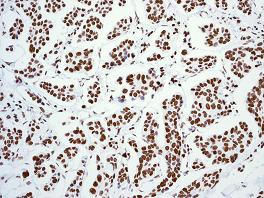
Rabbit Recombinant Monoclonal SAM68 antibody. Suitable for IHC-P, WB, ICC/IF, Flow Cyt (Intra) and reacts with Human samples. Cited in 4 publications.

查看别名

SAM68, KHDRBS1, GAP-associated tyrosine phosphoprotein p62, Src-associated in mitosis 68 kDa protein, p21 Ras GTPase-activating protein-associated p62, p68, Sam68
4 Images
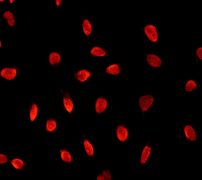
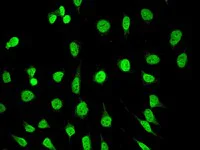
Immunocytochemistry/ Immunofluorescence - Anti-SAM68 antibody [EPR3232] (AB109197)
  • ICC/IF

Unknown

Immunocytochemistry/ Immunofluorescence - Anti-SAM68 antibody [EPR3232] (AB109197)

ab109197, at 1/250, staining SAM68 in HeLa cells by Immunofluorescence.
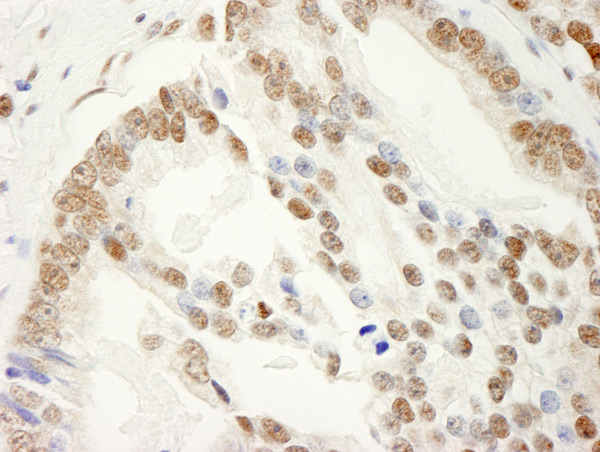
Immunohistochemistry (Formalin/PFA-fixed paraffin-embedded sections) - Anti-SAM68 antibody [EPR3232] (AB109197)
  • IHC-P

Unknown

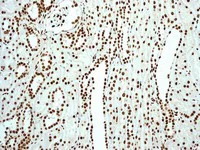
Immunohistochemistry (Formalin/PFA-fixed paraffin-embedded sections) - Anti-SAM68 antibody [EPR3232] (AB109197)

ab109197 at 1/250 staining SAM68 in paraffin-embedded Human kidney tissue by Immunohistochemistry.

Perform heat mediated antigen retrieval with citrate buffer pH 6 before commencing with IHC staining protocol.
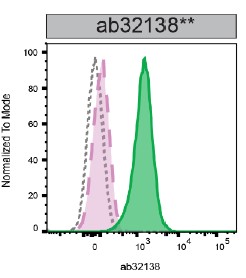
Flow Cytometry (Intracellular) - Anti-SAM68 antibody [EPR3232] (AB109197)
  • Flow Cyt (Intra)

Unknown

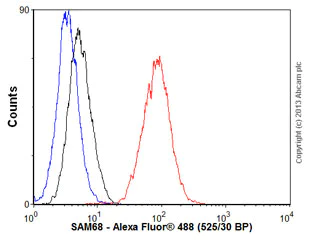
Flow Cytometry (Intracellular) - Anti-SAM68 antibody [EPR3232] (AB109197)

Overlay histogram showing HeLa cells stained with ab109197 (red line). The cells were fixed with 80% methanol (5 min) and then permeabilized with 0.1% PBS-Tween for 20 min. The cells were then incubated in 1x PBS / 10% normal goat serum / 0.3M glycine to block non-specific protein-protein interactions followed by the antibody (ab109197 1/1000 dilution) for 30 min at 22°C. The secondary antibody used was Alexa Fluor® 488 goat anti-rabbit IgG (H+L) (ab150077) at 1/2000 dilution for 30 min at 22°C. Isotype control antibody (black line) was rabbit IgG (monoclonal) (1μg/1x106 cells) used under the same conditions. Unlabelled sample (blue line) was also used as a control. Acquisition of >5000 events were collected using a 20mW Argon ion laser (488nm) and 525/30 bandpass filter.
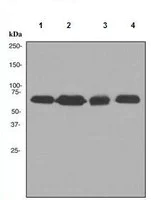
Western blot - Anti-SAM68 antibody [EPR3232] (AB109197)
  • WB

Unknown

Western blot - Anti-SAM68 antibody [EPR3232] (AB109197)

All lanes:

Western blot - Anti-SAM68 antibody [EPR3232] (ab109197) at 1/1000 dilution

Lane 1:

Jurkat cell lysate at 10 µg

Lane 2:

HeLa cell lysate at 10 µg

Lane 3:

A431 cell lysate at 10 µg

Lane 4:

A673 cell lysate at 10 µg

Predicted band size: 48 kDa

false

不同偶联物与剂型 (1)

  • Carrier free

    Anti-SAM68 antibody [EPR3232] - BSA and Azide free

关键信息

宿主种属

Rabbit

克隆

Monoclonal

克隆号

EPR3232

亚型

IgG

不含载体蛋白

No

反应种属

Human

应用

ICC/IF, IHC-P, WB, Flow Cyt (Intra)

applications

免疫原

The exact immunogen used to generate this antibody is proprietary information.

反应性数据

{ "title": "Reactivity Data", "filters": { "stats": ["", "Species", "Dilution Info", "Notes"], "tabs": { "all-applications": {"fullname" : "All Applications", "shortname": "All Applications"}, "IHCP" : {"fullname" : "Immunohistochemistry (Formalin/PFA-fixed paraffin-embedded sections)", "shortname":"IHC-P"}, "WB" : {"fullname" : "Western blot", "shortname":"WB"}, "ICCIF" : {"fullname" : "Immunocytochemistry/ Immunofluorescence", "shortname":"ICC/IF"}, "FlowCytIntra" : {"fullname" : "Flow Cytometry (Intracellular)", "shortname":"Flow Cyt (Intra)"} }, "product-promise": { "all": "all", "testedAndGuaranteed": "tested", "guaranteed": "expected", "predicted": "predicted", "notRecommended": "not-recommended" } }, "values": { "Human": { "IHCP-species-checked": "testedAndGuaranteed", "IHCP-species-dilution-info": "1/250 - 1/500", "IHCP-species-notes": "<p></p>", "WB-species-checked": "testedAndGuaranteed", "WB-species-dilution-info": "1/1000 - 1/10000", "WB-species-notes": "<p></p>", "ICCIF-species-checked": "testedAndGuaranteed", "ICCIF-species-dilution-info": "1/250 - 1/500", "ICCIF-species-notes": "<p></p>", "FlowCytIntra-species-checked": "testedAndGuaranteed", "FlowCytIntra-species-dilution-info": "1/100 - 1/1000", "FlowCytIntra-species-notes": "<p><a href='/products/primary-antibodies/rabbit-igg-monoclonal-epr25a-isotype-control-ab172730'>ab172730</a> - Rabbit monoclonal IgG, is suitable for use as an isotype control with this antibody.</p>" }, "Mouse": { "IHCP-species-checked": "predicted", "IHCP-species-dilution-info": "", "IHCP-species-notes": "", "WB-species-checked": "predicted", "WB-species-dilution-info": "", "WB-species-notes": "", "ICCIF-species-checked": "predicted", "ICCIF-species-dilution-info": "", "ICCIF-species-notes": "", "FlowCytIntra-species-checked": "predicted", "FlowCytIntra-species-dilution-info": "", "FlowCytIntra-species-notes": "" } } }

产品详情

Patented technology
Our RabMAb® technology is a patented hybridoma-based technology for making rabbit monoclonal antibodies. For details on our patents, please refer to RabMAb® patents.

What are the advantages of a recombinant monoclonal antibody?
This product is a recombinant monoclonal antibody, which offers several advantages including:

  • - High batch-to-batch consistency and reproducibility
  • - Improved sensitivity and specificity
  • - Long-term security of supply
  • - Animal-free batch production

For more information, read more on recombinant antibodies.

Species reactivity
Rat: We have preliminary internal testing data to indicate this antibody may not react with this species.
Please contact us for more information.

性能和储存信息

形式
Liquid
纯化工艺
Affinity purification Protein A
存储溶液
pH: 7.2 - 7.4 Preservative: 0.01% Sodium azide Constituents: PBS, 40% Glycerol (glycerin, glycerine), 0.05% BSA
运输条件
Conditional Ambient
推荐的短期储存条件
+4°C
推荐的长期储存条件
-20°C
储存信息
Stable for 12 months at -20°C

补充信息

This supplementary information is collated from multiple sources and compiled automatically.

The protein SAM68 also known as Src-associated in mitosis 68 kDa is a member of the STAR (Signal Transduction and Activation of RNA) family and has a mass of approximately 68 kilodaltons. SAM68 is expressed in a broad range of tissues but shows higher expression in the brain and testis. It functions mechanically as a nuclear RNA-binding protein involved in RNA metabolism alternative splicing and is linked to signal transduction pathways. The ability of SAM68 to bind RNA is important for its role in RNA processing.
Biological function summary

SAM68 impacts multiple cellular processes by regulating alternative splicing of pre-mRNA and is known to be part of a larger ribonucleoprotein complex. This functionality enables SAM68 to influence gene expression and impact cell proliferation and differentiation. By interacting with several signaling molecules it modulates processes that are vital for the proper functioning of various cell types including neurons and germ cells.

Pathways

SAM68 interacts with several signaling pathways notably the PI3K/AKT and MAPK/ERK pathways where it influences cellular survival and growth. Within these pathways SAM68 interacts with proteins such as the tyrosine kinase Src which facilitates signal transduction events leading to changes in cell behavior. The protein also associates with hnRNPA1 affecting mRNA processing and influencing downstream signaling cascades.

SAM68 has connections to cancer and neurodegenerative diseases. Abnormal expression or mutations in SAM68 are linked to oncogenesis particularly in prostate and breast cancers where it interacts with signaling proteins like ERK. In neurodegenerative disorders SAM68 is implicated in altering neuronal RNA processing potentially contributing to diseases such as Alzheimer's with connections to proteins like tau. Understanding SAM68's role in these diseases highlights its potential as a therapeutic target.

产品实验方案

For this product, it's our understanding that no specific protocols are required. You can visit:

靶点信息

Recruited and tyrosine phosphorylated by several receptor systems, for example the T-cell, leptin and insulin receptors. Once phosphorylated, functions as an adapter protein in signal transduction cascades by binding to SH2 and SH3 domain-containing proteins. Role in G2-M progression in the cell cycle. Represses CBP-dependent transcriptional activation apparently by competing with other nuclear factors for binding to CBP. Also acts as a putative regulator of mRNA stability and/or translation rates and mediates mRNA nuclear export. Positively regulates the association of constitutive transport element (CTE)-containing mRNA with large polyribosomes and translation initiation. According to some authors, is not involved in the nucleocytoplasmic export of unspliced (CTE)-containing RNA species according to (PubMed : 22253824). RNA-binding protein that plays a role in the regulation of alternative splicing and influences mRNA splice site selection and exon inclusion. Binds to RNA containing 5'-[AU]UAA-3' as a bipartite motif spaced by more than 15 nucleotides. Binds poly(A). Can regulate CD44 alternative splicing in a Ras pathway-dependent manner (PubMed : 26080397). In cooperation with HNRNPA1 modulates alternative splicing of BCL2L1 by promoting splicing toward isoform Bcl-X(S), and of SMN1 (PubMed : 17371836, PubMed : 20186123). Can regulate alternative splicing of NRXN1 and NRXN3 in the laminin G-like domain 6 containing the evolutionary conserved neurexin alternative spliced segment 4 (AS4) involved in neurexin selective targeting to postsynaptic partners. In a neuronal activity-dependent manner cooperates synergistically with KHDRBS2/SLIM-1 in regulation of NRXN1 exon skipping at AS4. The cooperation with KHDRBS2/SLIM-1 is antagonistic for regulation of NXRN3 alternative splicing at AS4 (By similarity).. Isoform 3, which is expressed in growth-arrested cells only, inhibits S phase.
See full target information KHDRBS1

文献 (4)

Recent publications for all applications. Explore the full list and refine your search

Molecular cancer therapeutics 23:1597-1612 PubMed39150446

2024

Inhibition of SUMOylation Induces Adaptive Antitumor Immunity against Pancreatic Cancer through Multiple Effects on the Tumor Microenvironment.

Applications

Unspecified application

Species

Unspecified reactive species

Suna Erdem,Hyojae James Lee,Jayanth Surya Narayanan Shankara Narayanan,Mohottige Don Neranjan Tharuka,Jorge De la Torre,Tianchen Ren,Yixuan Kuang,Tharindumala Abeywardana,Kevin Li,Allison J Berger,Andrew M Lowy,Rebekah R White,Yuan Chen

Biomedicines 8: PubMed33213024

2020

Leptin, Leptin Receptor, KHDRBS1 (KH RNA Binding Domain Containing, Signal Transduction Associated 1), and Adiponectin in Bone Metastasis from Breast Carcinoma: An Immunohistochemical Study.

Applications

Unspecified application

Species

Unspecified reactive species

Paola Maroni,Alessandro Luzzati,Giuseppe Perrucchini,Luca Cannavò,Paola Bendinelli

Cancers 11: PubMed31450747

2019

The Oncogene Metadherin Interacts with the Known Splicing Proteins YTHDC1, Sam68 and T-STAR and Plays a Novel Role in Alternative mRNA Splicing.

Applications

Unspecified application

Species

Unspecified reactive species

Hayley J Luxton,Benjamin S Simpson,Ian G Mills,Nicola R Brindle,Zeba Ahmed,Vasilis Stavrinides,Susan Heavey,Stefan Stamm,Hayley C Whitaker

Molecular medicine reports 20:3728-3734 PubMed31485651

2019

Sam68 mediates high glucose‑induced podocyte apoptosis through modulation of Bax/Bcl‑2.

Applications

Unspecified application

Species

Unspecified reactive species

Yuyu Chen,Li Zhang,Shuangxin Liu,Binfeng Yao,Hong Zhang,Shun Liang,Jianchao Ma,Xinling Liang,Wei Shi
View all publications

Abcam Product Promise

我们致力于为您的研究提供高质量的试剂,为您科研的每一步提供支持。若我们的产品未能达到预期性能,我们向您提供 Abcam Product Promise 保障。
详情请参阅我们的条款与条件。

Please note: All products are 'FOR RESEARCH USE ONLY. NOT FOR USE IN DIAGNOSTIC OR THERAPEUTIC PROCEDURES'.

For licensing inquiries, please contact partnerships@abcam.com