JavaScript is disabled in your browser. Please enable JavaScript to view this website.
AB150366

重组Anti-Proteasome 20S beta 6抗体[EPR9685]

Anti-Proteasome 20S beta 6 antibody [EPR9685]

Be the first to review this product! Submit a review

|

(1 Publication)

Rabbit Recombinant Monoclonal PSB6 antibody. Suitable for WB, Flow Cyt (Intra) and reacts with Human, Mouse, Rat samples. Cited in 1 publication.

查看别名

LMPY, Y, PSMB6, Proteasome subunit beta type-6, Macropain delta chain, Multicatalytic endopeptidase complex delta chain, Proteasome delta chain, Proteasome subunit Y, Proteasome subunit beta-1, beta-1
2 Images
Flow Cytometry (Intracellular) - Anti-Proteasome 20S beta 6 antibody [EPR9685] (AB150366)
  • Flow Cyt (Intra)

Unknown

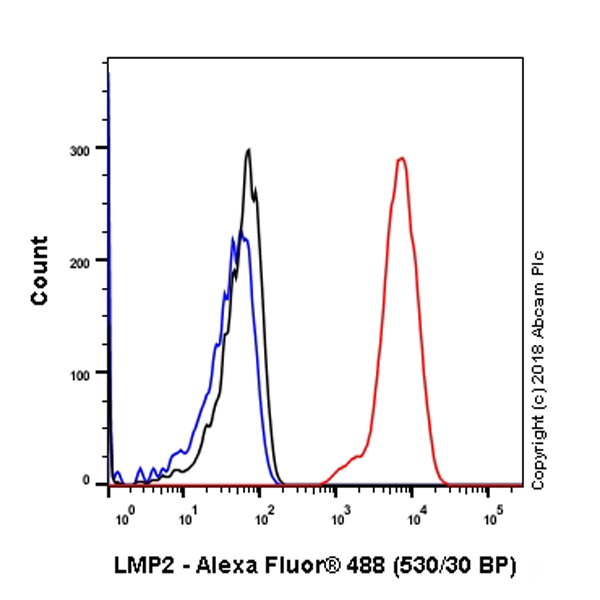
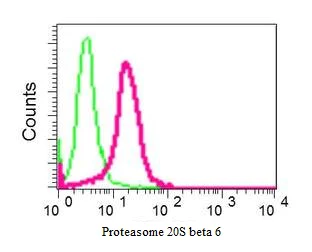
Flow Cytometry (Intracellular) - Anti-Proteasome 20S beta 6 antibody [EPR9685] (AB150366)

Intracellular flow cytometric analysis of permeabilized HeLa cells labelling Proteasome 20S beta 6 using ab150366 (red) or a rabbit IgG control (green).
Western blot - Anti-Proteasome 20S beta 6 antibody [EPR9685] (AB150366)
  • WB

Unknown

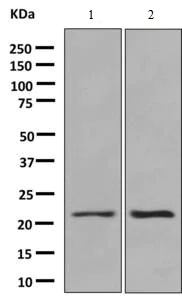
Western blot - Anti-Proteasome 20S beta 6 antibody [EPR9685] (AB150366)

All lanes:

Western blot - Anti-Proteasome 20S beta 6 antibody [EPR9685] (ab150366) at 1/1000 dilution

Lane 1:

Fetal liver lysate at 10 µg

Lane 2:

HeLa cell lysate at 10 µg

Secondary

All lanes:

HRP labelled goat anti-rabbit at 1/2000 dilution

Predicted band size: 25 kDa

false

不同偶联物与剂型 (1)

  • Carrier free

    Anti-Proteasome 20S beta 6 antibody [EPR9685] - BSA and Azide free

关键信息

宿主种属

Rabbit

克隆

Monoclonal

克隆号

EPR9685

亚型

IgG

不含载体蛋白

No

反应种属

Human

应用

Flow Cyt (Intra), WB

applications

免疫原

The exact immunogen used to generate this antibody is proprietary information.

反应性数据

{ "title": "Reactivity Data", "filters": { "stats": ["", "Species", "Dilution Info", "Notes"], "tabs": { "all-applications": {"fullname" : "All Applications", "shortname": "All Applications"}, "ICCIF" : {"fullname" : "Immunocytochemistry/ Immunofluorescence", "shortname":"ICC/IF"}, "WB" : {"fullname" : "Western blot", "shortname":"WB"}, "IHCP" : {"fullname" : "Immunohistochemistry (Formalin/PFA-fixed paraffin-embedded sections)", "shortname":"IHC-P"}, "FlowCytIntra" : {"fullname" : "Flow Cytometry (Intracellular)", "shortname":"Flow Cyt (Intra)"} }, "product-promise": { "all": "all", "testedAndGuaranteed": "tested", "guaranteed": "expected", "predicted": "predicted", "notRecommended": "not-recommended" } }, "values": { "Human": { "ICCIF-species-checked": "notRecommended", "ICCIF-species-dilution-info": "", "ICCIF-species-notes": "<p></p>", "WB-species-checked": "testedAndGuaranteed", "WB-species-dilution-info": "1/1000 - 1/10000", "WB-species-notes": "<p></p>", "IHCP-species-checked": "notRecommended", "IHCP-species-dilution-info": "", "IHCP-species-notes": "<p></p>", "FlowCytIntra-species-checked": "testedAndGuaranteed", "FlowCytIntra-species-dilution-info": "1/10 - 1/100", "FlowCytIntra-species-notes": "<p><a href='/products/primary-antibodies/rabbit-igg-monoclonal-epr25a-isotype-control-ab172730'>ab172730</a> - Rabbit monoclonal IgG, is suitable for use as an isotype control with this antibody.</p>" }, "Mouse": { "ICCIF-species-checked": "notRecommended", "ICCIF-species-dilution-info": "", "ICCIF-species-notes": "", "WB-species-checked": "guaranteed", "WB-species-dilution-info": "", "WB-species-notes": "<p></p>", "IHCP-species-checked": "notRecommended", "IHCP-species-dilution-info": "", "IHCP-species-notes": "", "FlowCytIntra-species-checked": "predicted", "FlowCytIntra-species-dilution-info": "", "FlowCytIntra-species-notes": "" }, "Rat": { "ICCIF-species-checked": "notRecommended", "ICCIF-species-dilution-info": "", "ICCIF-species-notes": "", "WB-species-checked": "guaranteed", "WB-species-dilution-info": "", "WB-species-notes": "<p></p>", "IHCP-species-checked": "notRecommended", "IHCP-species-dilution-info": "", "IHCP-species-notes": "", "FlowCytIntra-species-checked": "predicted", "FlowCytIntra-species-dilution-info": "", "FlowCytIntra-species-notes": "" } } }

产品详情

Patented technology
Our RabMAb® technology is a patented hybridoma-based technology for making rabbit monoclonal antibodies. For details on our patents, please refer to RabMAb® patents.

What are the advantages of a recombinant monoclonal antibody?
This product is a recombinant monoclonal antibody, which offers several advantages including:

  • - High batch-to-batch consistency and reproducibility
  • - Improved sensitivity and specificity
  • - Long-term security of supply
  • - Animal-free batch production

For more information, read more on recombinant antibodies.

性能和储存信息

形式
Liquid
纯化工艺
Affinity purification Protein A
存储溶液
pH: 7.2 - 7.4 Preservative: 0.01% Sodium azide Constituents: PBS, 40% Glycerol (glycerin, glycerine), 0.05% BSA
运输条件
Conditional Ambient
推荐的短期储存条件
+4°C
推荐的长期储存条件
-20°C
分装信息
Upon delivery aliquot
储存信息
Avoid freeze / thaw cycle

补充信息

This supplementary information is collated from multiple sources and compiled automatically.

Proteasome 20S beta 6 also known as PSMB6 is a subunit of the proteasome complex. It plays a significant role in the protein degradation process. Its molecular weight is around 25 kDa. The subunit gets expressed in various cell types throughout the body ensuring that proteins are effectively broken down into peptides. This is essential for maintaining protein homeostasis and recycling faulty proteins.
Biological function summary

The proteasome 20S beta 6 subunit forms part of the 20S core complex an important component of the proteasome. The proteasome operates as the main proteolytic machinery in both nucleus and cytoplasm. The 20S core complex pairs with the regulatory 19S cap to form the 26S proteasome. This assembly degrades ubiquitin-tagged proteins which regulates cell cycle progression apoptosis and DNA repair contributing to cellular function and health.

Pathways

Proteasome 20S beta 6 acts within the ubiquitin-proteasome pathway. This pathway regulates protein turnover affecting critical cellular processes such as cell cycle apoptosis and the immune response. The pathway also links with other proteins such as ubiquitin and E1 E2 and E3 ligases which modify proteins with ubiquitin chains to signal for their degradation.

Proteasome 20S beta 6 may relate to cancer and neurodegenerative diseases like Alzheimer's. The abnormal regulation of the proteasome pathway can lead to the accumulation of undegraded proteins contributing to these diseases. PSMB6 interacts with proteins such as p53 a tumor suppressor protein highlighting its relevance to cell cycle control and cancer progression.

产品实验方案

For this product, it's our understanding that no specific protocols are required. You can visit:

靶点信息

Component of the 20S core proteasome complex involved in the proteolytic degradation of most intracellular proteins. This complex plays numerous essential roles within the cell by associating with different regulatory particles. Associated with two 19S regulatory particles, forms the 26S proteasome and thus participates in the ATP-dependent degradation of ubiquitinated proteins. The 26S proteasome plays a key role in the maintenance of protein homeostasis by removing misfolded or damaged proteins that could impair cellular functions, and by removing proteins whose functions are no longer required. Associated with the PA200 or PA28, the 20S proteasome mediates ubiquitin-independent protein degradation. This type of proteolysis is required in several pathways including spermatogenesis (20S-PA200 complex) or generation of a subset of MHC class I-presented antigenic peptides (20S-PA28 complex). Within the 20S core complex, PSMB6 displays a peptidylglutamyl-hydrolizing activity also termed postacidic or caspase-like activity, meaning that the peptides bond hydrolysis occurs directly after acidic residues.
See full target information PSMB6

文献 (1)

Recent publications for all applications. Explore the full list and refine your search

Open medicine (Warsaw, Poland) 20:20251206 PubMed40918165

2025

Peptide CCAT1-70aa promotes hepatocellular carcinoma proliferation and invasion via the MAPK/ERK pathway.

Applications

Unspecified application

Species

Unspecified reactive species

Xianjian Wu,Ruifeng Liang,Guoman Liu,Quan Fang,Zuoming Xu,Wenchuan Li,Chuan Tan,Jian Pu
View all publications

Abcam Product Promise

我们致力于为您的研究提供高质量的试剂,为您科研的每一步提供支持。若我们的产品未能达到预期性能,我们向您提供 Abcam Product Promise 保障。
详情请参阅我们的条款与条件。

Please note: All products are 'FOR RESEARCH USE ONLY. NOT FOR USE IN DIAGNOSTIC OR THERAPEUTIC PROCEDURES'.

For licensing inquiries, please contact partnerships@abcam.com