JavaScript is disabled in your browser. Please enable JavaScript to view this website.
AB222065

Anti-POLR1A抗体

Anti-POLR1A antibody

Be the first to review this product! Submit a review

|

(2 Publications)

Rabbit Polyclonal POLR1A antibody. Suitable for ICC/IF and reacts with Human samples. Cited in 2 publications. Immunogen corresponding to Recombinant Fragment Protein within Human POLR1A aa 800-950.

查看别名

DNA-directed RNA polymerase I subunit RPA1, RNA polymerase I subunit A1, A190, DNA-directed RNA polymerase I largest subunit, DNA-directed RNA polymerase I subunit A, RNA polymerase I 194 kDa subunit, RPA194, POLR1A
1 Images
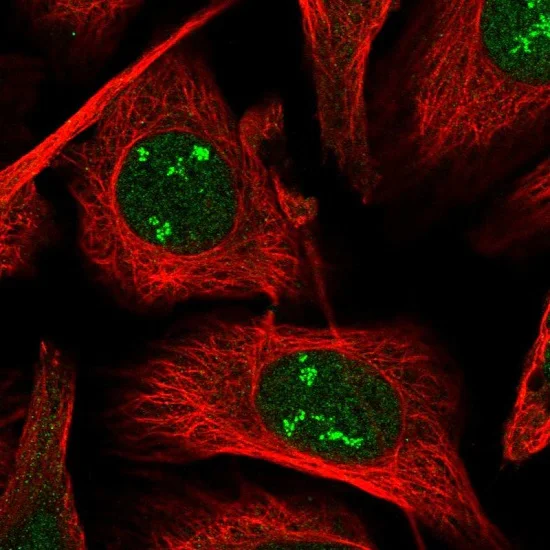
Immunocytochemistry/ Immunofluorescence - Anti-POLR1A antibody (AB222065)
  • ICC/IF

Supplier Data

Immunocytochemistry/ Immunofluorescence - Anti-POLR1A antibody (AB222065)

PFA-fixed, Triton X-100 permeabilized U-2 OS (human bone osteosarcoma epithelial cell line) cells stained for POLR1A (green) using ab222065 at 4 μg/ml in ICC/IF.

关键信息

宿主种属

Rabbit

克隆

Polyclonal

亚型

IgG

不含载体蛋白

No

反应种属

Human

应用

ICC/IF

applications

免疫原

Recombinant Fragment Protein within Human POLR1A aa 800-950. The exact immunogen used to generate this antibody is proprietary information.

O95602

反应性数据

{ "title": "Reactivity Data", "filters": { "stats": ["", "Species", "Dilution Info", "Notes"], "tabs": { "all-applications": {"fullname" : "All Applications", "shortname": "All Applications"}, "ICCIF" : {"fullname" : "Immunocytochemistry/ Immunofluorescence", "shortname":"ICC/IF"} }, "product-promise": { "all": "all", "testedAndGuaranteed": "tested", "guaranteed": "expected", "predicted": "predicted", "notRecommended": "not-recommended" } }, "values": { "Human": { "ICCIF-species-checked": "testedAndGuaranteed", "ICCIF-species-dilution-info": "0.25-2 µg/mL", "ICCIF-species-notes": "<p>Fixation/Permeabilization: PFA/Triton X-100.</p>" }, "Mouse": { "ICCIF-species-checked": "predicted", "ICCIF-species-dilution-info": "", "ICCIF-species-notes": "" }, "Rat": { "ICCIF-species-checked": "predicted", "ICCIF-species-dilution-info": "", "ICCIF-species-notes": "" } } }

性能和储存信息

形式
Liquid
纯化工艺
Affinity purification Immunogen
存储溶液
pH: 7.2 Preservative: 0.02% Sodium azide Constituents: PBS, 40% Glycerol (glycerin, glycerine)
运输条件
Blue Ice
推荐的短期储存时间
1-2 weeks
推荐的短期储存条件
+4°C
推荐的长期储存条件
-20°C
分装信息
Upon delivery aliquot
储存信息
Avoid freeze / thaw cycle

补充信息

This supplementary information is collated from multiple sources and compiled automatically.

The POLR1A protein also known as RNA polymerase I subunit RPA1 plays an important mechanical role in the synthesis of ribosomal RNA (rRNA). POLR1A has a molecular mass of approximately 194 kDa. This protein is ubiquitously expressed across various tissues contributing extensively to the cellular machinery for protein synthesis. As an essential component of RNA polymerase I POLR1A shares structural features typical of RNA polymerase enzymes facilitating the transcription of rRNA genes.
Biological function summary

POLR1A functions as part of the RNA polymerase I complex which specializes in transcribing rRNA a critical component of ribosome biogenesis. This process is central to the synthesis of rRNA precursors which later modify to form mature rRNA. POLR1A works in conjunction with other subunits to ensure efficient and accurate transcription within the nucleolus demonstrating its significance in maintaining cellular protein synthesis capacity. The protein's activity supports the assembly of ribosomes influencing cell growth and division.

Pathways

POLR1A is integrally involved in the ribosome biogenesis and rRNA transcription pathways. These pathways are essential for producing ribosomes the molecular machines responsible for protein translation in cells. POLR1A has interactions with proteins like TIF-IA and UBF both of which regulate its transcriptional activity at specific rRNA gene promoters. This interaction regulates POLR1A's function in response to cellular conditions ensuring that protein synthesis matches cellular demands.

POLR1A's function has links to conditions like Treacher Collins syndrome and Acrofacial Dysostosis. Mutations in POLR1A can lead to defects in ribosome biogenesis disrupting the growth and development of craniofacial structures observed in these syndromes. Additionally POLR1A interacts with proteins such as NOP56 and fibrillarin which are involved in rRNA processing and assembly suggesting that any disruptions in these interactions could contribute to ribosomopathies. POLR1A's role in maintaining rRNA transcription highlights its significance in preventing defects that translate to broader systemic issues.

产品实验方案

For this product, it's our understanding that no specific protocols are required. You can visit:

靶点信息

Catalytic core component of RNA polymerase I (Pol I), a DNA-dependent RNA polymerase which synthesizes ribosomal RNA precursors using the four ribonucleoside triphosphates as substrates. Transcribes 47S pre-rRNAs from multicopy rRNA gene clusters, giving rise to 5.8S, 18S and 28S ribosomal RNAs (PubMed : 11250903, PubMed : 11283244, PubMed : 16858408, PubMed : 34671025, PubMed : 34887565, PubMed : 36271492). Pol I-mediated transcription cycle proceeds through transcription initiation, transcription elongation and transcription termination stages. During transcription initiation, Pol I pre-initiation complex (PIC) is recruited by the selectivity factor 1 (SL1/TIF-IB) complex bound to the core promoter that precedes an rDNA repeat unit. The PIC assembly bends the promoter favoring the formation of the transcription bubble and promoter escape. Once the polymerase has escaped from the promoter it enters the elongation phase during which RNA is actively polymerized, based on complementarity with the template DNA strand. Highly processive, assembles in structures referred to as 'Miller trees' where many elongating Pol I complexes queue and transcribe the same rDNA coding regions. At terminator sequences downstream of the rDNA gene, PTRF interacts with Pol I and halts Pol I transcription leading to the release of the RNA transcript and polymerase from the DNA (PubMed : 11250903, PubMed : 11283244, PubMed : 16858408, PubMed : 34671025, PubMed : 34887565, PubMed : 36271492). Forms Pol I active center together with the second largest subunit POLR1B/RPA2. Appends one nucleotide at a time to the 3' end of the nascent RNA, with POLR1A/RPA1 contributing a Mg(2+)-coordinating DxDGD motif, and POLR1B/RPA2 participating in the coordination of a second Mg(2+) ion and providing lysine residues believed to facilitate Watson-Crick base pairing between the incoming nucleotide and the template base. Typically, Mg(2+) ions direct a 5' nucleoside triphosphate to form a phosphodiester bond with the 3' hydroxyl of the preceding nucleotide of the nascent RNA, with the elimination of pyrophosphate. Has proofreading activity : Pauses and backtracks to allow the cleavage of a missincorporated nucleotide via POLR1H/RPA12. High Pol I processivity is associated with decreased transcription fidelity (By similarity) (PubMed : 11250903, PubMed : 11283244, PubMed : 16858408, PubMed : 34671025, PubMed : 34887565, PubMed : 36271492).
See full target information POLR1A

文献 (2)

Recent publications for all applications. Explore the full list and refine your search

EMBO reports 25:1909-1935 PubMed38424231

2024

CKAP5 stabilizes CENP-E at kinetochores by regulating microtubule-chromosome attachments.

Applications

Unspecified application

Species

Unspecified reactive species

R Bhagya Lakshmi,Pinaki Nayak,Linoy Raz,Apurba Sarkar,Akshay Saroha,Pratibha Kumari,Vishnu M Nair,Delvin P Kombarakkaran,S Sajana,Sanusha M G,Sarit S Agasti,Raja Paul,Uri Ben-David,Tapas K Manna

PLoS neglected tropical diseases 13:e0007745 PubMed31560682

2019

Tick-borne encephalitis virus inhibits rRNA synthesis and host protein production in human cells of neural origin.

Applications

Unspecified application

Species

Unspecified reactive species

Martin Selinger,Hana Tykalová,Ján Štěrba,Pavlína Věchtová,Zuzana Vavrušková,Jaroslava Lieskovská,Alain Kohl,Esther Schnettler,Libor Grubhoffer
View all publications

Abcam Product Promise

我们致力于为您的研究提供高质量的试剂,为您科研的每一步提供支持。若我们的产品未能达到预期性能,我们向您提供 Abcam Product Promise 保障。
详情请参阅我们的条款与条件。

Please note: All products are 'FOR RESEARCH USE ONLY. NOT FOR USE IN DIAGNOSTIC OR THERAPEUTIC PROCEDURES'.

For licensing inquiries, please contact partnerships@abcam.com