JavaScript is disabled in your browser. Please enable JavaScript to view this website.
AB256533

重组Anti-Phosphothreonine抗体[EPR22006-23] - BSA and Azide free

Anti-Phosphothreonine antibody [EPR22006-23] - BSA and Azide free

Be the first to review this product! Submit a review

|

(1 Publication)

Rabbit Recombinant Monoclonal Phosphothreonine antibody. Carrier free. Suitable for ELISA, WB and reacts with Recombinant fragment, Mouse, Rat, Human samples. Cited in 1 publication.
1 Images
ELISA - Anti-Phosphothreonine antibody [EPR22006-23] - BSA and Azide free (AB256533)
  • ELISA

Unknown

ELISA - Anti-Phosphothreonine antibody [EPR22006-23] - BSA and Azide free (AB256533)

ELISA - Anti-Phosphothreonine antibody [EPR22006-23] (ab218195).

Each point in the Y axis represents one peptide of the corresponding protein used in ELISA test. The red asterisk indicates a phosphorylated amino acid site. The X axis is the signal to noise (S/N) ratio calculated by the signal intensity of a phospho peptide and its non-phospho paralog.

Antigens used at 1 μg/ml : TWIST1(pY107); TP73(pY99); SQSTM1 (pS403); NFKB (pS337); Phosphoserine; Phosphothreonine; ADD1(pT445); EIF2AK3(pT982); AURKB(pT232); AKT1(pT308).

Primary antibody ab218195 used at a 1/10,000 dilution.

Secondary antibody Alkaline Phosphatase AffiniPure Goat Anti-Rabbit IgG (H+L) used at a 1/2,500 dilution.

This data was developed using the same antibody clone in a different buffer formulation containing PBS, BSA, glycerol, and sodium azide (ab218195).

不同偶联物与剂型 (1)

关键信息

宿主种属

Rabbit

克隆

Monoclonal

克隆号

EPR22006-23

亚型

IgG

不含载体蛋白

Yes

反应种属

Mouse, Rat, Human

应用

ELISA, WB

applications

免疫原

The exact immunogen used to generate this antibody is proprietary information.

反应性数据

{ "title": "Reactivity Data", "filters": { "stats": ["", "Species", "Dilution Info", "Notes"], "tabs": { "all-applications": {"fullname" : "All Applications", "shortname": "All Applications"}, "IP" : {"fullname" : "Immunoprecipitation", "shortname":"IP"}, "FlowCyt" : {"fullname" : "Flow Cytometry", "shortname":"Flow Cyt"}, "ELISA" : {"fullname" : "ELISA", "shortname":"ELISA"}, "WB" : {"fullname" : "Western blot", "shortname":"WB"}, "ICCIF" : {"fullname" : "Immunocytochemistry/ Immunofluorescence", "shortname":"ICC/IF"} }, "product-promise": { "all": "all", "testedAndGuaranteed": "tested", "guaranteed": "expected", "predicted": "predicted", "notRecommended": "not-recommended" } }, "values": { "Human": { "IP-species-checked": "notRecommended", "IP-species-dilution-info": "", "IP-species-notes": "<p></p>", "FlowCyt-species-checked": "notRecommended", "FlowCyt-species-dilution-info": "", "FlowCyt-species-notes": "<p></p>", "ELISA-species-checked": "guaranteed", "ELISA-species-dilution-info": "", "ELISA-species-notes": "", "WB-species-checked": "testedAndGuaranteed", "WB-species-dilution-info": "", "WB-species-notes": "<p></p>", "ICCIF-species-checked": "notRecommended", "ICCIF-species-dilution-info": "", "ICCIF-species-notes": "<p></p>" }, "Mouse": { "IP-species-checked": "notRecommended", "IP-species-dilution-info": "", "IP-species-notes": "", "FlowCyt-species-checked": "notRecommended", "FlowCyt-species-dilution-info": "", "FlowCyt-species-notes": "", "ELISA-species-checked": "guaranteed", "ELISA-species-dilution-info": "", "ELISA-species-notes": "", "WB-species-checked": "testedAndGuaranteed", "WB-species-dilution-info": "", "WB-species-notes": "<p></p>", "ICCIF-species-checked": "notRecommended", "ICCIF-species-dilution-info": "", "ICCIF-species-notes": "" }, "Rat": { "IP-species-checked": "notRecommended", "IP-species-dilution-info": "", "IP-species-notes": "", "FlowCyt-species-checked": "notRecommended", "FlowCyt-species-dilution-info": "", "FlowCyt-species-notes": "", "ELISA-species-checked": "guaranteed", "ELISA-species-dilution-info": "", "ELISA-species-notes": "", "WB-species-checked": "testedAndGuaranteed", "WB-species-dilution-info": "", "WB-species-notes": "<p></p>", "ICCIF-species-checked": "notRecommended", "ICCIF-species-dilution-info": "", "ICCIF-species-notes": "" }, "Recombinant fragment": { "IP-species-checked": "notRecommended", "IP-species-dilution-info": "", "IP-species-notes": "", "FlowCyt-species-checked": "notRecommended", "FlowCyt-species-dilution-info": "", "FlowCyt-species-notes": "", "ELISA-species-checked": "testedAndGuaranteed", "ELISA-species-dilution-info": "", "ELISA-species-notes": "<p></p>", "WB-species-checked": "notRecommended", "WB-species-dilution-info": "", "WB-species-notes": "", "ICCIF-species-checked": "notRecommended", "ICCIF-species-dilution-info": "", "ICCIF-species-notes": "" } } }

产品详情

ab256533 is the carrier-free version of ab218195.

Patented technology
Our RabMAb® technology is a patented hybridoma-based technology for making rabbit monoclonal antibodies. For details on our patents, please refer to RabMAb® patents.

What are the advantages of a recombinant monoclonal antibody?
This product is a recombinant monoclonal antibody, which offers several advantages including:

  • - High batch-to-batch consistency and reproducibility
  • - Improved sensitivity and specificity
  • - Long-term security of supply
  • - Animal-free batch production

For more information, read more on recombinant antibodies.

Conjugation ready
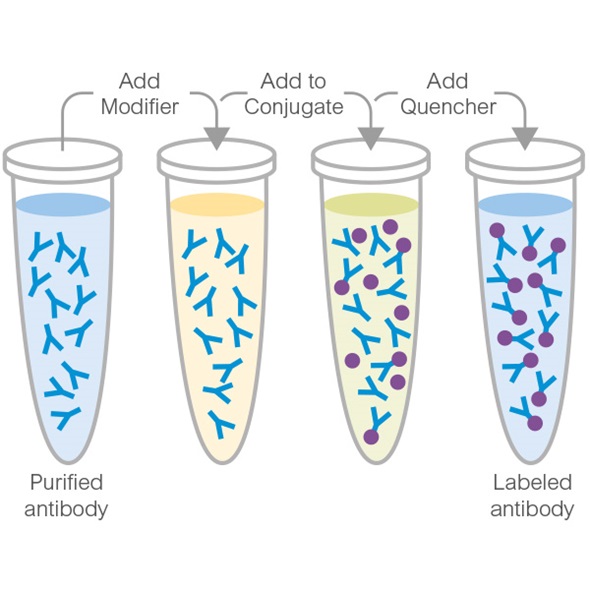
Our carrier-free antibodies are typically supplied in a PBS-only formulation, purified and free of BSA, sodium azide and glycerol. This conjugation-ready format is designed for use with fluorochromes, metal isotopes, oligonucleotides, and enzymes, which makes them ideal for antibody labelling, functional and cell-based assays, flow-based assays (e.g. mass cytometry) and Multiplex Imaging applications.

Use our conjugation kits for antibody conjugates that are ready-to-use in as little as 20 minutes with 1 minute hands-on-time and 100% antibody recovery: available for fluorescent dyes, HRP, biotin and gold.

Compatibility
This product is compatible with the Maxpar® Antibody Labeling Kit from Fluidigm, without the need for antibody preparation. Maxpar® is a trademark of Fluidigm Canada Inc.

性能和储存信息

形式
Liquid
纯化工艺
Affinity purification Protein A
存储溶液
pH: 7.2 - 7.4 Constituents: PBS
运输条件
Blue Ice
推荐的短期储存条件
+4°C
推荐的长期储存条件
+4°C
储存信息
Do Not Freeze

补充信息

This supplementary information is collated from multiple sources and compiled automatically.

Phosphothreonine often called phospho-threonine refers to a modified amino acid where a phosphate group attaches to threonine. It usually forms during protein post-translational modifications. This modification commonly occurs in eukaryotic cells and plays a significant role in regulating protein function. The mass of phosphothreonine itself is approximately 181 Da. Phosphothreonine residues are found in various proteins where they serve as important components for controlling multiple cellular processes.
Biological function summary

Phosphorylation of threonine residues influences protein activity localization and interactions. These phosphorylated threonine residues often exist as part of a larger protein complex influencing the dynamics of protein interactions. In cellular signal transduction they act as key regulatory switches. The modification is a reversible process which allows dynamic control over protein functionality in response to cellular signals.

Pathways

Signaling cascades often rely on phosphorylation events involving threonine which includes pathways like MAPK and PI3K/AKT. These pathways are essential for cellular responses to external stimuli and involve several other proteins such as RAS and AKT themselves. Through such pathways the phosphorylation state of threonine residues affects decisions about cell survival proliferation or differentiation.

Dysregulation of threonine phosphorylation links to conditions like cancer and diabetes. Abnormal phosphorylation patterns can lead to unregulated cell growth and survival common in tumorigenesis. Proteins such as p53 and insulin receptor substrates interact with phosphorylated threonine residues in these contexts. Investigating these interactions provides insights into the pathological mechanisms and potential therapeutic targets.

产品实验方案

For this product, it's our understanding that no specific protocols are required. You can visit:

文献 (1)

Recent publications for all applications. Explore the full list and refine your search

NPJ precision oncology 7:95 PubMed37723227

2023

Targeted single-cell proteomic analysis identifies new liquid biopsy biomarkers associated with multiple myeloma.

Applications

Unspecified application

Species

Unspecified reactive species

Sonia M Setayesh,Libere J Ndacayisaba,Kate E Rappard,Valerie Hennes,Luz Yurany Moreno Rueda,Guilin Tang,Pei Lin,Robert Z Orlowski,David E Symer,Elisabet E Manasanch,Stephanie N Shishido,Peter Kuhn
View all publications

Abcam Product Promise

我们致力于为您的研究提供高质量的试剂,为您科研的每一步提供支持。若我们的产品未能达到预期性能,我们向您提供 Abcam Product Promise 保障。
详情请参阅我们的条款与条件。

Please note: All products are 'FOR RESEARCH USE ONLY. NOT FOR USE IN DIAGNOSTIC OR THERAPEUTIC PROCEDURES'.

For licensing inquiries, please contact partnerships@abcam.com