重组Anti-Phosphothreonine抗体[EPR22006-23]
Anti-Phosphothreonine antibody [EPR22006-23]
- RabMAb
- Recombinant
- 了解详情
Be the first to review this product! Submit a review
|
(4 Publications)
- WB
Lab
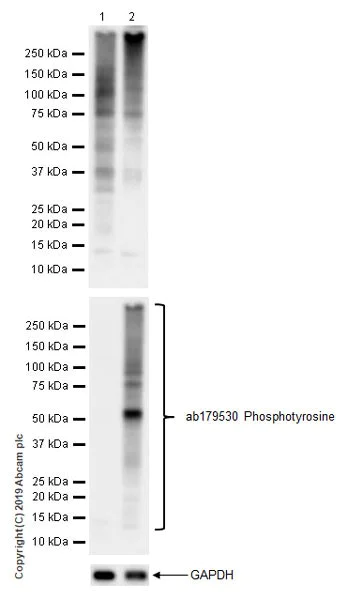
Western blot - Anti-Phosphothreonine antibody [EPR22006-23] (AB218195)
No difference in the signal detected by ab218195 upon pervanadate (a protein tyrosine phosphatase inhibitor) treatment.
Blocking/Dilution buffer : 5% NFDM/TBST.
All lanes:
Western blot - Anti-Phosphothreonine antibody [EPR22006-23] (ab218195) at 1/1000 dilution
Lane 1:
Untreated Jurkat (human t cell leukemia t lymphocyte) whole cell lysate at 20 µg
Lane 2:
Jurkat treated with 50 mM pervanadate for 5 minutes, whole cell lysate at 10 µg
Secondary
All lanes:
Western blot - Goat Anti-Rabbit IgG H&L (HRP) (<a href='/products/secondary-antibodies/goat-rabbit-igg-h-l-hrp-ab97051'>ab97051</a>) at 1/100000 dilution
false
Exposure time: 6s
- WB
Lab
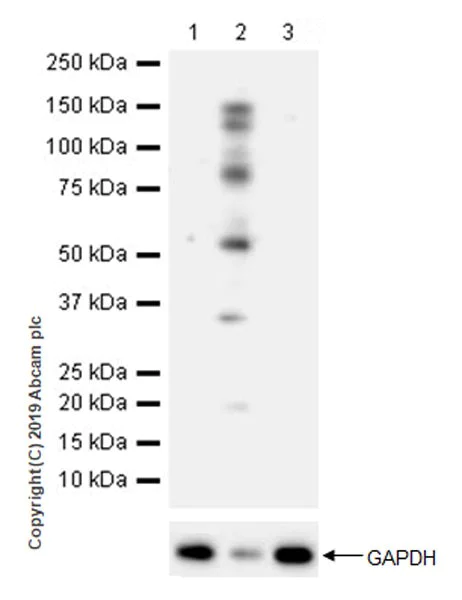
Western blot - Anti-Phosphothreonine antibody [EPR22006-23] (AB218195)
Blocking/Dilution buffer : 5% NFDM/TBST.
Observed MW : Multiple smeared bands.
All lanes:
Western blot - Anti-Phosphothreonine antibody [EPR22006-23] (ab218195) at 1/1000 dilution
Lane 1:
Untreated Jurkat (human t cell leukemia T lymphocyte) whole cell lysate (Untreated membrane) at 10 µg
Lane 2:
Jurkat treated with 0.1 μM Calyculin A for 45 minutes, whole cell lysate (Untreated membrane) at 10 µg
Lane 3:
Jurkat treated with 0.1 μM Calyculin A for 45 minutes, whole cell lysate (Phosphatase treated membrane) at 10 µg
Secondary
All lanes:
Western blot - Goat Anti-Rabbit IgG H&L (HRP) (<a href='/products/secondary-antibodies/goat-rabbit-igg-h-l-hrp-ab97051'>ab97051</a>) at 1/100000 dilution
false
Exposure time: 3min
- WB
Lab
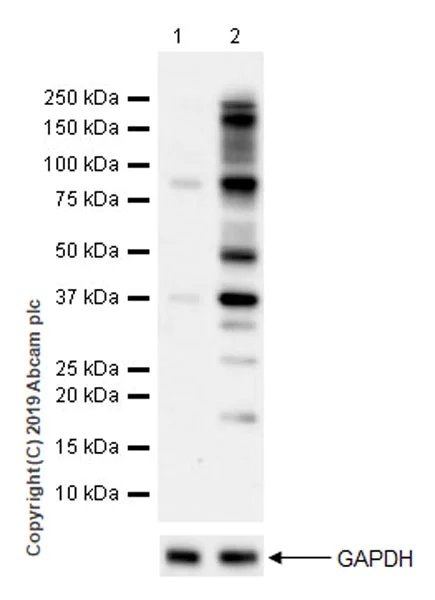
Western blot - Anti-Phosphothreonine antibody [EPR22006-23] (AB218195)
Blocking/Dilution buffer : 5% NFDM/TBST.
Observed MW : Multiple smeared bands.
All lanes:
Western blot - Anti-Phosphothreonine antibody [EPR22006-23] (ab218195) at 1/1000 dilution
Lane 1:
Untreated NIH/3T3 (mouse embryonic fibroblast) whole cell lysate at 10 µg
Lane 2:
NIH/3T3 treated with 0.1 uM Calyculin A for 15 minutes, whole cell lysate at 10 µg
Secondary
All lanes:
Western blot - Goat Anti-Rabbit IgG H&L (HRP) (<a href='/products/secondary-antibodies/goat-rabbit-igg-h-l-hrp-ab97051'>ab97051</a>) at 1/100000 dilution
false
Exposure time: 59s
- WB
Lab
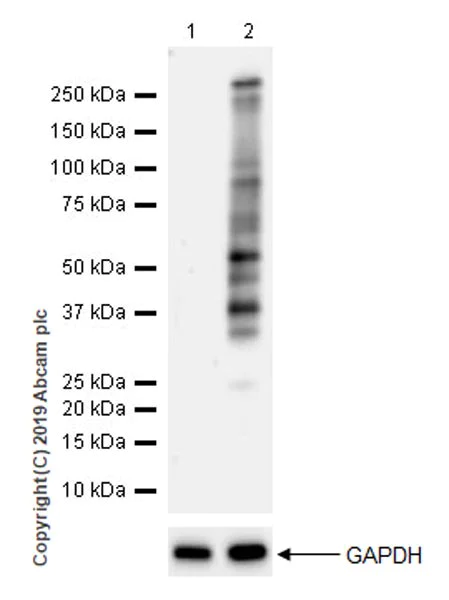
Western blot - Anti-Phosphothreonine antibody [EPR22006-23] (AB218195)
Blocking/Dilution buffer : 5% NFDM/TBST.
Observed MW : Multiple smeared bands.
All lanes:
Western blot - Anti-Phosphothreonine antibody [EPR22006-23] (ab218195) at 1/1000 dilution
Lane 1:
Untreated C6 (rat glial tumor glial cell) whole cell lysate at 10 µg
Lane 2:
C6 treated with 0.1 uM Calyculin A for 30 minutes, whole cell lysate at 10 µg
Secondary
All lanes:
Western blot - Goat Anti-Rabbit IgG H&L (HRP) (<a href='/products/secondary-antibodies/goat-rabbit-igg-h-l-hrp-ab97051'>ab97051</a>) at 1/100000 dilution
false
Exposure time: 3min
- ELISA
Unknown
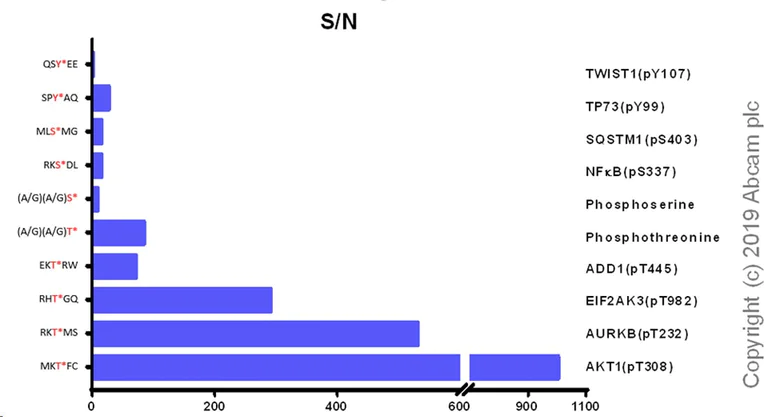
ELISA - Anti-Phosphothreonine antibody [EPR22006-23] (AB218195)
ELISA - Anti-Phosphothreonine antibody [EPR22006-23] (ab218195).
Each point in the Y axis represents one peptide of the corresponding protein used in ELISA test. The red asterisk indicates a phosphorylated amino acid site. The X axis is the signal to noise (S/N) ratio calculated by the signal intensity of a phospho peptide and its non-phospho paralog.
Antigens used at 1 μg/ml : TWIST1(pY107); TP73(pY99); SQSTM1 (pS403); NFKB (pS337); Phosphoserine; Phosphothreonine; ADD1(pT445); EIF2AK3(pT982); AURKB(pT232); AKT1(pT308).
Primary antibody ab218195 used at a 1/10,000 dilution.
Secondary antibody Alkaline Phosphatase AffiniPure Goat Anti-Rabbit IgG (H+L) used at a 1/2,500 dilution.
不同偶联物与剂型 (1)
-
Anti-Phosphothreonine antibody [EPR22006-23] - BSA and Azide free
替代产品


搭配使用产品

Primary Antibodies
AB179530
Anti-Phosphotyrosine antibody [EPR16871]
20ul selling size|RabMAb|Recombinant

- 0
- 0
反应性数据
产品详情
Patented technology
Our RabMAb® technology is a patented hybridoma-based technology for making rabbit monoclonal antibodies. For details on our patents, please refer to RabMAb® patents.
What are the advantages of a recombinant monoclonal antibody?
This product is a recombinant monoclonal antibody, which offers several advantages including:
- - High batch-to-batch consistency and reproducibility
- - Improved sensitivity and specificity
- - Long-term security of supply
- - Animal-free batch production
For more information, read more on recombinant antibodies.
性能和储存信息
形式
纯化工艺
存储溶液
运输条件
推荐的短期储存时间
推荐的短期储存条件
推荐的长期储存条件
分装信息
储存信息
补充信息
This supplementary information is collated from multiple sources and compiled automatically.
Biological function summary
Phosphorylation of threonine residues influences protein activity localization and interactions. These phosphorylated threonine residues often exist as part of a larger protein complex influencing the dynamics of protein interactions. In cellular signal transduction they act as key regulatory switches. The modification is a reversible process which allows dynamic control over protein functionality in response to cellular signals.
Pathways
Signaling cascades often rely on phosphorylation events involving threonine which includes pathways like MAPK and PI3K/AKT. These pathways are essential for cellular responses to external stimuli and involve several other proteins such as RAS and AKT themselves. Through such pathways the phosphorylation state of threonine residues affects decisions about cell survival proliferation or differentiation.
产品实验方案
- Visit the General protocols
- Visit the Troubleshooting
文献 (4)
Recent publications for all applications. Explore the full list and refine your search
Plant communications 6:101347 PubMed40319354
2025
Applications
Unspecified application
Species
Unspecified reactive species
ACS chemical biology 18:2485-2494 PubMed38098459
2023
Applications
Unspecified application
Species
Unspecified reactive species
Plant communications 4:100559 PubMed36774537
2023
Applications
Unspecified application
Species
Unspecified reactive species
ACS chemical biology 17:1598-1606 PubMed35647667
2022
Applications
Unspecified application
Species
Unspecified reactive species
Abcam Product Promise
Please note: All products are 'FOR RESEARCH USE ONLY. NOT FOR USE IN DIAGNOSTIC OR THERAPEUTIC PROCEDURES'.
For licensing inquiries, please contact partnerships@abcam.com