重组Anti-PHLDA1抗体[EPR6674]
Anti-PHLDA1 antibody [EPR6674]
- RabMAb
- Recombinant
- 了解详情
Be the first to review this product! Submit a review
|
(9 Publications)
Rabbit Recombinant Monoclonal PHLDA1 antibody. Suitable for IHC-P, WB, ICC/IF and reacts with Human samples. Cited in 9 publications.
查看别名
PHRIP, TDAG51, PHLDA1, Pleckstrin homology-like domain family A member 1, Apoptosis-associated nuclear protein, Proline- and glutamine-rich protein, Proline- and histidine-rich protein, T-cell death-associated gene 51 protein, PQ-rich protein, PQR protein
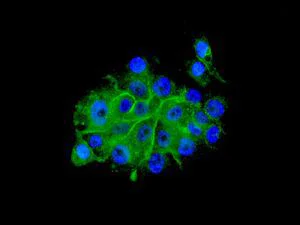
- ICC/IF
Unknown
Immunocytochemistry/ Immunofluorescence - Anti-PHLDA1 antibody [EPR6674] (AB133654)
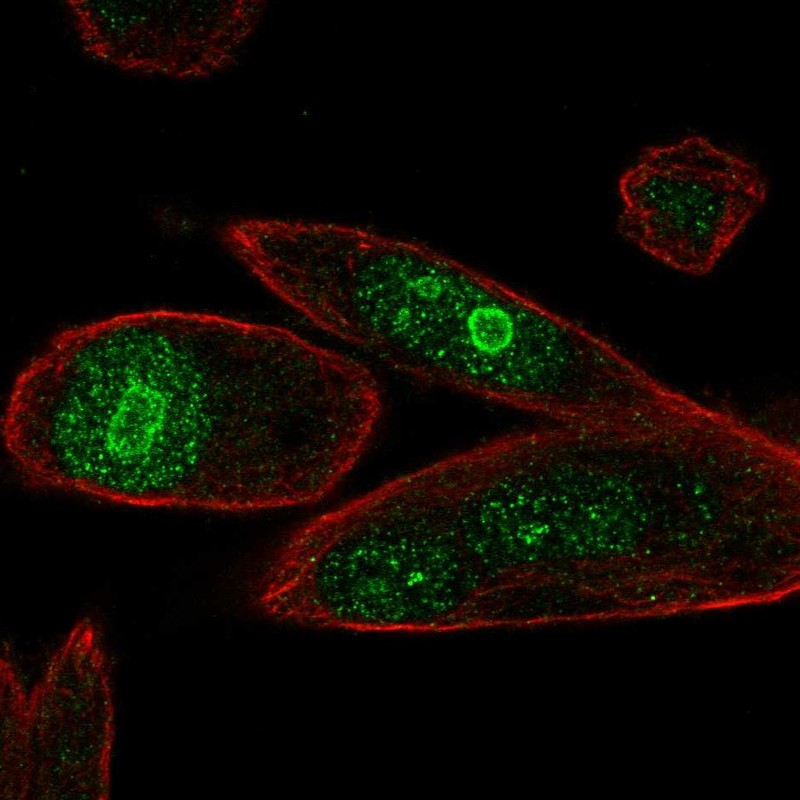
Immunocytochemical analysis of PHLDA1 in BxPC3 cells labelled with ab133654 at a 1/100 dilution.
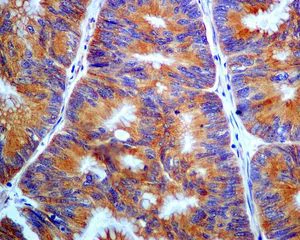
- IHC-P
Unknown
Immunohistochemistry (Formalin/PFA-fixed paraffin-embedded sections) - Anti-PHLDA1 antibody [EPR6674] (AB133654)
Immunohistochemical analysis of PHLDA1 in paraffin embedded Human colon carcinoma tissue labelled with ab133654 at a 1/50 dilution.
Perform heat mediated antigen retrieval before commencing with IHC staining protocol.
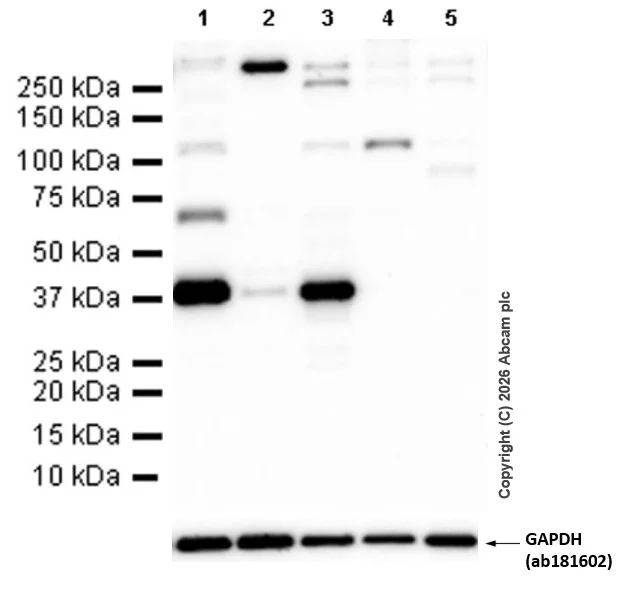
- WB
Lab
Western blot - Anti-PHLDA1 antibody [EPR6674] (AB133654)
Blocking and diluting buffer and concentration : 5% NFDM /TBST. ab181602 was used as a GAPDH loading control at 1/1000000 dilution. The observed signal is consistent with the database expression data.
All lanes:
Western blot - Anti-PHLDA1 antibody [EPR6674] (ab133654) at 1/1000 dilution
Lane 1:
SK-MEL-28 (human malignant melanoma) whole cell lysate at 20 µg
Lane 2:
HeLa (human cervix adenocarcinoma epithelial cell) whole cell lysate at 20 µg
Lane 3:
Human salivary gland tissue lysate at 20 µg
Lane 4:
Human lung tissue lysate at 20 µg
Lane 5:
Human liver tissue lysate at 20 µg
Secondary
All lanes:
Goat Anti-Rabbit IgG (HRP) with minimal cross-reactivity with human IgG at 1/2000 dilution
Observed band size: 45 kDa
false
Exposure time: 40s
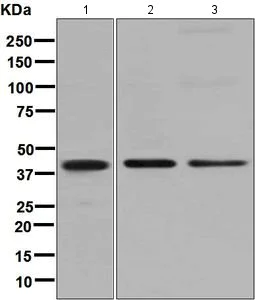
- WB
Unknown
Western blot - Anti-PHLDA1 antibody [EPR6674] (AB133654)
All lanes:
Western blot - Anti-PHLDA1 antibody [EPR6674] (ab133654) at 1/10000 dilution
Lane 1:
Human melanoma tissue lysate at 10 µg
Lane 2:
A375 cell lysate at 10 µg
Lane 3:
BxPC3 cell lysate at 10 µg
Secondary
All lanes:
Goat anti-Rabbit HRP at 1/2000 dilution
Predicted band size: 45 kDa
false
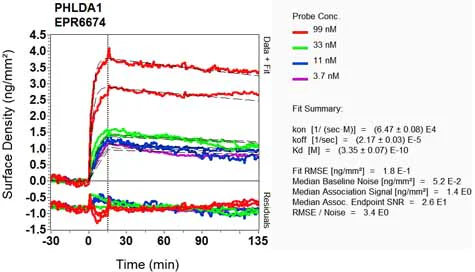
- OI-RD Scanning
Unknown
OI-RD Scanning - Anti-PHLDA1 antibody [EPR6674] (AB133654)
We have systematically measured KD (the equilibrium dissociation constant between the antibody and its antigen), of more than 840 recombinant antibodies to assess not only their individual KD values but also to see the average affinity of antibody. Based on the comparison with published literature values for mouse monoclonal antibodies, Recombinant antibodies appear to be on average 1-2 order of magnitude higher affinity.
不同偶联物与剂型 (3)
-
Anti-PHLDA1 antibody [EPR6674] - BSA and Azide free
-
519 Alexa Fluor® 488
Alexa Fluor® 488 Anti-PHLDA1 antibody [EPR6674]
-
665 Alexa Fluor® 647
Alexa Fluor® 647 Anti-PHLDA1 antibody [EPR6674]
替代产品
搭配使用产品
Primary Antibodies
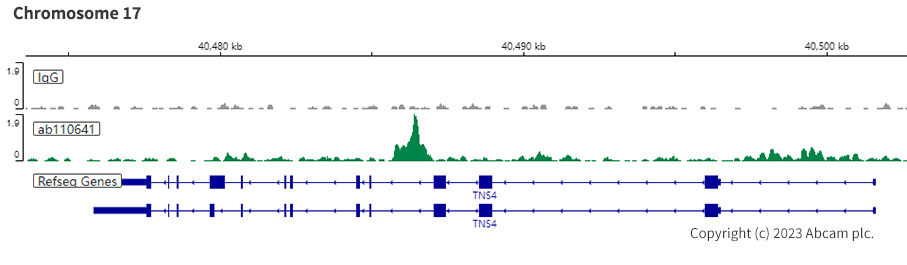
AB110641
Anti-BRG1 antibody [EPNCIR111A]
20ul selling size|BOND RX™ Validated|Recombinant|KO Validated|Advanced Validation|RabMAb
- 5
- 10
Primary Antibodies
AB32124
BOND RX™ Validated|RabMAb|Recombinant|KO Validated|20ul selling size

- 3
- 14
反应性数据
产品详情
Species reactivity
Mouse, Rat: We have preliminary internal testing data to indicate this antibody may not react with these species.
Please contact us for more information.
Patented technology
Our RabMAb® technology is a patented hybridoma-based technology for making rabbit monoclonal antibodies. For details on our patents, please refer to RabMAb® patents.
What are the advantages of a recombinant monoclonal antibody?
This product is a recombinant monoclonal antibody, which offers several advantages including:
- - High batch-to-batch consistency and reproducibility
- - Improved sensitivity and specificity
- - Long-term security of supply
- - Animal-free batch production
For more information, read more on recombinant antibodies.
性能和储存信息
形式
纯化工艺
存储溶液
运输条件
推荐的短期储存条件
推荐的长期储存条件
储存信息
补充信息
This supplementary information is collated from multiple sources and compiled automatically.
Biological function summary
PHLDA1 contributes to cellular processes such as apoptosis survival and proliferation. It does not appear to be part of a larger complex but engages in interactions that regulate cell fate. PHLDA1 mediates cellular response to stress and participates in cellular growth regulation by modulating the activity of other signaling molecules. This function makes it important in maintaining cellular homeostasis.
Pathways
Researchers connect PHLDA1 to the Akt signaling pathway and the TNF receptor pathway. In the Akt signaling pathway PHLDA1 interacts with proteins such as Forkhead box O3 (FOXO3) to influence cell survival and apoptosis. In the TNF receptor pathway PHLDA1 participates in modulating the balance between cell survival and programmed cell death impacting inflammatory responses.
产品实验方案
- Visit the General protocols
- Visit the Troubleshooting
靶点信息
文献 (9)
Recent publications for all applications. Explore the full list and refine your search
Translational oncology 55:102301 PubMed40132389
2025
Applications
Unspecified application
Species
Unspecified reactive species
International journal of molecular sciences 24: PubMed37047202
2023
Applications
Unspecified application
Species
Unspecified reactive species
Allergologia et immunopathologia 50:1-9 PubMed36335439
2022
Applications
Unspecified application
Species
Unspecified reactive species
Cellular and molecular life sciences : CMLS 79:520 PubMed36107262
2022
Applications
Unspecified application
Species
Unspecified reactive species
Nature communications 13:4063 PubMed35831322
2022
Applications
Unspecified application
Species
Unspecified reactive species
Frontiers in oncology 10:1250 PubMed32983961
2020
Applications
Unspecified application
Species
Unspecified reactive species
Cell reports 22:2469-2481 PubMed29490281
2018
Applications
Unspecified application
Species
Unspecified reactive species
Clinical and translational medicine 6:5 PubMed28101782
2017
Applications
Unspecified application
Species
Unspecified reactive species
The Journal of biological chemistry 291:10058-66 PubMed26961871
2016
Applications
Unspecified application
Species
Unspecified reactive species
Abcam Product Promise
Please note: All products are 'FOR RESEARCH USE ONLY. NOT FOR USE IN DIAGNOSTIC OR THERAPEUTIC PROCEDURES'.
For licensing inquiries, please contact partnerships@abcam.com