JavaScript is disabled in your browser. Please enable JavaScript to view this website.
AB53796

Anti-PARP9 抗体

Anti-PARP9 antibody

Be the first to review this product! Submit a review

|

(8 Publications)

Rabbit Polyclonal PARP9 antibody. Suitable for IP, WB and reacts with Human samples. Cited in 8 publications. Immunogen corresponding to Synthetic Peptide within Human PARP9.

查看别名

BAL, BAL1, PARP9, Protein mono-ADP-ribosyltransferase PARP9, ADP-ribosyltransferase diphtheria toxin-like 9, B aggressive lymphoma protein, Poly [ADP-ribose] polymerase 9, ARTD9, PARP-9
1 Images
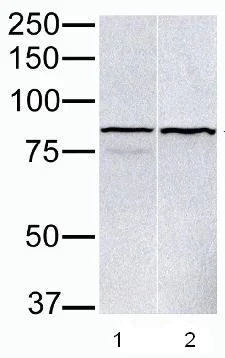
Western blot - Anti-PARP9 antibody (AB53796)
  • WB

Unknown

Western blot - Anti-PARP9 antibody (AB53796)

All lanes:

Western blot - Anti-PARP9 antibody (ab53796) at 1 µg/mL

Lane 1:

Farage (human non-Hodgkin's lymphoma B cell line) cell lysate

Lane 2:

BC-1 (human B-cell lymphoma cell line) cell lysate

Predicted band size: 96 kDa

Observed band size: 88 kDa

false

关键信息

宿主种属

Rabbit

克隆

Polyclonal

亚型

IgG

不含载体蛋白

No

反应种属

Human

应用

WB, IP

applications

免疫原

Synthetic Peptide within Human PARP9. The exact immunogen used to generate this antibody is proprietary information.

Q8IXQ6

反应性数据

{ "title": "Reactivity Data", "filters": { "stats": ["", "Species", "Dilution Info", "Notes"], "tabs": { "all-applications": {"fullname" : "All Applications", "shortname": "All Applications"}, "IP" : {"fullname" : "Immunoprecipitation", "shortname":"IP"}, "WB" : {"fullname" : "Western blot", "shortname":"WB"} }, "product-promise": { "all": "all", "testedAndGuaranteed": "tested", "guaranteed": "expected", "predicted": "predicted", "notRecommended": "not-recommended" } }, "values": { "Human": { "IP-species-checked": "guaranteed", "IP-species-dilution-info": "", "IP-species-notes": "<p>Use at a concentration of 7 Âμg/reaction.</p>", "WB-species-checked": "testedAndGuaranteed", "WB-species-dilution-info": "1-3 µg/mL", "WB-species-notes": "<p></p>" } } }

性能和储存信息

形式
Liquid
纯化工艺
Affinity purification Immunogen
纯化说明
This antibody is epitope affinity purified from rabbit antiserum.
存储溶液
pH: 7.4 Preservative: 0.1% Sodium azide Constituents: PBS
运输条件
Blue Ice
推荐的短期储存时间
1-2 weeks
推荐的短期储存条件
+4°C
推荐的长期储存条件
-20°C
分装信息
Upon delivery aliquot

补充信息

This supplementary information is collated from multiple sources and compiled automatically.

PARP9 also known as ADP-ribosyltransferase diphtheria toxin-like 9 is a protein involved in cellular DNA repair and immune response. The protein has a molecular mass of approximately 88 kDa. It is notably expressed in various tissues including lymphoid tissues and immune cells suggesting a role in the immune system. PARP9 possesses domains that may facilitate interactions with other proteins playing a part in regulating cellular repair processes.
Biological function summary

PARP9 enhances DNA repair mechanisms and modulates the immune response. It may work as part of larger protein complexes coordinating with other proteins to maintain genomic stability and regulate transcription. Its involvement in these complexes indicates a supportive role in cellular defense ensuring the integrity of genetic information and proper immune function. Moreover PARP9 may influence signal transduction pathways related to inflammation and cell survival.

Pathways

PARP9 participates in critical networks that govern DNA damage response and immune signaling. It aligns with the NF-kB pathway which controls transcription of DNA cytokine production and cell survival. Additionally PARP9 associates with the innate immune response pathway influencing processes driven by related proteins like STAT1 enhancing the cellular response to external stressors. These interactions reflect its contribution to cellular adaptation and resilience.

PARP9 links to conditions with underlying inflammatory or immune-related components. Its dysregulation associates with autoimmune diseases where it may influence abnormal immune activity. Additionally PARP9 has connections to certain cancers potentially through interactions with proteins like STAT3 which influences cell proliferation and survival. Understanding PARP9's role in these conditions could guide therapeutic strategies targeting abnormal protein interactions and signaling.

产品实验方案

For this product, it's our understanding that no specific protocols are required. You can visit:

靶点信息

ADP-ribosyltransferase which, in association with E3 ligase DTX3L, plays a role in DNA damage repair and in immune responses including interferon-mediated antiviral defenses (PubMed : 16809771, PubMed : 23230272, PubMed : 26479788, PubMed : 27796300). Within the complex, enhances DTX3L E3 ligase activity which is further enhanced by PARP9 binding to poly(ADP-ribose) (PubMed : 28525742). In association with DTX3L and in presence of E1 and E2 enzymes, mediates NAD(+)-dependent mono-ADP-ribosylation of ubiquitin which prevents ubiquitin conjugation to substrates such as histones (PubMed : 28525742). During DNA repair, PARP1 recruits PARP9/BAL1-DTX3L complex to DNA damage sites via PARP9 binding to ribosylated PARP1 (PubMed : 23230272). Subsequent PARP1-dependent PARP9/BAL1-DTX3L-mediated ubiquitination promotes the rapid and specific recruitment of 53BP1/TP53BP1, UIMC1/RAP80, and BRCA1 to DNA damage sites (PubMed : 23230272, PubMed : 28525742). In response to DNA damage, PARP9-DTX3L complex is required for efficient non-homologous end joining (NHEJ); the complex function is negatively modulated by PARP9 activity (PubMed : 28525742). Dispensable for B-cell receptor (BCR) assembly through V(D)J recombination and class switch recombination (CSR) (By similarity). In macrophages, positively regulates pro-inflammatory cytokines production in response to IFNG stimulation by suppressing PARP14-mediated STAT1 ADP-ribosylation and thus promoting STAT1 phosphorylation (PubMed : 27796300). Also suppresses PARP14-mediated STAT6 ADP-ribosylation (PubMed : 27796300).
See full target information PARP9

文献 (8)

Recent publications for all applications. Explore the full list and refine your search

Regenerative therapy 25:320-330 PubMed38327716

2024

Extracellular vesicles derived from HuMSCs alleviate daunorubicin-induced cardiac microvascular injury via miR-186-5p/PARP9/STAT1 signal pathway.

Applications

Unspecified application

Species

Unspecified reactive species

Shule Zhang,Dong Li,Linghong Liu,Qing Shi,Xiuli Ju

Journal of molecular biology 436:168434 PubMed38182103

2024

KH-like Domains in PARP9/DTX3L and PARP14 Coordinate Protein-Protein Interactions to Promote Cancer Cell Survival.

Applications

Unspecified application

Species

Unspecified reactive species

Hadil Saleh,Triantafillos Liloglou,Daniel J Rigden,Jason L Parsons,Gabrielle J Grundy

Archives of medical science : AMS 20:1228-1248 PubMed39439687

2023

PARP9 knockdown confers protection against chemoresistance and immune escape of breast cancer cells by blocking the PI3K/AKT pathway.

Applications

Unspecified application

Species

Unspecified reactive species

Tao Hong,Dingxiang Dong,Jun Li,Lin Wang

Life sciences 259:118168 PubMed32739469

2020

Circular RNA PRKCI silencing represses esophageal cancer progression and elevates cell radiosensitivity through regulating the miR-186-5p/PARP9 axis.

Applications

Unspecified application

Species

Unspecified reactive species

Yuefeng Ma,Danjie Zhang,Hua Wu,Pengfei Li,Wen Zhao,Xiaoping Yang,Xin Xing,Shaomin Li,Jianzhong Li

Arthritis & rheumatology (Hoboken, N.J.) 72:1003-1012 PubMed31876388

2020

Poly(ADP-Ribose) Polymerase Enhances Infiltration of Mononuclear Cells in Primary Sjögren's Syndrome Through Interferon-Induced Protein With Tetratricopeptide Repeats 1-Mediated Up-Regulation of CXCL10.

Applications

Unspecified application

Species

Unspecified reactive species

Qingqing Tian,Han Zhao,Hanzhi Ling,Li Sun,Chipeng Xiao,Guoyu Yin,Xiaobing Wang,Gan Wu,Chenglin Yang,Mu Chen,Shengwei Jin,Xinyu Yang,Jianguang Wang

Cell biology international 44:773-784 PubMed31774223

2019

Long noncoding RNA SNHG16 promotes the tumorigenicity of cervical cancer cells by recruiting transcriptional factor SPI1 to upregulate PARP9.

Applications

Unspecified application

Species

Unspecified reactive species

Ling Tao,Xiyan Wang,Qi Zhou

Nature communications 7:12849 PubMed27796300

2016

PARP9 and PARP14 cross-regulate macrophage activation via STAT1 ADP-ribosylation.

Applications

Unspecified application

Species

Unspecified reactive species

Hiroshi Iwata,Claudia Goettsch,Amitabh Sharma,Piero Ricchiuto,Wilson Wen Bin Goh,Arda Halu,Iwao Yamada,Hideo Yoshida,Takuya Hara,Mei Wei,Noriyuki Inoue,Daiju Fukuda,Alexander Mojcher,Peter C Mattson,Albert-László Barabási,Mark Boothby,Elena Aikawa,Sasha A Singh,Masanori Aikawa

Molecular and cellular biology 33:845-57 PubMed23230272

2012

BAL1 and its partner E3 ligase, BBAP, link Poly(ADP-ribose) activation, ubiquitylation, and double-strand DNA repair independent of ATM, MDC1, and RNF8.

Applications

Unspecified application

Species

Unspecified reactive species

Qingsheng Yan,Rong Xu,Liya Zhu,Xin Cheng,Zhe Wang,John Manis,Margaret A Shipp
View all publications

Abcam Product Promise

我们致力于为您的研究提供高质量的试剂,为您科研的每一步提供支持。若我们的产品未能达到预期性能,我们向您提供 Abcam Product Promise 保障。
详情请参阅我们的条款与条件。

Please note: All products are 'FOR RESEARCH USE ONLY. NOT FOR USE IN DIAGNOSTIC OR THERAPEUTIC PROCEDURES'.

For licensing inquiries, please contact partnerships@abcam.com