Anti-Osteoprotegerin 抗体
Anti-Osteoprotegerin antibody
Be the first to review this product! Submit a review
|
(44 Publications)
Rabbit Polyclonal Osteoprotegerin antibody. Suitable for WB, IHC-P and reacts with Mouse, Human, Rat samples. Cited in 44 publications. Immunogen corresponding to Synthetic Peptide within Human TNFRSF11B aa 1-100.
查看别名
OCIF, OPG, TNFRSF11B, Tumor necrosis factor receptor superfamily member 11B, Osteoclastogenesis inhibitory factor, Osteoprotegerin
- IHC-P
Supplier Data
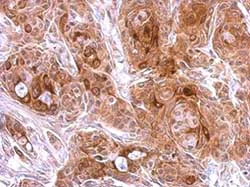
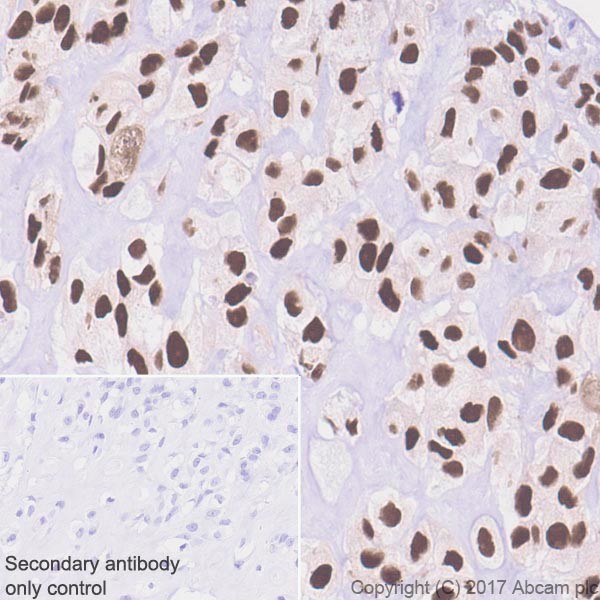
Immunohistochemistry (Formalin/PFA-fixed paraffin-embedded sections) - Anti-Osteoprotegerin antibody (AB183910)
Immunohistochemical analysis of paraffin-embedded Cal27 xenograft labeling OPG with ab183910 at 1/500 dilution. Antigen Retrieval : EDTA based buffer, pH 8.0 for 15 min.
- WB
Supplier Data
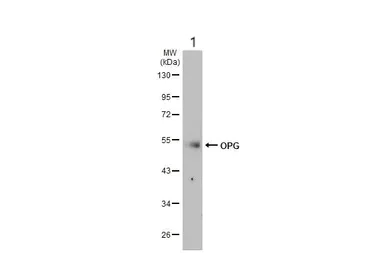
Western blot - Anti-Osteoprotegerin antibody (AB183910)
Samples were separated by 10 % SDS. The signal was developed with Trident ECL plus-Enhanced.
All lanes:
Western blot - Anti-Osteoprotegerin antibody (ab183910) at 1/1000 dilution
All lanes:
Human plasma at 30 µg
Secondary
All lanes:
HRP-conjugated anti-rabbit IgG antibody
Predicted band size: 46 kDa
true
- WB
CiteAb
Western blot - Anti-Osteoprotegerin antibody (AB183910)
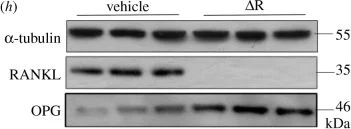
Osteoprotegerin western blot using anti-Osteoprotegerin antibody ab183910. Publication image and figure legend from Liu, W., Wang, Z., et al., 2019, Open Biol, PubMed 31088250.
ab183910 was used in this publication in western blot. This may not be the same as the application(s) guaranteed by Abcam. For a full list of applications guaranteed by Abcam for ab183910 please see the product overview.
Activation of mTORC1 in osteocytes stimulates RANKL expression and osteoclast formation in mice. (a) Representative images of TRAP staining of femora from 10-week-old control (DTCL) and Tsc1 CKO mice. The scale bars represent 50 μm. (b) Number of TRAP-positive osteoclasts (t-test, p = 0.0017, n = 6). (c) Western blot analysis of RANKL in bone lysates from DTCL and Tsc1 CKO mice (n = 6). (d–g) MLO-Y4 cells were infected with control shRNA lentivirus (shNC) and TSC1 shRNA lentivirus (ΔTSC1) for 72 h. (d) Representative images of lentivirus infection of MLO-Y4 cells. Scale bars, 50 μm. Western blot analysis of pS6, pS6K, RANKL and OPG (e) in MLO-Y4 cells infected with TSC1 shRNA lentivirus. qPCR analysis for (f) RANKL and (g) OPG mRNA levels (t-test, RANKL : p = 0.0054, OPG : p = 0.0171, n = 6). (h–j) MLO-Y4 cells were treated with 1 nM rapamycin (ΔR) and DMSO (vehicle) for 48 h, then cell lysates were subjected to immunoblot (h) and qPCR analysis for (i) RANKL and (j) OPG protein and mRNA levels, respectively (t-test, RANKL : p = 0.0003, OPG : p = 0.0220, n = 6). All experiments were repeated independently three times. Data are represented as mean ± s.d., *p < 0.05, **p < 0.01 and ***p < 0.001.
false
替代产品
Primary Antibodies
AB124820
Anti-Osteoprotegerin antibody [EPR3592]
RabMAb|Recombinant|Trial Size
- 4
- 2

搭配使用产品
Primary Antibodies
AB209484
Anti-Sp7 / Osterix antibody [EPR21034]
20ul selling size|BOND RX™ Validated|RabMAb|Recombinant
- 5
- 7

反应性数据
性能和储存信息
形式
纯化工艺
存储溶液
运输条件
推荐的短期储存时间
推荐的短期储存条件
推荐的长期储存条件
分装信息
储存信息
补充信息
This supplementary information is collated from multiple sources and compiled automatically.
Biological function summary
OPG inhibits the differentiation and activation of osteoclasts by binding to RANKL preventing its interaction with the receptor RANK on the surface of osteoclast progenitor cells. As part of a non-classical signaling pathway OPG plays a significant role in the regulation of bone remodeling and maintenance by controlling bone resorption. This activity preserves bone density and structure by limiting excessive osteoclastic activity.
Pathways
OPG operates within the RANK/RANKL/OPG signaling axis which is important for bone metabolism. It counteracts the bone-resorption pathway driven by the RANKL-RANK interaction inhibiting osteoclastogenesis. This axis involves interactions with other proteins such as RANK RANKL and TRAIL where TRAIL’s involvement hints towards a broader immune regulation role for OPG.
产品实验方案
- Visit the General protocols
- Visit the Troubleshooting
靶点信息
文献 (44)
Recent publications for all applications. Explore the full list and refine your search
PloS one 20:e0328459 PubMed40811619
2025
Applications
Unspecified application
Species
Unspecified reactive species
Journal of orthopaedic surgery and research 20:478 PubMed40380204
2025
Applications
Unspecified application
Species
Unspecified reactive species
Materials today. Bio 28:101170 PubMed39211290
2024
Applications
Unspecified application
Species
Unspecified reactive species
STAR protocols 5:103186 PubMed39003746
2024
Applications
Unspecified application
Species
Unspecified reactive species
Cell death discovery 10:195 PubMed38670955
2024
Applications
Unspecified application
Species
Unspecified reactive species
Aging 16:6334-6347 PubMed38575308
2024
Applications
Unspecified application
Species
Unspecified reactive species
Chemical biology & drug design 103:e14380 PubMed37890873
2023
Applications
Unspecified application
Species
Unspecified reactive species
Journal of clinical medicine 12: PubMed37762975
2023
Applications
Unspecified application
Species
Unspecified reactive species
iScience 26:107365 PubMed37554458
2023
Applications
Unspecified application
Species
Unspecified reactive species
Medicina (Kaunas, Lithuania) 59: PubMed37512126
2023
Applications
Unspecified application
Species
Unspecified reactive species
Abcam Product Promise
Please note: All products are 'FOR RESEARCH USE ONLY. NOT FOR USE IN DIAGNOSTIC OR THERAPEUTIC PROCEDURES'.
For licensing inquiries, please contact partnerships@abcam.com