JavaScript is disabled in your browser. Please enable JavaScript to view this website.
AB40465

Anti-LAG-3/CD223 抗体 [11E3]

Anti-LAG-3/CD223 antibody [11E3]

4

(2 Reviews)

|

(10 Publications)

Mouse Monoclonal LAG-3 antibody. Suitable for IP, BL, Flow Cyt, ELISA, WB, IHC-P, ICC/IF, IHC-Fr and reacts with Monkey, Human samples. Cited in 10 publications. Immunogen corresponding to Recombinant Full Length Protein corresponding to Human LAG-3/CD223.

查看别名

CD223, FDC, LAG3, Lymphocyte activation gene 3 protein, LAG-3
1 Images
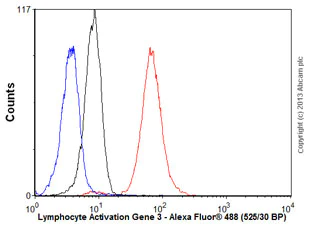
Flow Cytometry - Anti-LAG-3/CD223 antibody [11E3] (AB40465)
  • Flow Cyt

Unknown

Flow Cytometry - Anti-LAG-3/CD223 antibody [11E3] (AB40465)

Overlay histogram showing Jurkat cells stained with ab40465 (red line). The cells were fixed with 80% methanol (5 min) and then permeabilized with 0.1% PBS-Tween for 20 min. The cells were then incubated in 1x PBS / 10% normal goat serum / 0.3M glycine to block non-specific protein-protein interactions followed by the antibody (ab40465, 1μg/1x106 cells) for 30 min at 22°C. The secondary antibody used was Alexa Fluor® 488 goat anti-mouse IgG (H&L) (ab150113) at 1/2000 dilution for 30 min at 22°C. Isotype control antibody (black line) was mouse IgG1 [ICIGG1] (ab91353, 1μg/1x106 cells) used under the same conditions. Unlabelled sample (blue line) was also used as a control. Acquisition of >5,000 events were collected using a 20mW Argon ion laser (488nm) and 525/30 bandpass filter.

关键信息

宿主种属

Mouse

克隆

Monoclonal

克隆号

11E3

亚型

IgG1

不含载体蛋白

No

反应种属

Human, Monkey

应用

ICC/IF, IP, IHC-Fr, IHC-P, ELISA, Flow Cyt, WB, BL

applications

免疫原

Recombinant Full Length Protein corresponding to Human LAG-3/CD223.

P18627

特异性

Recognizes the first N-terminal D1 domain of LAG-3.

反应性数据

{ "title": "Reactivity Data", "filters": { "stats": ["", "Species", "Dilution Info", "Notes"], "tabs": { "all-applications": {"fullname" : "All Applications", "shortname": "All Applications"}, "IP" : {"fullname" : "Immunoprecipitation", "shortname":"IP"}, "BL" : {"fullname" : "Blocking", "shortname":"BL"}, "FlowCyt" : {"fullname" : "Flow Cytometry", "shortname":"Flow Cyt"}, "ELISA" : {"fullname" : "ELISA", "shortname":"ELISA"}, "WB" : {"fullname" : "Western blot", "shortname":"WB"}, "IHCP" : {"fullname" : "Immunohistochemistry (Formalin/PFA-fixed paraffin-embedded sections)", "shortname":"IHC-P"}, "ICCIF" : {"fullname" : "Immunocytochemistry/ Immunofluorescence", "shortname":"ICC/IF"}, "IHCFr" : {"fullname" : "Immunohistochemistry (Frozen sections)", "shortname":"IHC-Fr"} }, "product-promise": { "all": "all", "testedAndGuaranteed": "tested", "guaranteed": "expected", "predicted": "predicted", "notRecommended": "not-recommended" } }, "values": { "Human": { "IP-species-checked": "guaranteed", "IP-species-dilution-info": "", "IP-species-notes": "<p></p>", "BL-species-checked": "guaranteed", "BL-species-dilution-info": "", "BL-species-notes": "<p></p>", "FlowCyt-species-checked": "testedAndGuaranteed", "FlowCyt-species-dilution-info": "1 µg for 10^6 Cells", "FlowCyt-species-notes": "<p></p>", "ELISA-species-checked": "guaranteed", "ELISA-species-dilution-info": "", "ELISA-species-notes": "<p></p>", "WB-species-checked": "guaranteed", "WB-species-dilution-info": "", "WB-species-notes": "<p></p>", "IHCP-species-checked": "guaranteed", "IHCP-species-dilution-info": "", "IHCP-species-notes": "<p></p>", "ICCIF-species-checked": "guaranteed", "ICCIF-species-dilution-info": "", "ICCIF-species-notes": "<p></p>", "IHCFr-species-checked": "guaranteed", "IHCFr-species-dilution-info": "", "IHCFr-species-notes": "<p></p>" }, "Monkey": { "IP-species-checked": "guaranteed", "IP-species-dilution-info": "", "IP-species-notes": "<p></p>", "BL-species-checked": "guaranteed", "BL-species-dilution-info": "", "BL-species-notes": "<p></p>", "FlowCyt-species-checked": "predicted", "FlowCyt-species-dilution-info": "", "FlowCyt-species-notes": "", "ELISA-species-checked": "guaranteed", "ELISA-species-dilution-info": "", "ELISA-species-notes": "<p></p>", "WB-species-checked": "guaranteed", "WB-species-dilution-info": "", "WB-species-notes": "<p></p>", "IHCP-species-checked": "guaranteed", "IHCP-species-dilution-info": "", "IHCP-species-notes": "<p></p>", "ICCIF-species-checked": "guaranteed", "ICCIF-species-dilution-info": "", "ICCIF-species-notes": "<p></p>", "IHCFr-species-checked": "guaranteed", "IHCFr-species-dilution-info": "", "IHCFr-species-notes": "<p></p>" } } }

性能和储存信息

形式
Liquid
纯化工艺
Affinity purification Protein A
纯化说明
Purified from concentrated hybridoma tissue culture supernatant by Protein A Sepharose CL-4B Flow Fast Column. Purity >95% (SDS-PAGE).
存储溶液
Preservative: 0.02% Sodium azide Constituents: PBS, 10% Glycerol (glycerin, glycerine)
运输条件
Blue Ice
推荐的短期储存时间
1-2 weeks
推荐的短期储存条件
+4°C
推荐的长期储存条件
-20°C
分装信息
Upon delivery aliquot
储存信息
Avoid freeze / thaw cycle

补充信息

This supplementary information is collated from multiple sources and compiled automatically.

LAG-3 also known as CD223 is a transmembrane protein with a mass of approximately 70 kDa. It acts as a checkpoint molecule similar to CTLA-4 and PD-1 in the immune system. LAG-3 is expressed on activated T cells natural killer cells and some dendritic cells. It interacts with its ligand MHC class II leading to inhibition of cellular proliferation and cytokine secretion an important part of immune response regulation.
Biological function summary

LAG-3 is involved in maintaining immune homeostasis and preventing autoimmunity. It is not part of a complex but works in synergy with other immune checkpoint molecules. When interacting with MHC class II LAG-3 transmits inhibitory signals that attenuate immune cell responses. Its role in immune regulation helps to balance immune activation and tolerance which is essential for preventing tissue damage while protecting against pathogens.

Pathways

The inhibitory role of LAG-3 integrates into the T cell receptor (TCR) signaling pathway and is also linked to the PD-1 signaling pathway. In TCR signaling LAG-3 negatively regulates T cell activation. LAG-3 is functionally related to proteins like PD-1 and CTLA-4 sharing similar roles in immune checkpoint pathways that are critical for maintaining immune balance.

LAG-3 has links to cancer and autoimmune diseases. In cancer LAG-3 expression on tumor-infiltrating lymphocytes correlates with immune evasion by tumors. This relationship appears in various cancers including melanoma and renal cell carcinoma. In autoimmune diseases LAG-3's expression on regulatory T cells helps control conditions such as multiple sclerosis. It collaborates with CTLA-4 in modulating immune responses that prevent excessive immune activation and tissue damage associated with autoimmunity.

产品实验方案

For this product, it's our understanding that no specific protocols are required. You can visit:

靶点信息

Lymphocyte activation gene 3 protein. Inhibitory receptor on antigen activated T-cells (PubMed : 20421648, PubMed : 35761082, PubMed : 7805750, PubMed : 8647185). Delivers inhibitory signals upon binding to ligands, such as MHC class II, its main ligand present at the surface of antigen-presenting cells (APCs), and FGL1, which is secreted by hepatocytes and certain types of tumor cells (PubMed : 30580966, PubMed : 32920841, PubMed : 35761082, PubMed : 39671469, PubMed : 7589152, PubMed : 8647185, PubMed : 9159144). Ligand-binding initiates a signaling that inhibits the T-cell receptor (TCR) in the immunological synapse, preventing T-cell activation (PubMed : 40101708). Mechanistically, ligand-binding promotes (1) ubiquitination of the KIEELE motif, unleashing the RRFSALE motif from the membrane and (2) leading to the formation of condensates with the TCR component CD3E, thereby disrupting the association between CD3E and LCK and preventing TCR activation (PubMed : 40101708, PubMed : 40592325). May inhibit antigen-specific T-cell activation in synergy with PDCD1/PD-1 (By similarity). Negatively regulates the proliferation, activation, effector function and homeostasis of both CD8(+) and CD4(+) T-cells (PubMed : 20421648, PubMed : 7805750, PubMed : 8647185). Also mediates immune tolerance : constitutively expressed on a subset of regulatory T-cells (Tregs) and contributes to their suppressive function (By similarity). Also acts as a negative regulator of plasmacytoid dendritic cell (pDCs) activation (By similarity).. The LAG3-mediated inhibitory pathway is exploited by tumors to attenuate anti-tumor immunity and escape destruction by the immune system, thereby facilitating tumor survival (PubMed : 35981087, PubMed : 40101708). The blockage of the LAG3- and PDCD1-mediated pathways results in the reversal of the exhausted T-cell phenotype and the normalization of the anti-tumor response, providing a rationale for cancer immunotherapy (PubMed : 35981087, PubMed : 40101708).. Secreted lymphocyte activation gene 3 protein. May function as a ligand for MHC class II (MHC-II) on antigen-presenting cells (APC), promoting APC activation/maturation and driving Th1 immune response.
See full target information LAG-3/CD223

文献 (10)

Recent publications for all applications. Explore the full list and refine your search

Molecular medicine (Cambridge, Mass.) 31:298 PubMed41023624

2025

LAG-3 palmitoylation-inducing dysfunction of decidual CD4T cells is associated with recurrent pregnancy loss.

Applications

Unspecified application

Species

Unspecified reactive species

Liyuan Cui,Fengrun Sun,Xinhang Meng,Yujie Luo,Jinfeng Qian,Songcun Wang

Frontiers in pharmacology 16:1611637 PubMed40693271

2025

Antagonizing IL-6 receptor restores pancreatic tissue resident NK cells activation and ameliorates pancreatic injury in the mouse model of MASH.

Applications

Unspecified application

Species

Unspecified reactive species

Johnny Amer,Diana Abu Arra,Ahmad Salhab,Faris Kayed,Muneer Maali,Raghad Shweiki,Mustafa Ghanim

OncoTargets and therapy 13:9785-9795 PubMed33061457

2020

MiRNA505/NET1 Axis Acts as a CD8 T-TIL Regulator in Non-Small Cell Lung Cancer.

Applications

Unspecified application

Species

Unspecified reactive species

Pengyuan Zhu,Zhenchuan Liu,Haitao Huang,Chongjun Zhong,Yongxin Zhou

Leukemia research reports 14:100215 PubMed32695574

2020

Immune checkpoints bone marrow expression as the predictor of clinical outcome in myelodysplastic syndrome.

Applications

Unspecified application

Species

Unspecified reactive species

Nikolai Tcvetkov,Artem Gusak,Elena Morozova,Ivan Moiseev,Vadim Baykov,Maria Barabanshikova,Kirill Lepik,Evgenyi Bakin,Julia Vlasova,Anna Osipova,Ludmila Zubarovskaya,Boris Afanasyev

Journal of clinical laboratory analysis 34:e23244 PubMed32077528

2020

Ectopic expression of LAG-3 in non-small-cell lung cancer cells and its clinical significance.

Applications

Unspecified application

Species

Unspecified reactive species

Chenglong Ma,Xiao Sun,Dong Shen,Yuejun Sun,Naifu Guan,Chunjian Qi

Annals of translational medicine 7:776 PubMed32042792

2020

Characterization of LAG-3, CTLA-4, and CD8 TIL density and their joint influence on the prognosis of patients with esophageal squamous cell carcinoma.

Applications

Unspecified application

Species

Unspecified reactive species

Wenjia Wang,Donglai Chen,Yuhuan Zhao,Ting Zhao,Junmiao Wen,Yiming Mao,Chang Chen,Yonghua Sang,Yongsheng Zhang,Yongbing Chen

Journal of immunotherapy (Hagerstown, Md. : 1997) 42:279-283 PubMed31219974

2019

LAG3 in Solid Tumors as a Potential Novel Immunotherapy Target.

Applications

Unspecified application

Species

Unspecified reactive species

Su Jin Lee,Sun-Ju Byeon,Jeeyun Lee,Se Hoon Park,Joon Oh Park,Young Suk Park,Won Ki Kang,Ho Yeong Lim,Kyoung-Mee Kim,Seung Tae Kim

Journal of the American Academy of Dermatology 81:219-227 PubMed30880064

2019

Expression of lymphocyte-activating gene 3 and T-cell immunoreceptor with immunoglobulin and ITIM domains in cutaneous melanoma and their correlation with programmed cell death 1 expression in tumor-infiltrating lymphocytes.

Applications

Unspecified application

Species

Unspecified reactive species

Woo Jin Lee,Ye Jin Lee,Myoung Eun Choi,Kyung A Yun,Chong Hyun Won,Mi Woo Lee,Jee Ho Choi,Sung Eun Chang

Journal of translational medicine 16:86 PubMed29615076

2018

Use of the tumor-infiltrating CD8 to FOXP3 lymphocyte ratio in predicting treatment responses to combination therapy with pertuzumab, trastuzumab, and docetaxel for advanced HER2-positive breast cancer.

Applications

IHC-P

Species

Human

Koji Takada,Shinichiro Kashiwagi,Wataru Goto,Yuka Asano,Katsuyuki Takahashi,Tsutomu Takashima,Shuhei Tomita,Masahiko Ohsawa,Kosei Hirakawa,Masaichi Ohira

Proceedings of the National Academy of Sciences of the United States of America 94:5744-9 PubMed9159144

1997

Characterization of the major histocompatibility complex class II binding site on LAG-3 protein.

Applications

Unspecified application

Species

Unspecified reactive species

B Huard,R Mastrangeli,P Prigent,D Bruniquel,S Donini,N El-Tayar,B Maigret,M Dréano,F Triebel
View all publications

Abcam Product Promise

我们致力于为您的研究提供高质量的试剂,为您科研的每一步提供支持。若我们的产品未能达到预期性能,我们向您提供 Abcam Product Promise 保障。
详情请参阅我们的条款与条件。

Please note: All products are 'FOR RESEARCH USE ONLY. NOT FOR USE IN DIAGNOSTIC OR THERAPEUTIC PROCEDURES'.

For licensing inquiries, please contact partnerships@abcam.com