重组Anti-IFNGR1抗体[EPR24127-89]
Anti-IFNGR1 antibody [EPR24127-89]
- 20ul selling size
- RabMAb
- Recombinant
- KO Validated
- 了解详情
Be the first to review this product! Submit a review
|
(3 Publications)
Rabbit Recombinant Monoclonal IFNGR1 antibody. Suitable for ICC/IF, IP, Flow Cyt, WB and reacts with Mouse samples. Cited in 3 publications.
查看别名
CD119, Ifngr, Ifngr1, Interferon gamma receptor 1, IFN-gamma receptor 1, IFN-gamma-R1, Interferon gamma receptor alpha-chain, IFN-gamma-R-alpha
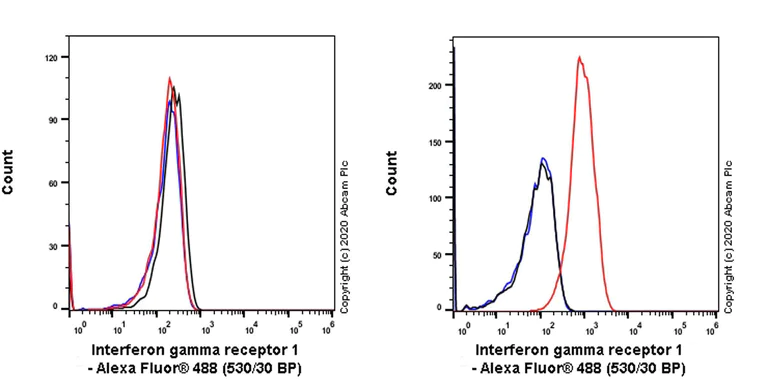
- Flow Cyt
Supplier Data
Flow Cytometry - Anti-IFNGR1 antibody [EPR24127-89] (AB280353)
Flow cytometric analysis of 4T1 (mouse mammary gland carcinoma epithelial cell, left)/ EL4 (mouse lymphoma T lymphocyte, right) cells labelling IFNGR1 with ab280353 at 1/500 dilution (Red) compared with a Rabbit monoclonal IgG (ab172730) (Black) isotype control and an unlabelled control (cells without incubation with primary antibody and secondary antibody) (Blue). Goat anti rabbit IgG (Alexa Fluor® 488, ab150077) at 1/2000 dilution was used as the secondary antibody. Low expression : 4T1(PMID : 12154047) Gated on viable cells.
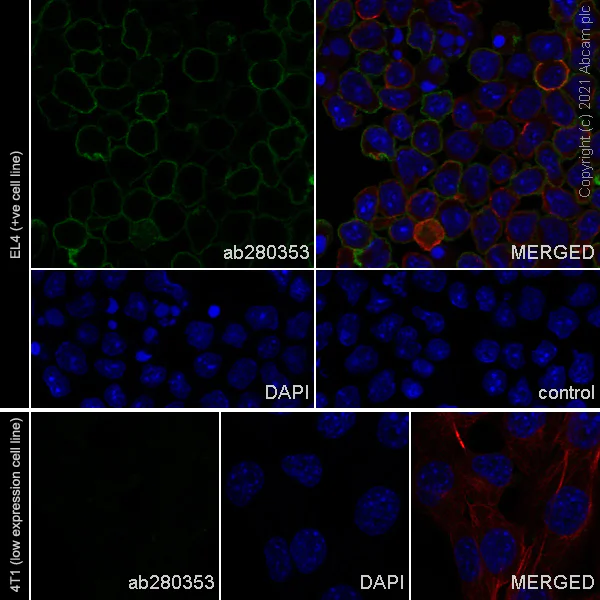
- ICC/IF
Supplier Data
Immunocytochemistry/ Immunofluorescence - Anti-IFNGR1 antibody [EPR24127-89] (AB280353)
Immunofluorescent analysis of 4% Paraformaldehyde-fixed, 0.1% TritonX-100 permeabilized EL4 cells labelling IFNGR1 with ab280353 at 1/50 dilution, followed by ab150077 Goat Anti-Rabbit IgG H&L (Alexa Fluor® 488) antibody at 1/1000 dilution (Green). Confocal image showing membranous staining in EL4 cell line. Low expression control : 4T1 (PMID : 12154047) is observed. ab195889 Anti-alpha Tubulin mouse monoclonal antibody - Microtubule Marker (Alexa Fluor® 594) was used to counterstain tubulin at 1/200 dilution (Red). The Nuclear counterstain was DAPI (Blue).
Secondary antibody only control : Secondary antibody is ab150077 Goat Anti-Rabbit IgG H&L (Alexa Fluor® 488) at 1/1000 dilution.
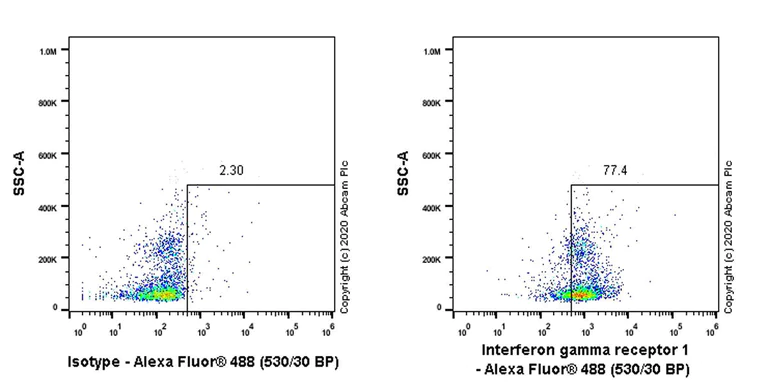
- Flow Cyt
Supplier Data
Flow Cytometry - Anti-IFNGR1 antibody [EPR24127-89] (AB280353)
Flow cytometric analysis of Mouse blood cells cells labelling IFNGR1 with ab280353 at 1/500 dilution (Right) compared with a Rabbit monoclonal IgG (ab172730) isotype control (Left). Goat anti rabbit IgG (Alexa Fluor® 488, ab150077) at 1/2000 dilution was used as the secondary antibody. Gated on viable cells.
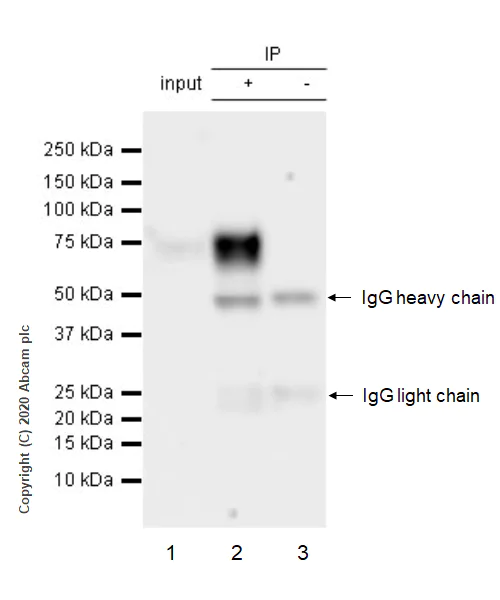
- IP
Supplier Data
Immunoprecipitation - Anti-IFNGR1 antibody [EPR24127-89] (AB280353)
IFNGR1 was immunoprecipitated from 0.35 mg EL4 (mouse lymphoma T lymphocyte), whole cell lysate 10 ug with ab280353 at 1/30 dilution (2ug in 0.35mg lysates). Western blot was performed on the immunoprecipitate using ab280353 at 1/1000 dilution. VeriBlot for IP Detection Reagent (HRP)(ab131366) was used at 1/5000 dilution.
Lane 1 : EL4 (mouse lymphoma T lymphocyte), whole cell lysate 10 ug
Lane 2 : ab280353 IP in EL4 whole cell lysate
Lane 3 : Rabbit monoclonal IgG (ab172730) instead of ab280353 in EL4 whole cell lysate
Blocking and dilution buffer and concentration : 5% NFDM/TBST.
Exposure time : 15 seconds
All lanes:
Immunoprecipitation - Anti-IFNGR1 antibody [EPR24127-89] (ab280353)
Predicted band size: 54 kDa
Observed band size: 70-95 kDa
false
- WB
Lab
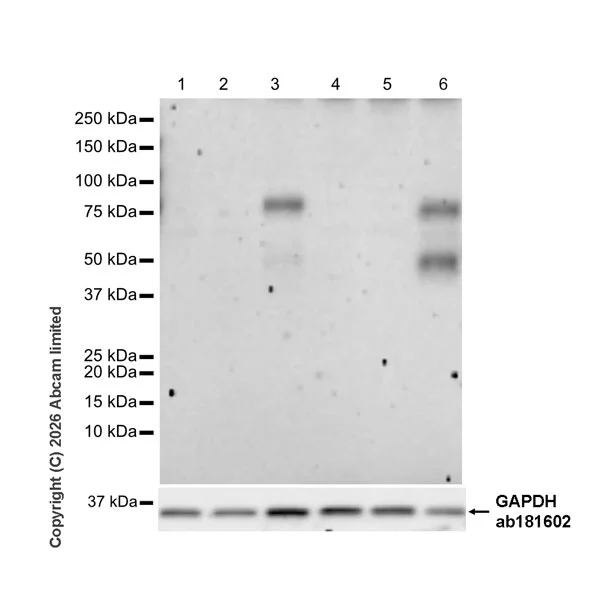
Western blot - Anti-IFNGR1 antibody [EPR24127-89] (AB280353)
Blocking and diluting buffer and concentration : 5% NFDM/TBST.
In Western blot, Anti-GAPDH antibody [EPR16891] - Loading Control (ab181602).
The tissue samples were kindly provided by GemPharmatech. C57BL/6JGpt wildtype mice and IFNGR1-KO homozygous mice (Strain ID : T012667).
All lanes:
Western blot - Anti-IFNGR1 antibody [EPR24127-89] (ab280353) at 1/1000 dilution
Lane 1:
Untreated IFNGR1 KO mouse lung tissue whole lysate at 20 µg
Lane 2:
IFNGR1 KO mouse lung tissue treated with 1μg/mL for 16 hours whole lysate at 20 µg
Lane 3:
Mouse lung tissue treated with 1μg/mL for 16 hours whole lysate at 20 µg
Lane 4:
Untreated IFNGR1 KO mouse spleen tissue whole lysate at 20 µg
Lane 5:
IFNGR1 KO mouse spleen tissue treated with 1μg/mL for 16 hours whole lysate at 20 µg
Lane 6:
Mouse spleen tissue treated with 1μg/mL for 16 hours whole lysate at 20 µg
Secondary
All lanes:
Western blot - Goat Anti-Rabbit IgG H&L (HRP) (<a href='/products/secondary-antibodies/goat-rabbit-igg-h-l-hrp-ab97051'>ab97051</a>) at 1/20000 dilution
Observed band size: 80 kDa,36 kDa
false
Exposure time: 180s
- WB
Lab
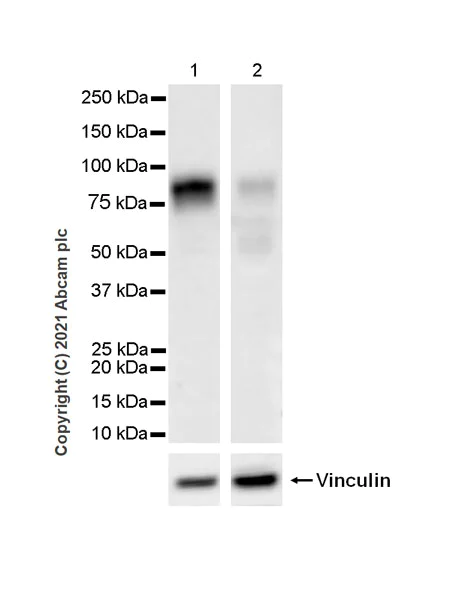
Western blot - Anti-IFNGR1 antibody [EPR24127-89] (AB280353)
Blocking and diluting buffer and concentration : 5% NFDM/TBST
Low expression : 4T1(PMID : 12154047)
Exposure time : 74 seconds
All lanes:
Western blot - Anti-IFNGR1 antibody [EPR24127-89] (ab280353) at 1/1000 dilution
Lane 1:
EL4 (mouse lymphoma T lymphocyte), whole cell lysate at 20 µg
Lane 2:
4T1 (mouse mammary gland carcinoma epithelial cell), whole cell lysate at 20 µg
Secondary
All lanes:
Western blot - Goat Anti-Rabbit IgG H&L (HRP) (<a href='/products/secondary-antibodies/goat-rabbit-igg-h-l-hrp-ab97051'>ab97051</a>) at 1/50000 dilution
Predicted band size: 54 kDa
Observed band size: 70-95 kDa
false
不同偶联物与剂型 (1)
-
Anti-IFNGR1 antibody [EPR24127-89] - BSA and Azide free
搭配使用产品
Primary Antibodies
AB237365
Alexa Fluor® 647 Anti-CD8 alpha antibody [EPR21769]
BOND RX™ Validated|RabMAb|Recombinant

- 0
- 0
反应性数据
产品详情
Patented technology
Our RabMAb® technology is a patented hybridoma-based technology for making rabbit monoclonal antibodies. For details on our patents, please refer to RabMAb® patents.
What are the advantages of a recombinant monoclonal antibody?
This product is a recombinant monoclonal antibody, which offers several advantages including:
- - High batch-to-batch consistency and reproducibility
- - Improved sensitivity and specificity
- - Long-term security of supply
- - Animal-free batch production
For more information, read more on recombinant antibodies.
性能和储存信息
形式
纯化工艺
存储溶液
运输条件
推荐的短期储存时间
推荐的短期储存条件
推荐的长期储存条件
分装信息
储存信息
补充信息
This supplementary information is collated from multiple sources and compiled automatically.
Biological function summary
IFNGR1 functions as part of the interferon-gamma receptor complex working alongside the IFNGR2 subunit. This interaction with IFNGR2 is important for the receptor to properly transmit signals inside the cell. The binding of interferon-gamma to this receptor complex activates the JAK-STAT signaling pathway promoting the transcription of genes that enhance the antimicrobial activity of immune cells and regulate cellular immunity.
Pathways
The IFNGR1 protein plays an important role in the JAK-STAT signaling pathway which is critical for mediating responses to interferon-gamma. Upon activation by IFN-γ IFNGR1 recruits JAK kinases leading to the phosphorylation of STAT1 a significant transcription factor. STAT1 then dimerizes and translocates to the nucleus where it induces the expression of genes involved in immune defense and inflammation. This process is vital for the body's ability to handle infections and other immunological challenges.
产品实验方案
- Visit the General protocols
- Visit the Troubleshooting
靶点信息
文献 (3)
Recent publications for all applications. Explore the full list and refine your search
Communications biology 8:1209 PubMed40804340
2025
Applications
Unspecified application
Species
Unspecified reactive species
eLife 13: PubMed39213029
2024
Applications
Unspecified application
Species
Unspecified reactive species
The Journal of clinical investigation 131: PubMed34623322
2021
Applications
Unspecified application
Species
Unspecified reactive species
Abcam Product Promise
Please note: All products are 'FOR RESEARCH USE ONLY. NOT FOR USE IN DIAGNOSTIC OR THERAPEUTIC PROCEDURES'.
For licensing inquiries, please contact partnerships@abcam.com