HRP Anti-GST抗体
HRP Anti-GST antibody
5
(3 Reviews)
|
(38 Publications)
Anti-GST antibody conjugated to HRP is a rabbit polyclonal antibody suitable for ELISA, Western blot.
查看别名
Glutathione S-transferase class-mu 26 kDa isozyme, GST 26, Sj26 antigen, SjGST
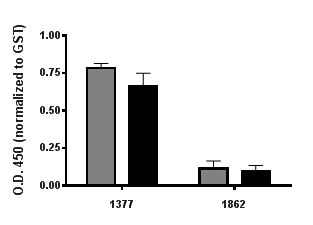
- ELISA
AbReview46320****
ELISA - HRP Anti-GST antibody (AB3416)
Graph of ELISA measuring levels of bound GST-tagged mosquito proteins. 5g of target protein was coated onto an ELISA plate and incubated overnight at 4°C. The plate was washed and GST-tagged mosquito proteins were incubated for an hour at RT. The proteins were washed off, GST-HRP antibody (ab3416) was diluted 1/5000 in 1%BSA in PBS and added for 30 min at RT. The plate was washed and TMB substrate was added for 20 min at RT. Stop solution was added and the O.D. of the wells read at 450 nm.
This image is courtesy of an anonymous abreview.
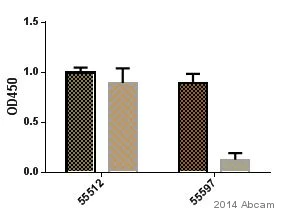
- ELISA
AbReview46487****
ELISA - HRP Anti-GST antibody (AB3416)
Graph of ELISA measuring levels of bound GST-tagged mosquito proteins. 5g of target protein was coated onto an ELISA plate and incubated overnight at 4°C. The plate was washed and GST-tagged mosquito proteins were incubated for an hour at RT. The proteins were washed off, GST-HRP antibody (ab3416) was diluted 1/5000 in 1%BSA in PBS and added for 30 min at RT. The plate was washed and TMB substrate was added for 20 min at RT. Stop solution was added and the O.D. of the wells read at 450 nm.
This image is courtesy of an anonymous abreview.
替代产品


搭配使用产品
Primary Antibodies
AB183734
RabMAb|Recombinant|Lab Essentials|20ul selling size
- 5
- 24

Primary Antibodies
AB1791
Anti-Histone H3 antibody - Nuclear Marker and ChIP Grade
Lab Essentials

- 5
- 233
反应性数据
产品详情
What is this antibody validated in?
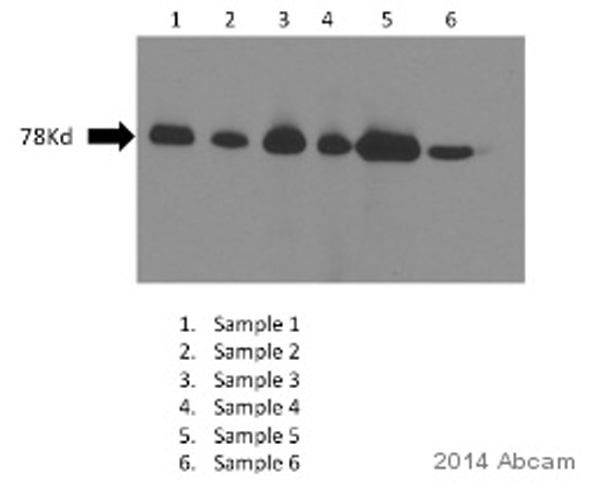
HRP Anti-GST antibody (ab3416) is a rabbit polyclonal antibody and is validated for use in Western Blot (WB), ELISA. Trusted by the scientific community
Anti-GST HRP (ab3416) was first used in a scientific publication in 2003 and has been cited over 30 times in peer-reviewed journals.
REACH authorisation
Abcam has not and does not intend to apply for the REACH Authorisation of customers' uses of products that contain European Authorisation list (Annex XIV) substances.
It is the responsibility of our customers to check the necessity of application of REACH Authorisation, and any other relevant authorisations, for their intended uses.
性能和储存信息
形式
纯化工艺
纯化说明
存储溶液
运输条件
推荐的短期储存条件
推荐的长期储存条件
补充信息
This supplementary information is collated from multiple sources and compiled automatically.
Biological function summary
GST enzymes participate in critical cellular detoxification processes enhancing the solubility of toxins. As part of these processes GST enzymes do not function as part of a larger complex but are individual actors within the cell. They facilitate the conjugation reactions fundamental to cellular metabolism and detoxification making them essential for maintaining cellular health.
Pathways
GST enzymes contribute significantly to the metabolic breakdown pathways like the xenobiotic metabolism pathway. This pathway involves proteins such as cytochrome P450 enzymes which often function upstream to modify compounds for further GST action. GSTs are important for efficiently detoxifying potentially harmful substances preventing cellular damage.
产品实验方案
- Visit the General protocols
- Visit the Troubleshooting
靶点信息
文献 (38)
Recent publications for all applications. Explore the full list and refine your search
Genome biology 26:155 PubMed40468392
2025
Applications
Unspecified application
Species
Unspecified reactive species
PloS one 20:e0318295 PubMed39903729
2025
Applications
Unspecified application
Species
Unspecified reactive species
Proceedings of the National Academy of Sciences of the United States of America 120:e2310126120 PubMed37934824
2023
Applications
Unspecified application
Species
Unspecified reactive species
Molecular cell 83:1743-1760.e11 PubMed37116497
2023
Applications
Unspecified application
Species
Unspecified reactive species
microPublication biology 2023: PubMed37038481
2023
Applications
Unspecified application
Species
Unspecified reactive species
Life science alliance 6: PubMed36882285
2023
Applications
Unspecified application
Species
Unspecified reactive species
Life science alliance 6: PubMed36375840
2022
Applications
Unspecified application
Species
Unspecified reactive species
Cell death & disease 13:575 PubMed35773260
2022
Applications
Unspecified application
Species
Unspecified reactive species
Proceedings of the National Academy of Sciences of the United States of America 119: PubMed35115407
2022
Applications
Unspecified application
Species
Unspecified reactive species
The Plant cell 33:3513-3531 PubMed34402905
2021
Applications
Unspecified application
Species
Unspecified reactive species
Abcam Product Promise
Please note: All products are 'FOR RESEARCH USE ONLY. NOT FOR USE IN DIAGNOSTIC OR THERAPEUTIC PROCEDURES'.
For licensing inquiries, please contact partnerships@abcam.com