JavaScript is disabled in your browser. Please enable JavaScript to view this website.
AB69771

FITC Anti-CD147 抗体 [MEM-M6/1]

FITC Anti-CD147 antibody [MEM-M6/1]

Be the first to review this product! Submit a review

|

(2 Publications)

Anti-CD147 antibody [MEM-M6/1] conjugated to FITC - suitable for flow cytometry, and reacts with human samples. Clone [MEM-M6/1] is a mouse monoclonal antibody cited in 18 publications.

Design your panel with our interactive flow cytometry panel builder. Click here.

查看别名

CD147, UNQ6505/PRO21383, BSG, Basigin, 5F7, Collagenase stimulatory factor, Extracellular matrix metalloproteinase inducer, Hepatoma-associated antigen, Leukocyte activation antigen M6, OK blood group antigen, Tumor cell-derived collagenase stimulatory factor, EMMPRIN, HAb18G, TCSF
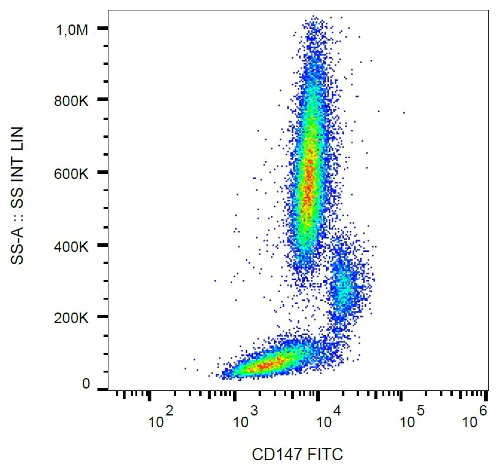
1 Images
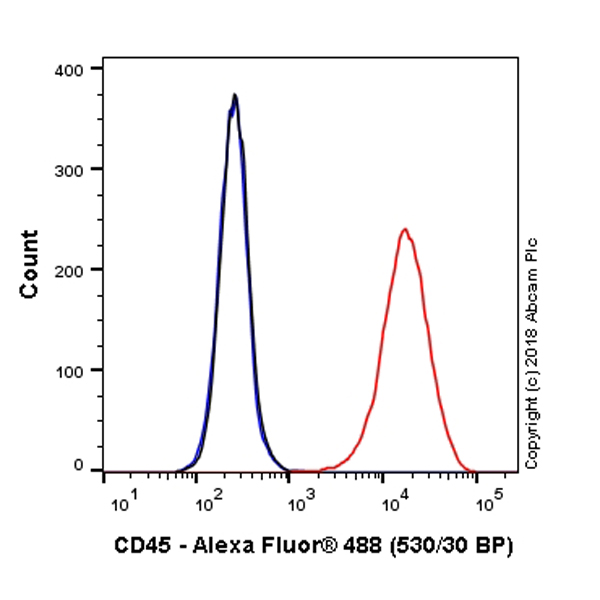
Flow Cytometry - FITC Anti-CD147 antibody [MEM-M6/1] (AB69771)
  • Flow Cyt

Unknown

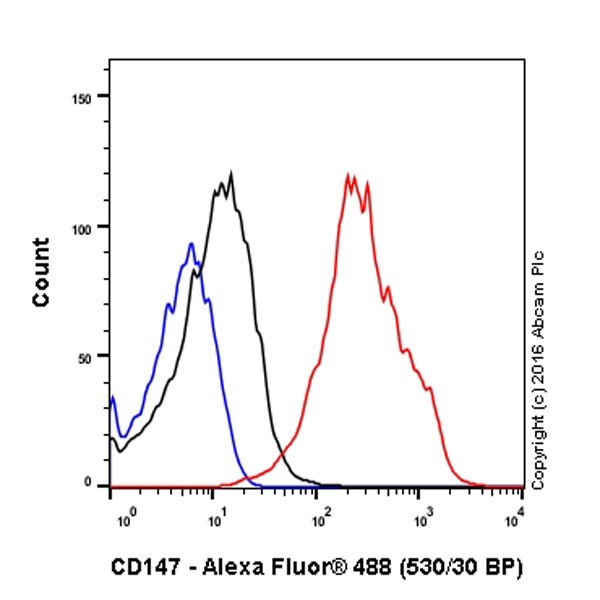
Flow Cytometry - FITC Anti-CD147 antibody [MEM-M6/1] (AB69771)

Surface staining of human peripheral blood with anti-human CD147 (MEM-M6/1) FITC.

不同偶联物与剂型 (1)

关键信息

宿主种属

Mouse

克隆

Monoclonal

克隆号

MEM-M6/1

亚型

IgG1

偶联物

FITC

激发波长/发射波长

Ex: 495nm, Em: 519nm

不含载体蛋白

No

反应种属

Human

应用

Flow Cyt

applications

免疫原

Recombinant Fragment Protein within Human BSG. The exact immunogen used to generate this antibody is proprietary information.

P35613

特异性

ab69771 recognizes an epitope in the N-terminal Ig domain (D1) of CD147 and is a high-affinity antibody capable of binding to unstimulated peripheral blood T cells.

反应性数据

{ "title": "Reactivity Data", "filters": { "stats": ["", "Species", "Dilution Info", "Notes"], "tabs": { "all-applications": {"fullname" : "All Applications", "shortname": "All Applications"}, "FlowCyt" : {"fullname" : "Flow Cytometry", "shortname":"Flow Cyt"} }, "product-promise": { "all": "all", "testedAndGuaranteed": "tested", "guaranteed": "expected", "predicted": "predicted", "notRecommended": "not-recommended" } }, "values": { "Human": { "FlowCyt-species-checked": "testedAndGuaranteed", "FlowCyt-species-dilution-info": "20 µL for 10^6 Cells", "FlowCyt-species-notes": "<p>Use 20µl for 10<sup>6</sup> cells or 100µl whole blood.</p><p><a href='/products/primary-antibodies/fitc-mouse-igg1-b11-6-isotype-control-ab91356'>ab91356</a> - Mouse monoclonal IgG1, is suitable for use as an isotype control with this antibody.</p>" } } }

产品详情

The purified antibody is conjugated with Fluorescein isothiocyanate (FITC) under optimum conditions. The reagent is free of unconjugated FITC.

性能和储存信息

形式
Liquid
纯化工艺
Size-exclusion chromatography
存储溶液
pH: 7.4 Preservative: 0.097% Sodium azide Constituents: PBS, 0.2% BSA
运输条件
Blue Ice
推荐的短期储存条件
+4°C
推荐的长期储存条件
+4°C

补充信息

This supplementary information is collated from multiple sources and compiled automatically.

CD147 also referred to as EMMPRIN or basigin is a transmembrane glycoprotein with a molecular weight of roughly 50–60 kDa. This protein is found on the surface of many cell types including leukocytes platelets and endothelial cells and it plays a critical role in cell function related to immune responses and cellular interactions. CD147 interacts with several cellular components serving mechanical functions such as facilitating cell-to-cell communication and contributing to the stability of cell structures. The protein is ubiquitously expressed but exhibits higher levels in tissues like the brain skin and liver.
Biological function summary

CD147 engages in multiple roles beyond its mechanical functions. It functions as a part of protein complexes and is involved in processes such as regulation of matrix metalloproteinases (MMPs) which are pivotal in tissue remodeling and repair. It can modulate inflammatory responses and is essential for cellular signaling pathways that affect cellular metabolism and growth. The involvement of CD147 in immune responses indicates its importance in various physiological processes.

Pathways

CD147 plays a significant role in the MAPK and NF-kB signaling pathways which are fundamental for controlling inflammatory responses and cell survival. It interacts with proteins such as integrins and cyclophilins which are important for mediating these pathways. These interactions highlight CD147's impact on cellular dynamics and its potential role in modulating the cellular environment in response to external stimuli.

CD147 has been implicated in cancer promotion and progression as well as inflammatory diseases like rheumatoid arthritis. Its overexpression is often observed in tumors where it interacts with MMPs to facilitate tumor invasion and metastasis. In inflammatory conditions CD147 can influence the behavior of proteins like cytokines exacerbating symptoms and contributing to disease severity. These associations make CD147 a potential target for therapeutic intervention in cancer and inflammatory diseases.

产品实验方案

For this product, it's our understanding that no specific protocols are required. You can visit:

靶点信息

Isoform 1. Essential for normal retinal maturation and development (By similarity). Acts as a retinal cell surface receptor for NXNL1 and plays an important role in NXNL1-mediated survival of retinal cone photoreceptors (PubMed : 25957687). In association with glucose transporter SLC16A1/GLUT1 and NXNL1, promotes retinal cone survival by enhancing aerobic glycolysis and accelerating the entry of glucose into photoreceptors (PubMed : 25957687). May act as a potent stimulator of IL6 secretion in multiple cell lines that include monocytes (PubMed : 21620857).. Isoform 1. (Microbial infection) Erythrocyte receptor for P.falciparum RH5 which is essential for erythrocyte invasion by the merozoite stage of P.falciparum isolates 3D7 and Dd2.. Isoform 2. Signaling receptor for cyclophilins, essential for PPIA/CYPA and PPIB/CYPB-dependent signaling related to chemotaxis and adhesion of immune cells (PubMed : 11688976, PubMed : 11943775). Plays an important role in targeting monocarboxylate transporters SLC16A1/GLUT1, SLC16A11 and SLC16A12 to the plasma membrane (PubMed : 17127621, PubMed : 21778275, PubMed : 28666119). Acts as a coreceptor for vascular endothelial growth factor receptor 2 (KDR/VEGFR2) in endothelial cells enhancing its VEGFA-mediated activation and downstream signaling (PubMed : 25825981). Promotes angiogenesis through EPAS1/HIF2A-mediated up-regulation of VEGFA (isoform VEGF-165 and VEGF-121) and KDR/VEGFR2 in endothelial cells (PubMed : 19837976). Plays a key role in regulating tumor growth, invasion, metastasis and neoangiogenesis by stimulating the production and release of extracellular matrix metalloproteinases and KDR/VEGFR2 by both tumor cells and stromal cells (fibroblasts and endothelial cells) (PubMed : 11992541, PubMed : 12553375, PubMed : 15833850).. Isoform 2. (Microbial infection) Erythrocyte receptor for P.falciparum RH5 which is essential for erythrocyte invasion by the merozoite stage of P.falciparum isolates 3D7, Dd2, 7G8 and HB3 (PubMed : 22080952, PubMed : 26195724). Binding of P.falciparum RH5 results in BSG dimerization which triggers an increase in intracellular Ca(2+) in the erythrocyte (PubMed : 28409866). This essential step leads to a rearrangement of the erythrocyte cytoskeleton required for the merozoite invasion (PubMed : 28409866).. Isoform 2. (Microbial infection) Can facilitate human SARS coronavirus (SARS-CoV-1) infection via its interaction with virus-associated PPIA/CYPA.. Isoform 2. (Microbial infection) Can facilitate HIV-1 infection via its interaction with virus-associated PPIA/CYPA.. Isoform 2. (Microbial infection) First described as a receptor for severe acute respiratory syndrome coronavirus 2 (SARS-CoV-2), it is not required for SARS-CoV-2 infection.. Isoform 2. (Microbial infection) Acts as a receptor for measles virus.. Isoform 2. (Microbial infection) Promotes entry of pentamer-expressing human cytomegalovirus (HCMV) into epithelial and endothelial cells.. Plays a role in neurite outgrowth.
See full target information BSG

文献 (2)

Recent publications for all applications. Explore the full list and refine your search

PloS one 9:e90571 PubMed25076423

2014

Hepatocyte produced matrix metalloproteinases are regulated by CD147 in liver fibrogenesis.

Applications

Unspecified application

Species

Unspecified reactive species

Sarah R Calabro,Annette E Maczurek,Alison J Morgan,Thomas Tu,Victoria W Wen,Christine Yee,Auvro Mridha,Maggie Lee,William d'Avigdor,Stephen A Locarnini,Geoffrey W McCaughan,Fiona J Warner,Susan V McLennan,Nicholas A Shackel

International immunology 11:777-86 PubMed10330283

1999

T cell activation-associated epitopes of CD147 in regulation of the T cell response, and their definition by antibody affinity and antigen density.

Applications

Unspecified application

Species

Unspecified reactive species

C Koch,G Staffler,R Hüttinger,I Hilgert,E Prager,J Cerný,P Steinlein,O Majdic,V Horejsí,H Stockinger
View all publications

Abcam Product Promise

我们致力于为您的研究提供高质量的试剂,为您科研的每一步提供支持。若我们的产品未能达到预期性能,我们向您提供 Abcam Product Promise 保障。
详情请参阅我们的条款与条件。

Please note: All products are 'FOR RESEARCH USE ONLY. NOT FOR USE IN DIAGNOSTIC OR THERAPEUTIC PROCEDURES'.

For licensing inquiries, please contact partnerships@abcam.com