JavaScript is disabled in your browser. Please enable JavaScript to view this website.
AB192589

Anti-FGFR4 (phospho Y642)抗体

Anti-FGFR4 (phospho Y642) antibody

Be the first to review this product! Submit a review

|

(6 Publications)

Rabbit Polyclonal FGFR4 phospho Y642 antibody. Suitable for WB and reacts with Human samples. Cited in 6 publications. Immunogen corresponding to Synthetic Peptide within Human FGFR4 pY642 conjugated to Keyhole Limpet Haemocyanin.

查看别名

CD334, JTK2, TKF, FGFR4, Fibroblast growth factor receptor 4, FGFR-4
1 Images
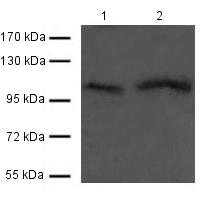
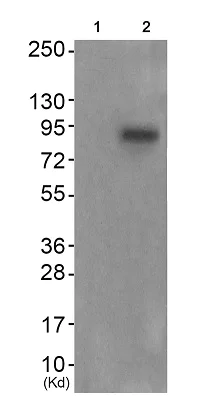
Western blot - Anti-FGFR4 (phospho Y642) antibody (AB192589)
  • WB

Supplier Data

Western blot - Anti-FGFR4 (phospho Y642) antibody (AB192589)

All lanes:

Western blot - Anti-FGFR4 (phospho Y642) antibody (ab192589) at 1/500 dilution

Lane 1:

JK cell extract with antigen specific peptide

Lane 2:

JK cell extract

Predicted band size: 88 kDa

false

关键信息

宿主种属

Rabbit

克隆

Polyclonal

亚型

IgG

不含载体蛋白

No

反应种属

Human

应用

WB

applications

免疫原

Synthetic Peptide within Human FGFR4 pY642 conjugated to Keyhole Limpet Haemocyanin. The exact immunogen used to generate this antibody is proprietary information.

P22455

反应性数据

{ "title": "Reactivity Data", "filters": { "stats": ["", "Species", "Dilution Info", "Notes"], "tabs": { "all-applications": {"fullname" : "All Applications", "shortname": "All Applications"}, "WB" : {"fullname" : "Western blot", "shortname":"WB"} }, "product-promise": { "all": "all", "testedAndGuaranteed": "tested", "guaranteed": "expected", "predicted": "predicted", "notRecommended": "not-recommended" } }, "values": { "Human": { "WB-species-checked": "testedAndGuaranteed", "WB-species-dilution-info": "1/500 - 1/1000", "WB-species-notes": "<p></p>" }, "Mouse": { "WB-species-checked": "predicted", "WB-species-dilution-info": "", "WB-species-notes": "" }, "Rat": { "WB-species-checked": "predicted", "WB-species-dilution-info": "", "WB-species-notes": "" } } }

性能和储存信息

形式
Liquid
纯化工艺
Affinity purification Immunogen
纯化说明
ab192589 was purified by affinity-chromatography using epitope-specific phosphopeptide. Non-phospho specific antibodies were removed by chromatography using non-phosphopeptide.
存储溶液
pH: 7.4 Preservative: 0.02% Sodium azide Constituents: PBS, 50% Glycerol (glycerin, glycerine), 0.87% Sodium chloride
运输条件
Blue Ice
推荐的短期储存时间
1-2 weeks
推荐的短期储存条件
+4°C
推荐的长期储存条件
-20°C
分装信息
Upon delivery aliquot
储存信息
Avoid freeze / thaw cycle

补充信息

This supplementary information is collated from multiple sources and compiled automatically.

FGFR4 or fibroblast growth factor receptor 4 is a receptor tyrosine kinase weighing approximately 110 kDa. This protein plays a role in cellular processes by binding to fibroblast growth factors. FGFR4 is expressed in many tissues including muscle liver and the developing epidermis. It is known by alternate names like CD334 or FRFR4. This receptor's activation leads to receptor dimerization and autophosphorylation triggering downstream signaling pathways that affect cell proliferation differentiation and migration.
Biological function summary

FGFR4 influences various developmental and metabolic processes. It is important in limb and skeletal development epithelial cell morphogenesis and muscle fiber regeneration. FGFR4 often partners with heparan sulfate proteoglycans to form a signaling complex which defines the specificity and regulation of fibroblast growth factor signaling. The receptor's interaction with other proteins like FRFR4 and 5b5 further modulates its biological activity.

Pathways

FGFR4 participates in the MAPK and PI3K-Akt signaling pathways both important for regulating cell survival and growth. These pathways allow FGFR4 to connect with several other proteins such as FGFR1 and BLU-554. FGFR4's activation within these pathways helps determine cellular responses to hormonal and mitogenic signals further influencing tissue homeostasis and repair mechanisms.

FGFR4 is linked to certain cancers including hepatocellular carcinoma and colorectal cancer notable in cell lines like HCT116 and others. Overexpression or mutations in FGFR4 can drive tumor progression promoting uncontrolled growth and metastasis. FGFR4's relation to other key proteins such as FRAF and 19h3 highlights its role in pathogenesis making it a potential target for therapeutic interventions. Studies involving FGFR4 ELISA kits enhance understanding of its role in disease development and progression.

产品实验方案

For this product, it's our understanding that no specific protocols are required. You can visit:

靶点信息

Tyrosine-protein kinase that acts as a cell-surface receptor for fibroblast growth factors and plays a role in the regulation of cell proliferation, differentiation and migration, and in regulation of lipid metabolism, bile acid biosynthesis, glucose uptake, vitamin D metabolism and phosphate homeostasis. Required for normal down-regulation of the expression of CYP7A1, the rate-limiting enzyme in bile acid synthesis, in response to FGF19. Phosphorylates PLCG1 and FRS2. Ligand binding leads to the activation of several signaling cascades. Activation of PLCG1 leads to the production of the cellular signaling molecules diacylglycerol and inositol 1,4,5-trisphosphate. Phosphorylation of FRS2 triggers recruitment of GRB2, GAB1, PIK3R1 and SOS1, and mediates activation of RAS, MAPK1/ERK2, MAPK3/ERK1 and the MAP kinase signaling pathway, as well as of the AKT1 signaling pathway. Promotes SRC-dependent phosphorylation of the matrix protease MMP14 and its lysosomal degradation. FGFR4 signaling is down-regulated by receptor internalization and degradation; MMP14 promotes internalization and degradation of FGFR4. Mutations that lead to constitutive kinase activation or impair normal FGFR4 inactivation lead to aberrant signaling.
See full target information FGFR4 pY642

文献 (6)

Recent publications for all applications. Explore the full list and refine your search

Cancers 15: PubMed37627061

2023

Preclinical Evaluation of the FGFR-Family Inhibitor Futibatinib for Pediatric Rhabdomyosarcoma.

Applications

Unspecified application

Species

Unspecified reactive species

Jerry T Wu,Adam Cheuk,Kristine Isanogle,Christina Robinson,Xiaohu Zhang,Michele Ceribelli,Erin Beck,Paul Shinn,Carleen Klumpp-Thomas,Kelli M Wilson,Crystal McKnight,Zina Itkin,Hiroshi Sotome,Hiroshi Hirai,Elizabeth Calleja,Volker Wacheck,Brad Gouker,Cody J Peer,Natalia Corvalan,David Milewski,Yong Y Kim,William D Figg,Elijah F Edmondson,Craig J Thomas,Simone Difilippantonio,Jun S Wei,Javed Khan

Advanced science (Weinheim, Baden-Wurttemberg, Germany) 10:e2302677 PubMed37387563

2023

Small Extracellular Vesicle-Derived vWF Induces a Positive Feedback Loop between Tumor and Endothelial Cells to Promote Angiogenesis and Metastasis in Hepatocellular Carcinoma.

Applications

Unspecified application

Species

Unspecified reactive species

Samuel Wan Ki Wong,Sze Keong Tey,Xiaowen Mao,Hiu Ling Fung,Zhi-Jie Xiao,Danny Ka Ho Wong,Lung-Yi Mak,Man-Fung Yuen,Irene Oi-Lin Ng,Jing Ping Yun,Yi Gao,Judy Wai Ping Yam

Frontiers in cardiovascular medicine 10:990422 PubMed36895836

2023

Indoxyl sulfate induces left ventricular hypertrophy the AhR-FGF23-FGFR4 signaling pathway.

Applications

Unspecified application

Species

Unspecified reactive species

Hiroshi Kishimoto,Toshiaki Nakano,Kumiko Torisu,Masanori Tokumoto,Yushi Uchida,Shunsuke Yamada,Masatomo Taniguchi,Takanari Kitazono

International journal of molecular sciences 23: PubMed36362025

2022

Reduced Acquired Resistance to Erlotinib in NSCLC by Reversing the Epithelial-Mesenchymal Transition via the FGFR/MAPK/c-fos Signaling Pathway.

Applications

Unspecified application

Species

Unspecified reactive species

Chunsheng Hu,Anting Zhou,Xin Hu,Yu Xiang,Mengjun Huang,Jiuhong Huang,Donglin Yang,Yan Tang

Nature communications 11:4664 PubMed32938919

2020

IRF1-mediated downregulation of PGC1α contributes to cardiorenal syndrome type 4.

Applications

Unspecified application

Species

Unspecified reactive species

Yinghui Huang,Shaobo Wang,Jie Zhou,Yong Liu,Changhong Du,Ke Yang,Xianjin Bi,Mingying Liu,Wenhao Han,Kailong Wang,Jiachuan Xiong,Song Wang,Yue Wang,Ling Nie,Chi Liu,Daohai Zhang,Jun Gu,Chunyu Zeng,Jinghong Zhao

Thoracic cancer 8:655-665 PubMed28906590

2017

FGF19 genetic amplification as a potential therapeutic target in lung squamous cell carcinomas.

Applications

WB

Species

Unspecified reactive species

Xiaochen Zhang,Mei Kong,Zhen Zhang,Suzhen Xu,Feifei Yan,Liyuan Wei,Jianying Zhou
View all publications

Abcam Product Promise

我们致力于为您的研究提供高质量的试剂,为您科研的每一步提供支持。若我们的产品未能达到预期性能,我们向您提供 Abcam Product Promise 保障。
详情请参阅我们的条款与条件。

Please note: All products are 'FOR RESEARCH USE ONLY. NOT FOR USE IN DIAGNOSTIC OR THERAPEUTIC PROCEDURES'.

For licensing inquiries, please contact partnerships@abcam.com