重组Anti-DHODH抗体[EPR11814] - BSA and Azide free
Anti-DHODH antibody [EPR11814] - BSA and Azide free
- RabMAb
- Recombinant
- 了解详情
Be the first to review this product! Submit a review
|
(1 Publication)
Rabbit Recombinant Monoclonal DHODH antibody. Carrier free. Suitable for WB and reacts with Human, Mouse, Rat samples. Cited in 1 publication.
查看别名
DHOdehase, Dihydroorotate oxidase, DHODH
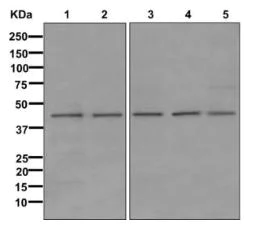
- WB
Supplier Data
Western blot - Anti-DHODH antibody [EPR11814] - BSA and Azide free (AB238968)
Note : ab174288 is diluted in 1% BSA.
This data was developed using the same antibody clone in a different buffer formulation containing PBS, BSA, glycerol, tissue culture supernatant and sodium azide (ab174288).
All lanes:
Western blot - Anti-DHODH antibody [EPR11814] (<a href='/products/primary-antibodies/dhodh-antibody-epr11814-ab174288'>ab174288</a>) at 1/1000 dilution
Lane 1:
SK-BR-3 (Human mammary gland adenocarcinoma cell line) cell lysate at 10 µg
Lane 2:
Human fetal heart tissue lysate at 10 µg
Lane 3:
MCF7 (Human breast adenocarcinoma cell line) cell lysate at 10 µg
Lane 4:
HepG2 (Human liver hepatocellular carcinoma cell line) cell lysate at 10 µg
Lane 5:
Jurkat (Human T cell leukemia cell line from peripheral blood) cell lysate at 10 µg
Predicted band size: 43 kDa
false
不同偶联物与剂型 (1)
-
Anti-DHODH antibody [EPR11814]
替代产品

搭配使用产品
Primary Antibodies
AB125066
Anti-Glutathione Peroxidase 4 antibody [EPNCIR144]
BOND RX™ Validated|KO Validated|RabMAb|Recombinant|Lab Essentials

- 5
- 13
Primary Antibodies
AB155282
20ul selling size|RabMAb|Recombinant|KO Validated
- 4
- 1
Primary Antibodies
AB307601
Anti-xCT antibody [EPR27115-64]
BOND RX™ Validated|20ul selling size|RabMAb|Recombinant|KO Validated
- 5
- 1
反应性数据
产品详情
ab238968 is the carrier-free version of ab174288.
Patented technology
Our RabMAb® technology is a patented hybridoma-based technology for making rabbit monoclonal antibodies. For details on our patents, please refer to RabMAb® patents.
What are the advantages of a recombinant monoclonal antibody?
This product is a recombinant monoclonal antibody, which offers several advantages including:
- - High batch-to-batch consistency and reproducibility
- - Improved sensitivity and specificity
- - Long-term security of supply
- - Animal-free batch production
For more information, read more on recombinant antibodies.
Conjugation ready
Our carrier-free antibodies are typically supplied in a PBS-only formulation, purified and free of BSA, sodium azide and glycerol. This conjugation-ready format is designed for use with fluorochromes, metal isotopes, oligonucleotides, and enzymes, which makes them ideal for antibody labelling, functional and cell-based assays, flow-based assays (e.g. mass cytometry) and Multiplex Imaging applications.
Use our conjugation kits for antibody conjugates that are ready-to-use in as little as 20 minutes with 1 minute hands-on-time and 100% antibody recovery: available for fluorescent dyes, HRP, biotin and gold.
Compatibility
This product is compatible with the Maxpar® Antibody Labeling Kit from Fluidigm, without the need for antibody preparation. Maxpar® is a trademark of Fluidigm Canada Inc.
性能和储存信息
形式
纯化工艺
存储溶液
运输条件
推荐的短期储存条件
推荐的长期储存条件
储存信息
补充信息
This supplementary information is collated from multiple sources and compiled automatically.
Biological function summary
Dihydroorotate dehydrogenase is involved in establishing the pyrimidine pool necessary for DNA and RNA synthesis. It is a single-component enzyme but its activity supports the function of other enzymes in the pathway such as carbamoyl-phosphate synthetase. The proper regulation of DHODH is integral to cellular proliferation and immune responses. Cells that synthesize nucleotides at high rates such as immune cells and cancer cells heavily depend on its activity.
Pathways
Dihydroorotate dehydrogenase is an important player in the pyrimidine biosynthesis pathway and links to the mitochondrial electron transport chain. Its interaction with ubiquinone underlines its role in energy production connecting it to respiratory complexes. DHODH works alongside proteins such as orotate phosphoribosyltransferase which further transforms orotate to orotidine-5'-monophosphate in pyrimidine biosynthesis. These pathways are vital for maintaining the balance of nucleotide levels impacting processes like DNA replication.
产品实验方案
- Visit the General protocols
- Visit the Troubleshooting
靶点信息
文献 (1)
Recent publications for all applications. Explore the full list and refine your search
Cell death discovery 7:33 PubMed33597510
2021
Applications
Unspecified application
Species
Unspecified reactive species
Abcam Product Promise
Please note: All products are 'FOR RESEARCH USE ONLY. NOT FOR USE IN DIAGNOSTIC OR THERAPEUTIC PROCEDURES'.
For licensing inquiries, please contact partnerships@abcam.com