JavaScript is disabled in your browser. Please enable JavaScript to view this website.
AB181244

重组Anti-DEP1抗体[EPR13398]

Anti-DEP1 antibody [EPR13398]

Be the first to review this product! Submit a review

|

(2 Publications)

Rabbit Recombinant Monoclonal DEP1 antibody. Suitable for WB and reacts with Human samples. Cited in 2 publications.

查看别名

CD148, DEP1, PTPRJ, Receptor-type tyrosine-protein phosphatase eta, Protein-tyrosine phosphatase eta, R-PTP-eta, Density-enhanced phosphatase 1, HPTP eta, Protein-tyrosine phosphatase receptor type J, DEP-1, R-PTP-J
1 Images
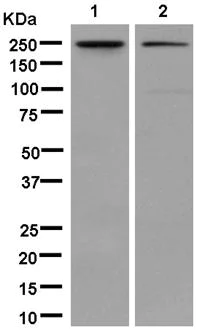
Western blot - Anti-DEP1 antibody [EPR13398] (AB181244)
  • WB

Supplier Data

Western blot - Anti-DEP1 antibody [EPR13398] (AB181244)

All lanes:

Western blot - Anti-DEP1 antibody [EPR13398] (ab181244) at 1/10000 dilution

Lane 1:

Jurkat cell lysate at 20 µg

Lane 2:

K562 cell lysate at 20 µg

Secondary

All lanes:

goat anti-rabbit IgG, (H+L), peroxidase conjugated at 1/1000 dilution

Predicted band size: 145 kDa

Observed band size: 220-250 kDa

true

不同偶联物与剂型 (1)

  • Carrier free

    Anti-DEP1 antibody [EPR13398] - BSA and Azide free

关键信息

宿主种属

Rabbit

克隆

Monoclonal

克隆号

EPR13398

亚型

IgG

不含载体蛋白

No

反应种属

Human

应用

WB

applications

免疫原

The exact immunogen used to generate this antibody is proprietary information.

反应性数据

{ "title": "Reactivity Data", "filters": { "stats": ["", "Species", "Dilution Info", "Notes"], "tabs": { "all-applications": {"fullname" : "All Applications", "shortname": "All Applications"}, "WB" : {"fullname" : "Western blot", "shortname":"WB"} }, "product-promise": { "all": "all", "testedAndGuaranteed": "tested", "guaranteed": "expected", "predicted": "predicted", "notRecommended": "not-recommended" } }, "values": { "Human": { "WB-species-checked": "testedAndGuaranteed", "WB-species-dilution-info": "1/1000 - 1/10000", "WB-species-notes": "<p></p>" }, "Mouse": { "WB-species-checked": "predicted", "WB-species-dilution-info": "", "WB-species-notes": "" }, "Rat": { "WB-species-checked": "predicted", "WB-species-dilution-info": "", "WB-species-notes": "" } } }

产品详情

Patented technology
Our RabMAb® technology is a patented hybridoma-based technology for making rabbit monoclonal antibodies. For details on our patents, please refer to RabMAb® patents.

What are the advantages of a recombinant monoclonal antibody?
This product is a recombinant monoclonal antibody, which offers several advantages including:

  • - High batch-to-batch consistency and reproducibility
  • - Improved sensitivity and specificity
  • - Long-term security of supply
  • - Animal-free batch production

For more information, read more on recombinant antibodies.

性能和储存信息

形式
Liquid
纯化工艺
Affinity purification Protein A
存储溶液
Preservative: 0.01% Sodium azide Constituents: PBS, 40% Glycerol (glycerin, glycerine), 0.05% BSA
运输条件
Conditional Ambient
推荐的短期储存时间
1-2 weeks
推荐的短期储存条件
+4°C
推荐的长期储存条件
-20°C
分装信息
Upon delivery aliquot
储存信息
Avoid freeze / thaw cycle

补充信息

This supplementary information is collated from multiple sources and compiled automatically.

DEP1 also known as protein tyrosine phosphatase receptor type J (PTPRJ) is an important regulator in cell signaling. Its molecular mass is approximately 135-150 kDa. DEP1 is a transmembrane protein expressed in many tissues like epithelial cells endothelial cells and hematopoietic cells. It functions as a protein tyrosine phosphatase meaning it removes phosphate groups from tyrosine residues on target proteins which impacts many cellular processes.
Biological function summary

DEP1 acts as a negative regulator of cell proliferation differentiation and migration. It plays a role in maintaining cellular homeostasis and is often found in complex with other signaling molecules at cell-cell junctions. DEP1 modulates signaling pathways by dephosphorylating receptor tyrosine kinases or their downstream targets. This regulation impacts how cells respond to external stimuli and maintain normal physiological activities.

Pathways

DEP1 is active in both the RAS/MAPK signaling pathway and the PI3K/AKT pathway. It interacts with signaling molecules such as epidermal growth factor receptor (EGFR) and vascular endothelial growth factor receptor (VEGFR) impacting their signaling abilities. By dephosphorylating these receptors DEP1 modulates the pathways that control cell growth and survival influencing how cells react to growth factors and other signals.

DEP1 connects to several cancers and cardiovascular diseases. It often acts as a tumor suppressor by inhibiting signaling pathways that promote uncontrolled cell growth. In cancer altered DEP1 expression or function can lead to changes in cellular behaviors contributing to tumorigenesis. It relates to proteins like VEGFR in these contexts as their dysregulation can lead to abnormal vascularization in tumors and in cardiovascular disease affecting angiogenesis and blood vessel integrity.

产品实验方案

For this product, it's our understanding that no specific protocols are required. You can visit:

靶点信息

Tyrosine phosphatase which dephosphorylates or contributes to the dephosphorylation of CTNND1, FLT3, PDGFRB, MET, KDR, LYN, SRC, MAPK1, MAPK3, EGFR, TJP1, OCLN, PIK3R1 and PIK3R2 (PubMed : 10821867, PubMed : 12062403, PubMed : 12370829, PubMed : 12475979, PubMed : 18348712, PubMed : 19494114, PubMed : 19922411, PubMed : 21262971). Plays a role in cell adhesion, migration, proliferation and differentiation (PubMed : 12370829, PubMed : 14709717, PubMed : 16682945, PubMed : 19836242). Has a role in megakaryocytes and platelet formation (PubMed : 30591527). Involved in vascular development (By similarity). Regulator of macrophage adhesion and spreading (By similarity). Positively affects cell-matrix adhesion (By similarity). Positive regulator of platelet activation and thrombosis. Negative regulator of cell proliferation (PubMed : 16682945). Negative regulator of PDGF-stimulated cell migration; through dephosphorylation of PDGFR (PubMed : 21091576). Positive regulator of endothelial cell survival, as well as of VEGF-induced SRC and AKT activation; through KDR dephosphorylation (PubMed : 18936167). Negative regulator of EGFR signaling pathway; through EGFR dephosphorylation (PubMed : 19836242). Enhances the barrier function of epithelial junctions during reassembly (PubMed : 19332538). Negatively regulates T-cell receptor (TCR) signaling (PubMed : 11259588, PubMed : 9531590, PubMed : 9780142). Upon T-cell TCR activation, it is up-regulated and excluded from the immunological synapses, while upon T-cell-antigen presenting cells (APC) disengagement, it is no longer excluded and can dephosphorylate PLCG1 and LAT to down-regulate prolongation of signaling (PubMed : 11259588, PubMed : 12913111).. Isoform 2. Activates angiogenesis and cell migration (PubMed : 28052032). Downregulates the expression of the endothelial adhesion molecules ICAM1 and VCAM1 (PubMed : 28052032).
See full target information PTPRJ

文献 (2)

Recent publications for all applications. Explore the full list and refine your search

Journal of translational medicine 20:626 PubMed36578050

2022

miR-4443 promotes radiation resistance of esophageal squamous cell carcinoma via targeting PTPRJ.

Applications

Unspecified application

Species

Unspecified reactive species

Xiaobo Shi,Xiaoxiao Liu,Shan Huang,Yu Hao,Shupei Pan,Yue Ke,Wei Guo,Yuchen Wang,Hongbing Ma

Molecules (Basel, Switzerland) 22: PubMed28858244

2017

Andrographolide Suppresses MV4-11 Cell Proliferation through the Inhibition of FLT3 Signaling, Fatty Acid Synthesis and Cellular Iron Uptake.

Applications

Unspecified application

Species

Unspecified reactive species

Xiao Chen,Jianbin Zhang,Lixia Yuan,Yifei Lay,Yin Kwan Wong,Teck Kwang Lim,Chye Sun Ong,Qingsong Lin,Jigang Wang,Zichun Hua
View all publications

Abcam Product Promise

我们致力于为您的研究提供高质量的试剂,为您科研的每一步提供支持。若我们的产品未能达到预期性能,我们向您提供 Abcam Product Promise 保障。
详情请参阅我们的条款与条件。

Please note: All products are 'FOR RESEARCH USE ONLY. NOT FOR USE IN DIAGNOSTIC OR THERAPEUTIC PROCEDURES'.

For licensing inquiries, please contact partnerships@abcam.com