JavaScript is disabled in your browser. Please enable JavaScript to view this website.
AB308390

Anti-Dengue virus Type 2 NS5蛋白抗体[GT361]

Anti-Dengue virus Type 2 NS5 protein antibody [GT361]

Be the first to review this product! Submit a review

|

(0 Publication)

Mouse Recombinant Monoclonal POLG antibody. Suitable for ICC/IF, WB and reacts with Dengue virus 3, Dengue virus 2, Transfected cell line - Dengue virus 3, Transfected cell line - Dengue virus 2 samples. Immunogen corresponding to Synthetic Peptide within Dengue virus type 2 (strain 16681-PDK53) Dengue virus type 2 (strain 16681-PDK53) (DENV-2).

查看别名

Genome polyprotein
4 Images
Immunocytochemistry/ Immunofluorescence - Anti-Dengue virus Type 2 NS5 protein antibody [GT361] (AB308390)
  • ICC/IF

Supplier Data

Immunocytochemistry/ Immunofluorescence - Anti-Dengue virus Type 2 NS5 protein antibody [GT361] (AB308390)

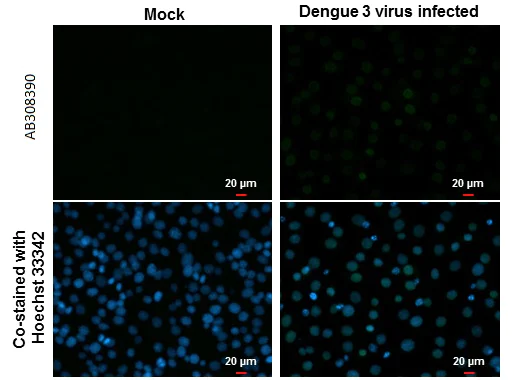
For immunofluorescence analysis, BHK-21 cells mock (left) and infected with Dengue virus 3 (right) were fixed in paraformaldehyde and permeabilized for detection of Dengue virus Type 2 NS5 protein using ab308390 at 1/2000 dilution (green). Blue : Hoechst 33342 staining.
Immunocytochemistry/ Immunofluorescence - Anti-Dengue virus Type 2 NS5 protein antibody [GT361] (AB308390)
  • ICC/IF

Supplier Data

Immunocytochemistry/ Immunofluorescence - Anti-Dengue virus Type 2 NS5 protein antibody [GT361] (AB308390)

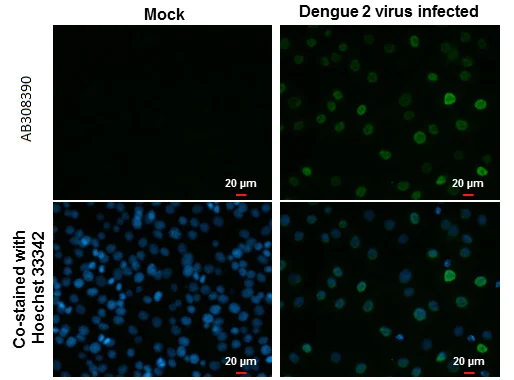
For immunofluorescence analysis, BHK-21 cells mock (left) and infected with Dengue virus 2 (right) were fixed in paraformaldehyde and permeabilized for detection of Dengue virus Type 2 NS5 protein using ab308390 at 1/2000 dilution (green). Blue : Hoechst 33342 staining.
Western blot - Anti-Dengue virus Type 2 NS5 protein antibody [GT361] (AB308390)
  • WB

Supplier Data

Western blot - Anti-Dengue virus Type 2 NS5 protein antibody [GT361] (AB308390)

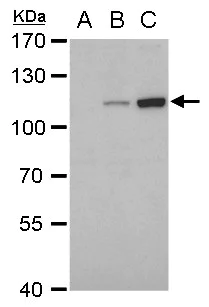
NS5 (Dengue virus 2) antibody [GT361] detects NS5 (Dengue virus 2) protein by western blot analysis. A. 30 μg BHK-21 whole cell extract B. 30 μg whole cell extract of Dengue virus type 2 infected BHK-21 cells C. 30 μg whole cell extract of Dengue virus type 3 infected BHK-21 cells 7.5% SDS-PAGE NS5 (Dengue virus 2) antibody [GT361] (ab308390) dilution : 1/5000 The HRP-conjugated anti-mouse IgG antibody was used to detect the primary antibody.

All lanes:

Western blot - Anti-Dengue virus Type 2 NS5 protein antibody [GT361] (ab308390) at 1/5000 dilution

Lane 1:

BHK-21 whole cell extract at 30 µg

Lane 2:

Whole cell extract of Dengue virus type 2 infected BHK-21 cells at 30 µg

Lane 3:

Whole cell extract of Dengue virus type 3 infected BHK-21 cells at 30 µg

Secondary

All lanes:

HRP-conjugated anti-mouse IgG antibody

false
Western blot - Anti-Dengue virus Type 2 NS5 protein antibody [GT361] (AB308390)
  • WB

Supplier Data

Western blot - Anti-Dengue virus Type 2 NS5 protein antibody [GT361] (AB308390)

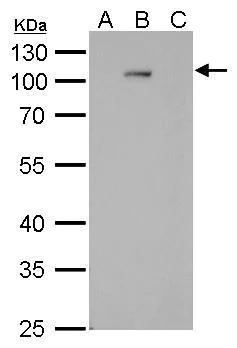
NS5 (Dengue Virus 2) antibody [GT361] detects NS5 protein by western blot analysis. A. 30 μg BHK21 whole cell lysate/extract B. 30 μg whole cell lysate/extract of Dengue virus 2 infected BHK21 cells C. 30 μg whole cell lysate/extract of Japanese encephalitis virus infected BHK21 cells 10% SDS-PAGE NS5 (Dengue Virus 2) antibody [GT361] (ab308390) dilution : 1/5000 The HRP-conjugated anti-mouse IgG antibody was used to detect the primary antibody.

All lanes:

Western blot - Anti-Dengue virus Type 2 NS5 protein antibody [GT361] (ab308390) at 1/5000 dilution

Lane 1:

whole cell lysate/extract of Dengue virus 2 infected BHK21 cells at 30 µg

Lane 2:

Whole cell lysate/extract of Dengue virus 2 infected BHK21 cells at 30 µg

Lane 3:

Whole cell lysate/extract of Japanese encephalitis virus infected BHK21 cells at 30 µg

Secondary

All lanes:

HRP-conjugated anti-mouse IgG antibody

false

关键信息

宿主种属

Mouse

克隆

Monoclonal

克隆号

GT361

亚型

IgG1

不含载体蛋白

No

反应种属

Dengue virus 2, Dengue virus 3

应用

WB, ICC/IF

applications

免疫原

Synthetic Peptide within Dengue virus type 2 (strain 16681-PDK53) Dengue virus type 2 (strain 16681-PDK53) (DENV-2). The exact immunogen used to generate this antibody is proprietary information.

P29991

反应性数据

{ "title": "Reactivity Data", "filters": { "stats": ["", "Species", "Dilution Info", "Notes"], "tabs": { "all-applications": {"fullname" : "All Applications", "shortname": "All Applications"}, "ICCIF" : {"fullname" : "Immunocytochemistry/ Immunofluorescence", "shortname":"ICC/IF"}, "WB" : {"fullname" : "Western blot", "shortname":"WB"} }, "product-promise": { "all": "all", "testedAndGuaranteed": "tested", "guaranteed": "expected", "predicted": "predicted", "notRecommended": "not-recommended" } }, "values": { "Dengue virus 2": { "ICCIF-species-checked": "testedAndGuaranteed", "ICCIF-species-dilution-info": "1/2000", "ICCIF-species-notes": "<p></p>", "WB-species-checked": "guaranteed", "WB-species-dilution-info": "", "WB-species-notes": "" }, "Dengue virus 3": { "ICCIF-species-checked": "testedAndGuaranteed", "ICCIF-species-dilution-info": "", "ICCIF-species-notes": "<p></p>", "WB-species-checked": "guaranteed", "WB-species-dilution-info": "", "WB-species-notes": "" }, "Transfected cell line - Dengue virus 2": { "ICCIF-species-checked": "notRecommended", "ICCIF-species-dilution-info": "", "ICCIF-species-notes": "", "WB-species-checked": "testedAndGuaranteed", "WB-species-dilution-info": "1/5000", "WB-species-notes": "<p></p>" }, "Transfected cell line - Dengue virus 3": { "ICCIF-species-checked": "notRecommended", "ICCIF-species-dilution-info": "", "ICCIF-species-notes": "", "WB-species-checked": "testedAndGuaranteed", "WB-species-dilution-info": "", "WB-species-notes": "<p></p>" } } }

产品详情

What are the advantages of a recombinant monoclonal antibody?
This product is a recombinant monoclonal antibody, which offers several advantages including:

  • - High batch-to-batch consistency and reproducibility
  • - Improved sensitivity and specificity
  • - Long-term security of supply
  • - Animal-free batch production

For more information, read more on recombinant antibodies.

性能和储存信息

形式
Liquid
纯化工艺
Affinity purification Protein G
存储溶液
pH: 7 Constituents: PBS, 20% Glycerol (glycerin, glycerine)
运输条件
Blue Ice
推荐的短期储存时间
1-2 weeks
推荐的短期储存条件
+4°C
推荐的长期储存条件
+4°C
分装信息
Upon delivery aliquot
储存信息
Avoid freeze / thaw cycle

补充信息

This supplementary information is collated from multiple sources and compiled automatically.

Dengue Virus 2 often called Dengue Type 2 is a serotype of the dengue virus a significant vector-borne pathogen. The virus has a positive-sense single-stranded RNA genome encoding several structural and non-structural proteins including the capsid protein and NS5. The capsid protein weighing approximately 12 kDa is important for encapsulating the viral RNA forming the nucleocapsid. NS5 with a mass around 103 kDa functions as a methyltransferase and RNA-dependent RNA polymerase essential for the viral replication cycle. These proteins are expressed predominantly in host cells after the virus infects facilitating its life cycle and pathogenesis.
Biological function summary

Within host cells the capsid protein and NS5 are involved in viral assembly and RNA synthesis respectively. The capsid protein enables efficient packaging of the viral genome interacting with several cellular components for the assembly of new virions. NS5 engages in the methylation of viral RNA and replication of the viral genome. NS5 does not act alone; it works as part of a larger replication complex involving other viral proteins such as NS3 which provides helicase activity further supporting the functionality of the viral replication machinery.

Pathways

Dengue Virus 2 proteins play key roles in the viral replication and immune evasion pathways. The replication complex containing NS5 and other non-structural proteins orchestrates the replication pathway ensuring the production of viral progeny. The capsid protein is associated with the budding of new virions within the endoplasmic reticulum which is important for the release of infectious particles. In addition NS5 interacts with host proteins such as STAT2 modulating immune pathways to conceal the virus from host defenses enabling persistent viral replication and infection.

Dengue Virus 2 is related to Dengue fever and severe forms like Dengue hemorrhagic fever. The NS5 protein through its interaction with STAT2 plays a role in immune suppression affecting disease outcomes. The capsid protein's strong involvement in viral assembly links it to the efficient dissemination of the virus contributing to the severity and viral load in dengue infections. Understanding these interactions is essential for future therapeutic strategies aimed at mitigating dengue-related health issues worldwide.

产品实验方案

For this product, it's our understanding that no specific protocols are required. You can visit:

靶点信息

Capsid protein C. Capsid protein C self-assembles to form an icosahedral capsid about 30 nm in diameter. The capsid encapsulates the genomic RNA (Probable). Plays a role in virus budding by binding to the cell membrane and gathering the viral RNA into a nucleocapsid that forms the core of a mature virus particle. During virus entry, may induce genome penetration into the host cytoplasm after hemifusion induced by the surface proteins. Can migrate to the cell nucleus where it modulates host functions. Overcomes the anti-viral effects of host EXOC1 by sequestering and degrading the latter through the proteasome degradation pathway.. Peptide pr. Prevents premature fusion activity of envelope proteins in trans-Golgi by binding to envelope protein E at pH6.0. After virion release in extracellular space, gets dissociated from E dimers.. Protein prM. Acts as a chaperone for envelope protein E during intracellular virion assembly by masking and inactivating envelope protein E fusion loop. prM is the only viral peptide matured by host furin in the trans-Golgi network probably to avoid catastrophic activation of the viral fusion activity in acidic Golgi compartment prior to virion release. prM-E cleavage is inefficient, and many virions are only partially matured. These uncleaved prM would play a role in immune evasion.. Small envelope protein M. May play a role in virus budding. Exerts cytotoxic effects by activating a mitochondrial apoptotic pathway through M ectodomain. May display a viroporin activity.. Envelope protein E. Type II fusion protein that binds to host cell surface receptor and mediates fusion between viral and cellular membranes (By similarity). The envelope protein E shifts from dimeric state to trimeric state to perform fusion with the host membrane (By similarity). The fusion loops of the three subunits come together to form a membrane-insertable tip containing aromatic residues (By similarity). Envelope protein is synthesized in the endoplasmic reticulum in the form of heterodimer with protein prM. They play a role in virion budding in the ER, and the newly formed immature particle is covered with 60 spikes composed of heterodimers of precursor prM and envelope protein E (By similarity). Envelope protein exposes a positively-charged pr-binding pocket at the E dimer interface, inducing (prM/E)2 dimer formation to generate smooth particles in the Golgi (By similarity). The virion is transported to the Golgi apparatus where the low pH causes dissociation of PrM-E heterodimers and formation of E homodimers (By similarity). prM-E cleavage is inefficient, and many virions are only partially matured. These uncleaved prM would play a role in immune evasion (By similarity). Pr is shed from the particle upon subsequent secretion into the extracellular environment, leaving an activated particle, prone to mediate acidic pH-triggered membrane fusion upon entry into a target cell (By similarity).. Non-structural protein 1. Involved in immune evasion, pathogenesis and viral replication. Once cleaved off the polyprotein, is targeted to three destinations : the viral replication cycle, the plasma membrane and the extracellular compartment. Essential for viral replication. Required for formation of the replication complex and recruitment of other non-structural proteins to the ER-derived membrane structures. Excreted as a hexameric lipoparticle that plays a role against host immune response. Antagonizing the complement function. Binds to the host macrophages and dendritic cells. Inhibits signal transduction originating from Toll-like receptor 3 (TLR3). Mediates complement activation, which may contribute to the pathogenesis of the vascular leakage that occurs in severe dengue disease. Activates autophagy through the AMPK/ERK/mTOR signaling pathway. Mechanistically, acts as the assembly platform for STK11-AMPK interactions and promotes STK11-AMPK interactions. In turn, promotes phosphorylation of the AMPK kinase structural domain and activates AMPK, thereby positively regulating the AMPK/ERK/mTOR signaling pathway and inducing autophagy.. Non-structural protein 1. Disrupts the host endothelial glycocalyx layer of host pulmonary microvascular endothelial cells, inducing degradation of sialic acid and shedding of heparan sulfate proteoglycans. NS1 induces expression of sialidases, heparanase, and activates cathepsin L, which activates heparanase via enzymatic cleavage. These effects are probably linked to the endothelial hyperpermeability observed in severe dengue disease.. Non-structural protein 2A. Component of the viral RNA replication complex that functions in virion assembly and antagonizes the host immune response.. Serine protease subunit NS2B. Required cofactor for the serine protease function of NS3. May have membrane-destabilizing activity and form viroporins (By similarity).. Serine protease NS3. Displays three enzymatic activities : serine protease, NTPase and RNA helicase. NS3 serine protease, in association with NS2B, performs its autocleavage and cleaves the polyprotein at dibasic sites in the cytoplasm : C-prM, NS2A-NS2B, NS2B-NS3, NS3-NS4A, NS4A-2K and NS4B-NS5. NS3 RNA helicase binds RNA and unwinds dsRNA in the 3' to 5' direction.. Non-structural protein 4A. Regulates the ATPase activity of the NS3 helicase activity. NS4A allows NS3 helicase to conserve energy during unwinding. Plays a role in the inhibition of the host innate immune response. Interacts with host MAVS and thereby prevents the interaction between RIGI and MAVS. In turn, IFN-beta production is impaired. Interacts with host AUP1 which mediates induction of lipophagy in host cells and facilitates production of virus progeny particles (PubMed : 29902443).. Peptide 2k. Functions as a signal peptide for NS4B and is required for the interferon antagonism activity of the latter.. Non-structural protein 4B. Induces the formation of ER-derived membrane vesicles where the viral replication takes place. Inhibits interferon (IFN)-induced host STAT1 phosphorylation and nuclear translocation, thereby preventing the establishment of cellular antiviral state by blocking the IFN-alpha/beta pathway.. RNA-directed RNA polymerase/Methyltransferase NS5. Replicates the viral (+) and (-) RNA genome, and performs the capping of genomes in the cytoplasm. NS5 methylates viral RNA cap at guanine N-7 and ribose 2'-O positions. Besides its role in RNA genome replication, also prevents the establishment of cellular antiviral state by blocking the interferon-alpha/beta (IFN-alpha/beta) signaling pathway. Inhibits host TYK2 and STAT2 phosphorylation, thereby preventing activation of JAK-STAT signaling pathway (By similarity). May reduce immune responses by preventing the recruitment of the host PAF1 complex to interferon-responsive genes (By similarity).
See full target information Dengue virus type 2 (strain 16681-PDK53) (DENV-2)

Abcam Product Promise

我们致力于为您的研究提供高质量的试剂,为您科研的每一步提供支持。若我们的产品未能达到预期性能,我们向您提供 Abcam Product Promise 保障。
详情请参阅我们的条款与条件。

Please note: All products are 'FOR RESEARCH USE ONLY. NOT FOR USE IN DIAGNOSTIC OR THERAPEUTIC PROCEDURES'.

For licensing inquiries, please contact partnerships@abcam.com