JavaScript is disabled in your browser. Please enable JavaScript to view this website.
AB76015

重组Anti-CTNNA2抗体[EPR1795]

Anti-CTNNA2 antibody [EPR1795]

5

(1 Review)

|

(4 Publications)

Rabbit Recombinant Monoclonal CTNNA2 antibody. Suitable for WB and reacts with Mouse samples. Cited in 4 publications.

查看别名

CAPR, CTNNA2, Catenin alpha-2, Alpha N-catenin, Alpha-catenin-related protein
1 Images
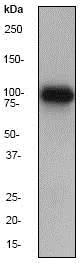
Western blot - Anti-CTNNA2 antibody [EPR1795] (AB76015)
  • WB

Unknown

Western blot - Anti-CTNNA2 antibody [EPR1795] (AB76015)

All lanes:

Western blot - Anti-CTNNA2 antibody [EPR1795] (ab76015) at 1/2000 dilution

All lanes:

mouse brain lysate at 10 µg

Secondary

All lanes:

Goat anti-rabbit HRP at 1/2000 dilution

Predicted band size: 105 kDa

Observed band size: 102 kDa

false

不同偶联物与剂型 (1)

  • Carrier free

    Anti-CTNNA2 antibody [EPR1795] - BSA and Azide free

关键信息

宿主种属

Rabbit

克隆

Monoclonal

克隆号

EPR1795

亚型

IgG

不含载体蛋白

No

反应种属

Mouse

应用

WB

applications

免疫原

The exact immunogen used to generate this antibody is proprietary information.

反应性数据

{ "title": "Reactivity Data", "filters": { "stats": ["", "Species", "Dilution Info", "Notes"], "tabs": { "all-applications": {"fullname" : "All Applications", "shortname": "All Applications"}, "FlowCyt" : {"fullname" : "Flow Cytometry", "shortname":"Flow Cyt"}, "WB" : {"fullname" : "Western blot", "shortname":"WB"}, "IHCP" : {"fullname" : "Immunohistochemistry (Formalin/PFA-fixed paraffin-embedded sections)", "shortname":"IHC-P"} }, "product-promise": { "all": "all", "testedAndGuaranteed": "tested", "guaranteed": "expected", "predicted": "predicted", "notRecommended": "not-recommended" } }, "values": { "Human": { "FlowCyt-species-checked": "notRecommended", "FlowCyt-species-dilution-info": "", "FlowCyt-species-notes": "", "WB-species-checked": "predicted", "WB-species-dilution-info": "", "WB-species-notes": "", "IHCP-species-checked": "notRecommended", "IHCP-species-dilution-info": "", "IHCP-species-notes": "" }, "Mouse": { "FlowCyt-species-checked": "notRecommended", "FlowCyt-species-dilution-info": "", "FlowCyt-species-notes": "<p></p>", "WB-species-checked": "testedAndGuaranteed", "WB-species-dilution-info": "1/2000", "WB-species-notes": "<p></p>", "IHCP-species-checked": "notRecommended", "IHCP-species-dilution-info": "", "IHCP-species-notes": "<p></p>" }, "Rat": { "FlowCyt-species-checked": "notRecommended", "FlowCyt-species-dilution-info": "", "FlowCyt-species-notes": "", "WB-species-checked": "predicted", "WB-species-dilution-info": "", "WB-species-notes": "", "IHCP-species-checked": "notRecommended", "IHCP-species-dilution-info": "", "IHCP-species-notes": "" } } }

产品详情

Patented technology
Our RabMAb® technology is a patented hybridoma-based technology for making rabbit monoclonal antibodies. For details on our patents, please refer to RabMAb® patents.

What are the advantages of a recombinant monoclonal antibody?
This product is a recombinant monoclonal antibody, which offers several advantages including:

  • - High batch-to-batch consistency and reproducibility
  • - Improved sensitivity and specificity
  • - Long-term security of supply
  • - Animal-free batch production

For more information, read more on recombinant antibodies.

性能和储存信息

形式
Liquid
纯化工艺
Affinity purification Protein A
存储溶液
pH: 7.2 - 7.4 Preservative: 0.01% Sodium azide Constituents: PBS, 40% Glycerol (glycerin, glycerine), 0.05% BSA
运输条件
Conditional Ambient
推荐的短期储存条件
+4°C
推荐的长期储存条件
-20°C
分装信息
Upon delivery aliquot
储存信息
Avoid freeze / thaw cycle

补充信息

This supplementary information is collated from multiple sources and compiled automatically.

CTNNA2 also known as alpha-N-catenin is a protein that plays a mechanical role in cellular adhesion. This protein has a mass of approximately 102 kDa. CTNNA2 localizes at adherens junctions and is expressed in various tissues with a high prominence in the nervous system. It connects the actin cytoskeleton to cadherin complexes facilitating cell-cell interactions that are essential for maintaining tissue integrity.
Biological function summary

CTNNA2 contributes significantly to cellular signaling and structural maintenance. It forms part of the cadherin-catenin complex important in linking cadherins to the actin cytoskeleton. This complex supports the stability and function of cellular junctions enabling communication between cells and influencing cell shape and polarity. The protein's role in the nervous system suggests its involvement in synaptic connectivity and plasticity.

Pathways

CTNNA2 participates in the Wnt signaling and the actin cytoskeleton regulation pathways. These pathways are vital for cellular growth differentiation and motility. In the Wnt signaling pathway CTNNA2 interacts with beta-catenin to regulate gene transcription and cell fate decisions. Its involvement in actin cytoskeleton regulation implicates it in coordination with actin filament dynamics sharing relations with actin-binding proteins like alpha-actinin.

CTNNA2 has connections with neurological disorders such as autism and intellectual disability. Alterations in its function or expression can disrupt neural development and synaptic function leading to cognitive impairments. Additionally CTNNA2 links to other proteins implicated in these conditions such as beta-catenin which is known to affect neural development and psychiatric conditions.

产品实验方案

For this product, it's our understanding that no specific protocols are required. You can visit:

靶点信息

May function as a linker between cadherin adhesion receptors and the cytoskeleton to regulate cell-cell adhesion and differentiation in the nervous system (By similarity). Required for proper regulation of cortical neuronal migration and neurite growth (PubMed : 30013181). It acts as a negative regulator of Arp2/3 complex activity and Arp2/3-mediated actin polymerization (PubMed : 30013181). It thereby suppresses excessive actin branching which would impair neurite growth and stability (PubMed : 30013181). Regulates morphological plasticity of synapses and cerebellar and hippocampal lamination during development. Functions in the control of startle modulation (By similarity).
See full target information CTNNA2

文献 (4)

Recent publications for all applications. Explore the full list and refine your search

Communications biology 8:1 PubMed39747445

2025

Fortilin binds CTNNA3 and protects it against phosphorylation, ubiquitination, and proteasomal degradation to guard cells against apoptosis.

Applications

Unspecified application

Species

Unspecified reactive species

Mari Nakashima,Decha Pinkaew,Uttariya Pal,Fei Miyao,Hanna Huynh,Lena Tanaka,Ken Fujise

Journal of molecular endocrinology 64:43-52 PubMed31786540

2019

miR-183-5p regulates uterine receptivity and enhances embryo implantation.

Applications

Unspecified application

Species

Unspecified reactive species

Rubab Akbar,Kamran Ullah,Tanzil Ur Rahman,Yi Cheng,Hai-Yan Pang,Lu-Yang Jin,Qi-Jing Wang,He-Feng Huang,Jian-Zhong Sheng

DNA and cell biology 38:151-161 PubMed30526004

2018

Novel-miR-4885 Promotes Migration and Invasion of Esophageal Cancer Cells Through Targeting CTNNA2.

Applications

Unspecified application

Species

Unspecified reactive species

Jing Song,Peng Zhang,Mengxin Liu,Ming Xie,Zhikui Gao,Xianghu Wang,Tian Wang,Jiechen Yin,Ran Liu

PloS one 8:e84354 PubMed24391944

2013

Impaired function of the blood-testis barrier during aging is preceded by a decline in cell adhesion proteins and GTPases.

Applications

WB

Species

Rat

Catriona Paul,Bernard Robaire
View all publications

Abcam Product Promise

我们致力于为您的研究提供高质量的试剂,为您科研的每一步提供支持。若我们的产品未能达到预期性能,我们向您提供 Abcam Product Promise 保障。
详情请参阅我们的条款与条件。

Please note: All products are 'FOR RESEARCH USE ONLY. NOT FOR USE IN DIAGNOSTIC OR THERAPEUTIC PROCEDURES'.

For licensing inquiries, please contact partnerships@abcam.com