重组Anti-CPM抗体[EPR8052]
Anti-CPM antibody [EPR8052]
- RabMAb
- Recombinant
- 了解详情
Be the first to review this product! Submit a review
|
(3 Publications)
Rabbit Recombinant Monoclonal CPM antibody. Suitable for IHC-P, WB and reacts with Human samples. Cited in 3 publications.
查看别名
Carboxypeptidase M, CPM
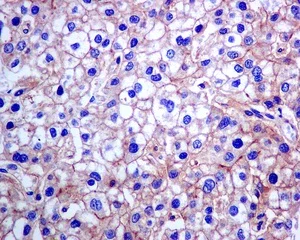
- IHC-P
Unknown
Immunohistochemistry (Formalin/PFA-fixed paraffin-embedded sections) - Anti-CPM antibody [EPR8052] (AB150405)
Immunohistochemistry (Formalin/PFA-fixed paraffin-embedded sections) analysis of human hepatocellular carcinoma tissue labelling CPM with unpurified ab150405 at a dilution of 1/50.
Perform heat mediated antigen retrieval before commencing with IHC staining protocol.
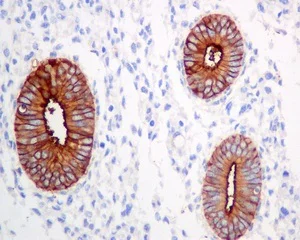
- IHC-P
Unknown
Immunohistochemistry (Formalin/PFA-fixed paraffin-embedded sections) - Anti-CPM antibody [EPR8052] (AB150405)
Immunohistochemistry (Formalin/PFA-fixed paraffin-embedded sections) analysis of human uterus tissue labelling CPM with unpurified ab150405 at a dilution of 1/50.
Perform heat mediated antigen retrieval before commencing with IHC staining protocol.
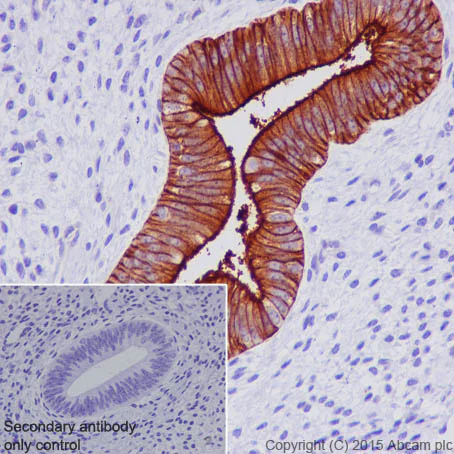
- IHC-P
Lab
Immunohistochemistry (Formalin/PFA-fixed paraffin-embedded sections) - Anti-CPM antibody [EPR8052] (AB150405)
Immunohistochemistry (Formalin/PFA-fixed paraffin-embedded sections) analysis of human endometrium tissue labelling CPM with purified ab150405 at 1/500. Heat mediated antigen retrieval was performed using Tris/EDTA buffer pH 9. ab97051 a HRP-conjugated goat anti-rabbit IgG (H+L) was used as the secondary antibody (1/500). Negative control using PBS instead of primary antibody. Counterstained with hematoxylin.
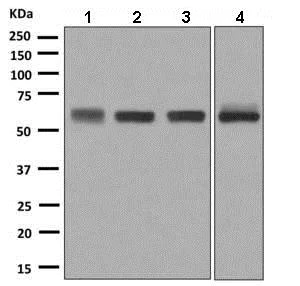
- WB
Unknown
Western blot - Anti-CPM antibody [EPR8052] (AB150405)
All lanes:
Western blot - Anti-CPM antibody [EPR8052] (ab150405) at 1/1000 dilution
Lane 1:
293T (Human embryonic kidney epithelial cell) cell lysate at 10 µg
Lane 2:
Human fetal kidney tissue lysate at 10 µg
Lane 3:
Human fetal liver tissue lysate at 10 µg
Lane 4:
Human placenta lysate at 10 µg
Secondary
All lanes:
HRP-conjugated goat anti-rabbit IgG at 1/2000 dilution
Predicted band size: 51 kDa
Observed band size: 62 kDa
false
- WB
Lab
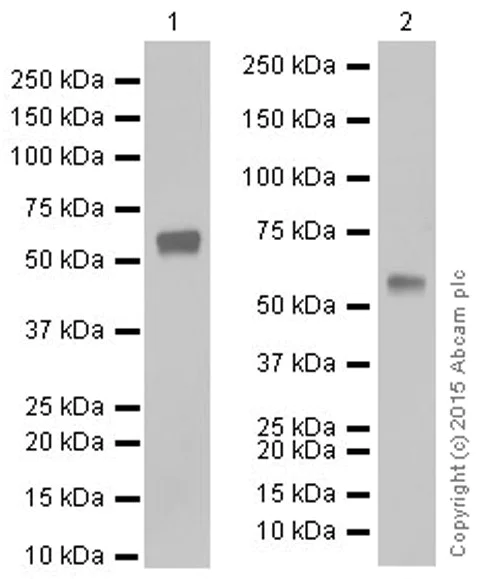
Western blot - Anti-CPM antibody [EPR8052] (AB150405)
Blocking and dilution buffer : 5% NFDM /TBST.
All lanes:
Western blot - Anti-CPM antibody [EPR8052] (ab150405) at 1/5000 dilution
Lane 1:
Human fetal liver tissue lysate at 10 µg
Lane 2:
Human fetal kidney tissue lysate at 10 µg
Secondary
All lanes:
HRP-conjugated goat anti-rabbit IgG, specific to the non-reduced form of IgG at 1/1000 dilution
Predicted band size: 51 kDa
Observed band size: 62 kDa
false
- WB
Lab
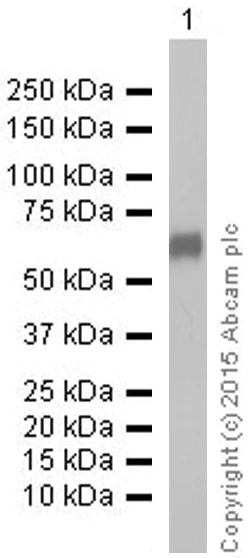
Western blot - Anti-CPM antibody [EPR8052] (AB150405)
Blocking and dilution buffer : 5% NFDM /TBST.
All lanes:
Western blot - Anti-CPM antibody [EPR8052] (ab150405) at 1/2500 dilution
All lanes:
Human placenta tissue lysate at 10 µg
Secondary
All lanes:
HRP-conjugated goat anti-rabbit IgG, specific to the non-reduced form of IgG at 1/1000 dilution
Predicted band size: 51 kDa
Observed band size: 62 kDa
false
不同偶联物与剂型 (8)
-
Anti-CPM antibody [EPR8052] - BSA and Azide free
-
660 APC
APC Anti-CPM antibody [EPR8052]
-
519 Alexa Fluor® 488
Alexa Fluor® 488 Anti-CPM antibody [EPR8052]
-
565 Alexa Fluor® 555
Alexa Fluor® 555 Anti-CPM antibody [EPR8052]
-
617 Alexa Fluor® 594
Alexa Fluor® 594 Anti-CPM antibody [EPR8052]
-
665 Alexa Fluor® 647
Alexa Fluor® 647 Anti-CPM antibody [EPR8052]
-
775 Alexa Fluor® 750
Alexa Fluor® 750 Anti-CPM antibody [EPR8052]
-
578 PE
PE Anti-CPM antibody [EPR8052]
替代产品
搭配使用产品
Primary Antibodies
AB115730
Anti-Glucose Transporter GLUT1 antibody [EPR3915]
BOND RX™ Validated|20ul selling size|RabMAb|Recombinant|KO Validated

- 4
- 20
Primary Antibodies
AB182422
Anti-CD163 antibody [EPR19518]
BOND RX™ Validated|20ul selling size|RabMAb|Advanced Validation|Recombinant

- 5
- 17
Primary Antibodies
AB190684
Anti-SorLA/SORL1 antibody [EPR14670]
BOND RX™ Validated|20ul selling size|RabMAb|Recombinant

- 1
- 1
Primary Antibodies
AB51074
BOND RX™ Validated|RabMAb|Recombinant|KO Validated|20ul selling size

- 4
- 20
反应性数据
产品详情
Species reactivity
Mouse, Rat: We have preliminary internal testing data to indicate this antibody may not react with these species.
Please contact us for more information.
Patented technology
Our RabMAb® technology is a patented hybridoma-based technology for making rabbit monoclonal antibodies. For details on our patents, please refer to RabMAb® patents.
What are the advantages of a recombinant monoclonal antibody?
This product is a recombinant monoclonal antibody, which offers several advantages including:
- - High batch-to-batch consistency and reproducibility
- - Improved sensitivity and specificity
- - Long-term security of supply
- - Animal-free batch production
For more information, read more on recombinant antibodies.
性能和储存信息
形式
纯化工艺
存储溶液
运输条件
推荐的短期储存时间
推荐的短期储存条件
推荐的长期储存条件
分装信息
储存信息
补充信息
This supplementary information is collated from multiple sources and compiled automatically.
Biological function summary
CPM is involved in peptide processing and degradation contributing to the regulation of hormonal and neurotransmitter peptides. As part of a larger proteolytic system CPM modifies the activity and half-life of bioactive peptides by removing terminal residues. Its activity influences the regulation of peptide signaling pathways. In such roles it resounds in processes like local inflammatory response and modulation of cell surface receptors. CPM’s enzymatic activity ensures the proper function of the physiological regulatory mechanisms where peptidase activity is required.
Pathways
CPM is instrumental in the kallikrein-kinin and complement pathways. In the kallikrein-kinin system CPM regulates kinin levels influencing blood pressure and inflammation. It also relates to the complement system interacting with components that participate in immune responses. CPM’s function closely links to other carboxypeptidases in these pathways enhancing its role in regulating peptide effects or degradation. Its enzymatic interactions can influence the outcomes of these pathways ensuring an adequate biological response.
产品实验方案
- Visit the General protocols
- Visit the Troubleshooting
靶点信息
文献 (3)
Recent publications for all applications. Explore the full list and refine your search
Acta neuropathologica 147:65 PubMed38557897
2024
Applications
Unspecified application
Species
Unspecified reactive species
Antioxidants & redox signaling 35:917-950 PubMed34269613
2021
Applications
Unspecified application
Species
Unspecified reactive species
Oncotarget 8:22674-22684 PubMed28186967
2017
Applications
IHC-P, WB
Species
Human, Human
Abcam Product Promise
Please note: All products are 'FOR RESEARCH USE ONLY. NOT FOR USE IN DIAGNOSTIC OR THERAPEUTIC PROCEDURES'.
For licensing inquiries, please contact partnerships@abcam.com